
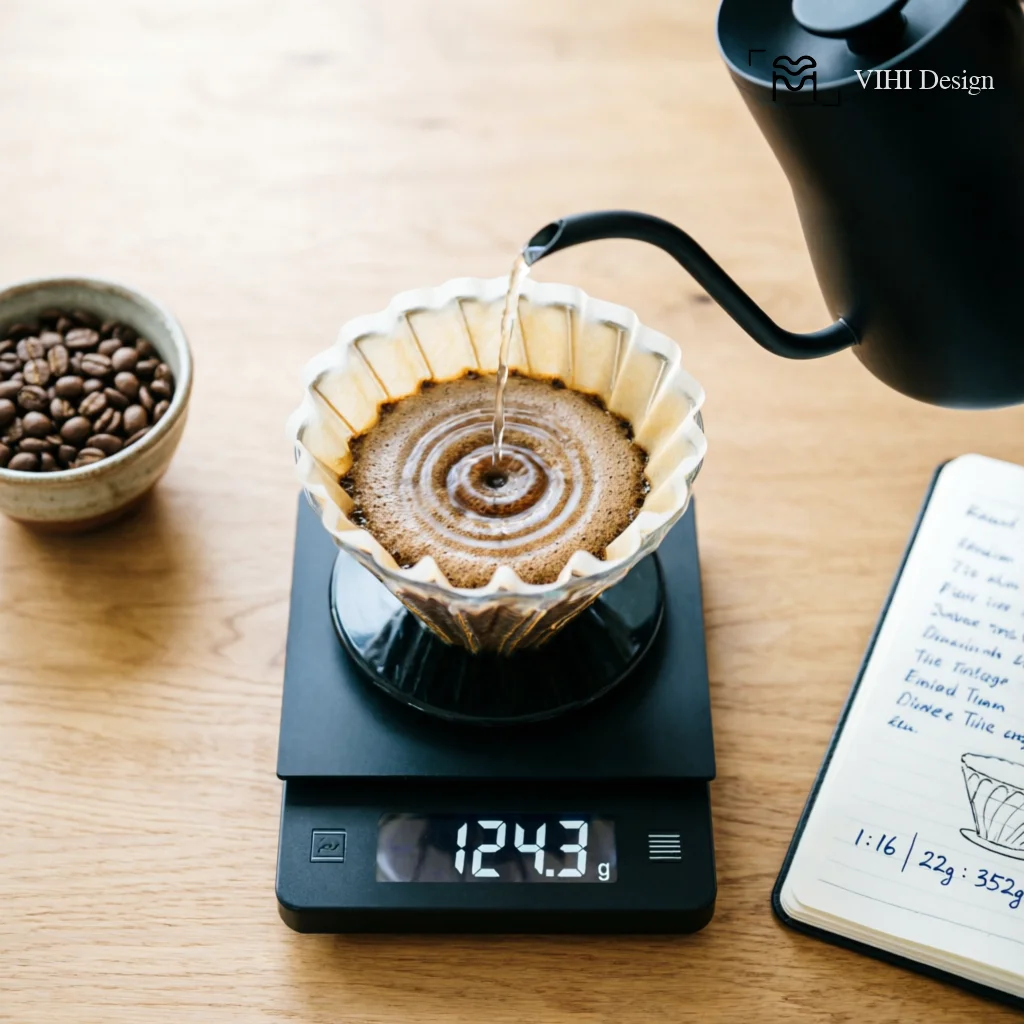
Introduction: The Pursuit of Sweetness in Manual Brewing
The manual pour-over represents the pinnacle of interactive coffee preparation, a method where the brewer’s technique directly dictates the sensory profile of the final cup. Among the diverse array of brewers available, the Origami Dripper has emerged as a particularly compelling tool for the specialty coffee enthusiast. Its unique conical form, compatible with both flat-bottom and cone-shaped filters, offers a versatile hydrodynamic canvas. However, this versatility presents a significant challenge: without a structured and intentional approach to water distribution and flow, the potential for an uneven, inconsistent, and suboptimal extraction is high. The central aim of this research is to define and validate a replicable pour structure—the 5-Pour Method—specifically engineered for the Origami Dripper to maximize the perception of sweetness, the most prized and often elusive attribute in a high-quality coffee.
Sweetness in coffee is not the presence of sugar, but rather a complex perceptual outcome of balanced extraction. It arises when soluble compounds—primarily certain sugars and acids—are dissolved from the coffee grounds at optimal rates and concentrations, without being overshadowed by excessive bitterness or astringency from over-extraction, or sourness from under-extraction. This paper posits that achieving this balance in the Origami Dripper is not merely a function of grind size and water temperature, but is fundamentally governed by the pour structure: the strategic timing, volume, and spatial distribution of water throughout the brew cycle. We introduce a methodical five-stage pour designed to control bed temperature, manage turbulence, and ensure uniform saturation to target a high-sweetness extraction window.
Theoretical Background: Hydrodynamics, Extraction Kinetics, and Sensory Perception
The scientific foundation of pour-over brewing rests on three interconnected pillars: the physics of water flow through a porous bed (hydrodynamics), the chemistry of compound dissolution (extraction kinetics), and the human perception of flavor (sensory science). The Origami Dripper’s design influences all three. Its steep, ribbed walls and wide aperture at the base promote a faster drawdown compared to many flat-bottom brewers, while its compatibility with a cone filter creates a deeper bed at the center than a true flat-bottom brewer like the Kalita Wave. This hybrid geometry necessitates a tailored brewing protocol.
1. Extraction Kinetics and the “Sweet Spot”: Coffee extraction is a time-dependent process. Early in the brew, highly soluble compounds like fruity acids, caffeine, and some sugars dissolve quickly. Mid-phase extraction brings more sugars and balanced flavors, while late-phase extraction pulls out slower-dissolving, often bitter and astringent compounds like polyphenols. The “sweet spot” is the target total dissolved solids (TDS) range, typically 18-22%, where the positive flavor compounds are prominent and negative ones are minimized. The 5-Pour Method is designed to modulate the rate of extraction to prolong the mid-phase, where sweetness is most prominent, and curtail the late-phase.
2. Hydrodynamics of Pour Structure: Each pour in a sequence performs a distinct hydrodynamic function. The initial bloom pour releases carbon dioxide, preventing it from creating channeling. Subsequent pours reintroduce thermal energy to maintain a stable slurry temperature, critical for consistent extraction kinetics. More importantly, controlled, pulsed pours—as opposed to a single continuous pour—allow for brief periods of percolation between saturations. This periodic draining prevents the filter from becoming fully waterlogged, which can stall drawdown and lead to localized over-extraction. For the Origami, pulses help manage the faster flow rate, ensuring water contacts the grounds evenly before exiting.
3. Uniform Saturation and Avoidance of By-Pass: A key challenge in any cone-shaped brewer is ensuring the entire bed, from the center to the periphery near the walls, is evenly extracted. Due to gravity and flow dynamics, water tends to find the path of least resistance, often channeling down the center or along the filter walls (by-pass). The Origami’s ribs mitigate wall by-pass by creating air channels. The 5-Pour Method complements this by mandating a deliberate, spiral pouring pattern from center to edges and back, physically directing water to saturate the entire bed uniformly. This minimizes under-extracted zones (sour, vegetal notes) and over-extracted channels (bitter, drying notes), creating a harmonious, sweet cup.
4. Sensory Perception of Sweetness: Perceived sweetness is a neurological response that can be enhanced or suppressed by other taste compounds. A balanced ratio of sweetness to acidity amplifies the perception of both, creating a vibrant, fruit-like quality. Conversely, high bitterness or astringency actively suppresses the perception of sweetness. Therefore, the methodological goal is not simply to extract more sugars, but to create an extract where sweetness is the dominant perceptual axis, supported by a complementary, not competing, acidity and a clean, non-astringent finish. The proposed pour structure is a hydrodynamic intervention designed to produce this specific chemical and sensory outcome in the Origami Dripper.
Mastering the Origami Dripper Pour Structure: The 5-Pour Method for Maximum Sweetness
As established, the goal is a cup where sweetness is the dominant axis. The following 5-pour structure is a precise, repeatable method to achieve this in the Origami Dripper, leveraging its unique geometry and hybrid flow characteristics.
The 5-Pour Method: A Phase-by-Phase Guide
This method divides the total water into five distinct pours. Each phase has a specific hydrodynamic and extraction purpose, building towards a balanced, sweet culmination.
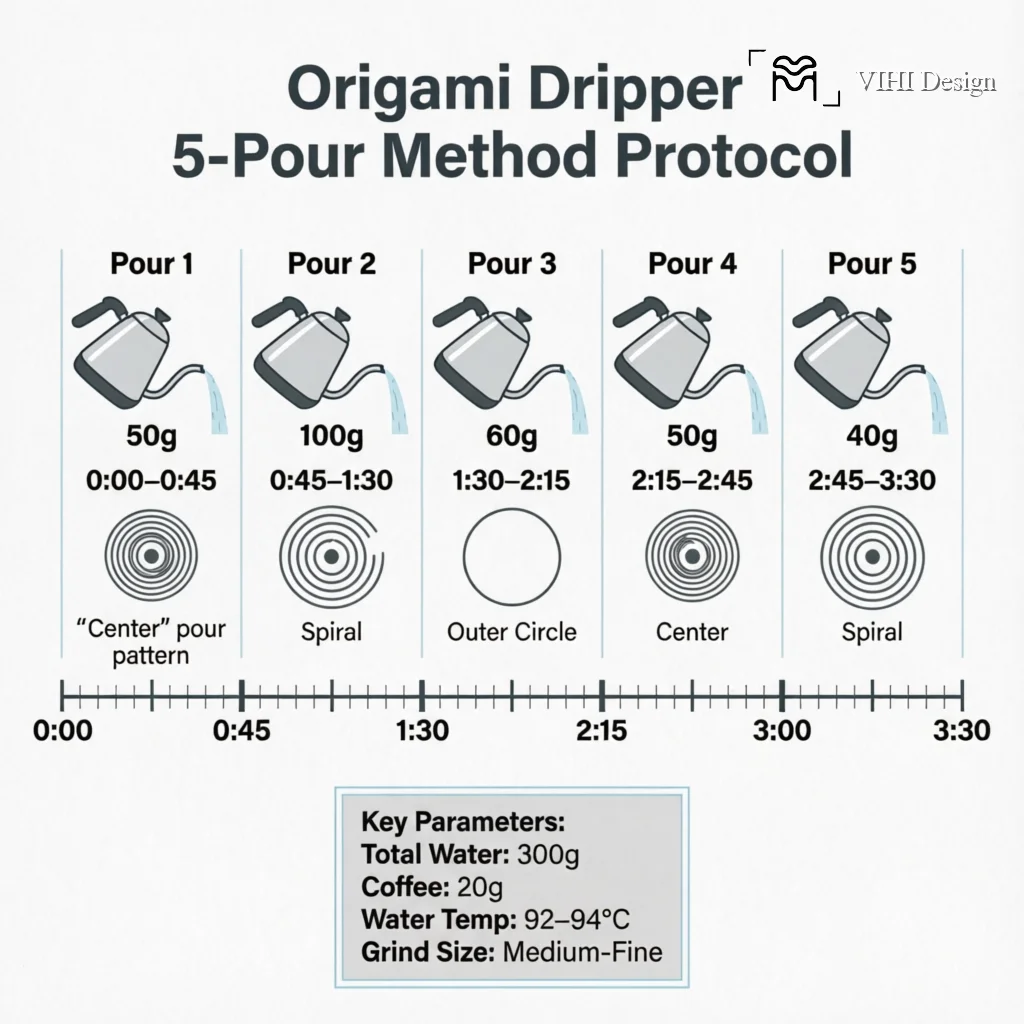
Phase 1: The Foundation Bloom (50g water)
Goal: Complete, even degassing and initial saturation. This is critical for preventing dry pockets and ensuring uniform extraction from the start.
Technique: Pour 50g of water (off-boil, ~96°C) swiftly and centrally, ensuring all grounds are saturated. Gently swirl or stir with a spoon to incorporate any dry grounds. Let bloom for 45 seconds.
Phase 2 & 3: The Body Builders (Pours of 70g each at 0:45 and 1:30)
Goal: Establish the core strength and sweetness of the brew. These pours maintain a high slurry temperature to efficiently extract sucrose and fruity acids.
Technique: Start your second pour at 0:45. Pour 70g in a slow, steady spiral from the center outward, avoiding the very edge of the filter. Allow the water to drain until the slurry is just visible (about 45 seconds). Repeat the exact same 70g pour at 1:30.
Phase 4: The Balance Bridge (60g water at 2:15)
Goal: Transition from high-strength extraction to the final clarifying phase. This slightly smaller pour begins to taper the extraction, preventing the over-extraction of bitter compounds.
Technique: At 2:15, pour 60g in the same gentle spiral. By now, the bed should be settled and flat. This pour should drain noticeably faster.
Phase 5: The Clarifying Finish (50g water at 2:45)
Goal: Rinse the sweetness from the bed and lock in a clean finish. This final pour ensures all extracted sugars are carried into the carafe and dilutes the brew to the ideal TDS range.
Technique: Your final 50g pour at 2:45 can be a simple central pour. The total brew time should finish between 3:15 and 3:45, depending on your grind size and coffee.
Optimizing for Your Palette: Practical Adjustments
The 5-pour structure is a framework. Your grind size is the primary variable for dialing in. Use taste and the target metrics (TDS/EY) as your guide.
- If your brew is sour, thin, or weak (likely low TDS/EY): Your grind is likely too coarse. Make it finer to increase extraction and body. Ensure your water is hot enough (93-96°C).
- If your brew is bitter, dry, or heavy (likely high TDS/EY): Your grind is likely too fine. Coarsen it slightly to reduce extraction and ease flow rate. Check that you’re not pouring too aggressively.
- For maximum perceived sweetness: Aim for the higher end of the EY range (21-22%) with a moderate TDS (~1.35%). This often means a medium-fine grind that allows full extraction without stalling.
Why This Works: The Science of Structured Extraction
This method isn’t arbitrary. It’s designed to manipulate the extraction gradient—the order in which compounds dissolve from the coffee cell structure.
1. Sequential Saturation: Multiple small pours keep the slurry temperature consistently high, which is crucial for efficient sugar extraction. A single large pour causes significant heat loss.
2. Managing the Concentration Gradient: By allowing partial drainage between pours, we periodically lower the concentration of dissolved solids in the slurry water. Fresh water is a more efficient solvent, so each new pour actively seeks to extract more, focusing on desirable sugars before harsh compounds.
3. Hydrodynamic Control: The gentle, spiral pours and the Origami’s geometry promote a flat, even bed. An even bed is the single greatest defense against channeling, which is the primary cause of simultaneous under-extraction (sourness) and localized over-extraction (bitterness/astringency).
By combining thermal management, concentration gradient control, and even saturation, the 5-Pour Method systematically prioritizes the extraction of sweetness, resulting in a cup that is complex yet fundamentally sweet, bright yet never sharp, and rich yet clean.
Learn More: For a comprehensive understanding, explore our main guide on The Origami Dripper Mastery Guide: From Geometric Design to Flavor Precision.