The Origami Dripper Mastery Guide:
From Geometric Design to Flavor Precision
Introduction
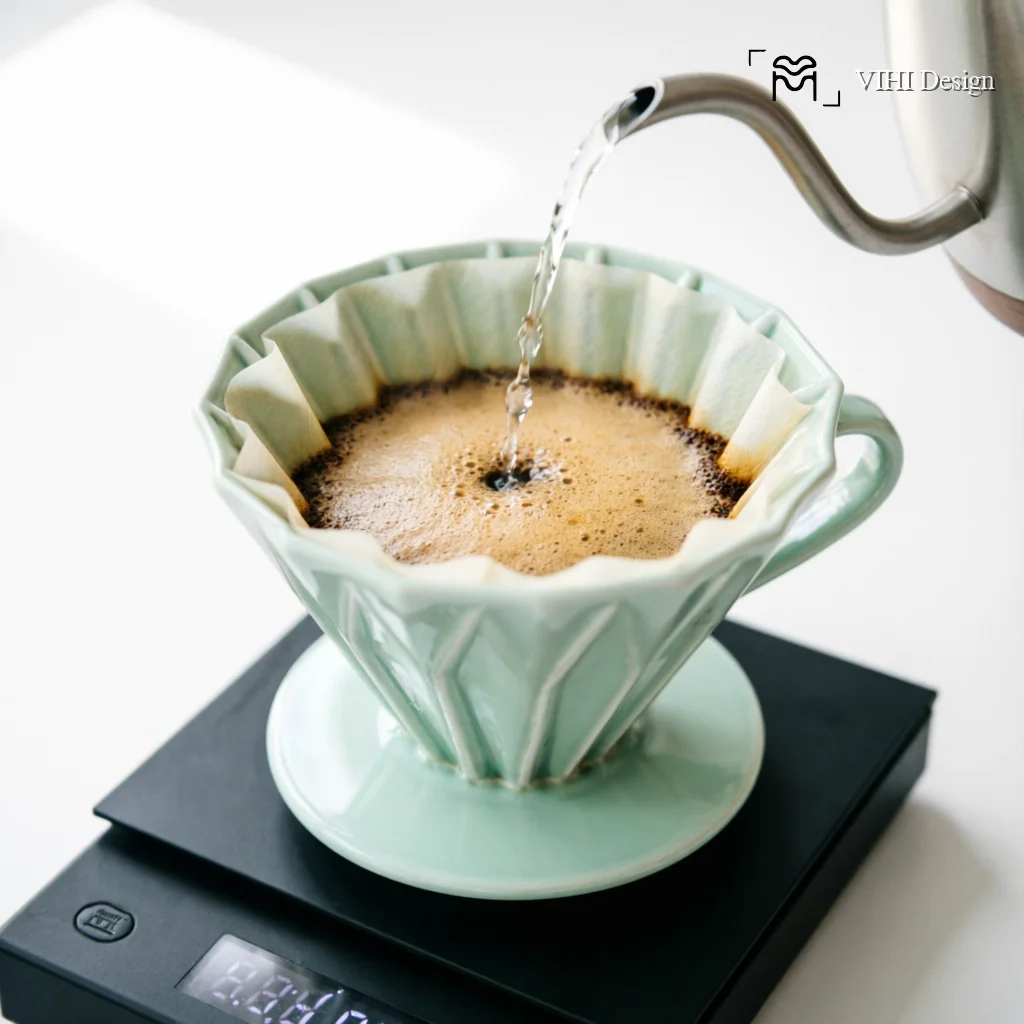
The pursuit of the perfect cup of filter coffee is a journey defined by the interplay of variables: grind size, water chemistry, temperature, and time. Central to this orchestration is the brewing device itself—the conduit through which water meets coffee. In recent years, the specialty coffee landscape has witnessed the rise of a brewer that is as much a feat of engineering as it is an art form: the Origami Dripper. Characterized by its distinctive fluted, conical shape and flat bottom, this brewer transcends its role as a mere tool, becoming a dynamic platform for experimentation and precision.
Unlike traditional brewers with fixed geometries, the Origami Dripper presents a unique proposition. Its design, inspired by the Japanese art of paper folding, incorporates a series of pronounced ribs and a wide aperture. This architecture does not dictate a single brewing method but instead invites the barista to actively participate in defining the extraction process. The choice of filter paper—the pointed-cone style or the flat-bottom “Kalita-style”—fundamentally alters the brewer’s hydraulic behavior, creating two distinct brewing environments within a single device. This inherent flexibility positions the Origami Dripper not as a brewer with a fixed recipe, but as a variable-geometry extraction chamber, where the user’s decisions directly sculpt the flow dynamics and, consequently, the sensory profile of the final brew.
This guide, “The Origami Dripper Mastery Guide: From Geometric Design to Flavor Precision,” aims to deconstruct this elegant apparatus. We will move beyond anecdotal recipe sharing to establish a scientific and practical framework for mastery. By examining its geometric principles, modeling its fluid dynamics, and empirically linking these physical parameters to flavor outcomes, we equip the practitioner with the knowledge to wield the Origami Dripper with intentionality and repeatable precision.
Theoretical Background
To master the Origami Dripper, one must first understand the core physical principles that govern extraction in any percolation brewer, and then identify how this brewer’s specific design modulates those principles. The theoretical foundation rests on three interconnected pillars: the geometry of extraction, the physics of flow, and the kinetics of dissolution.
1. Brewer Geometry as an Extraction Variable
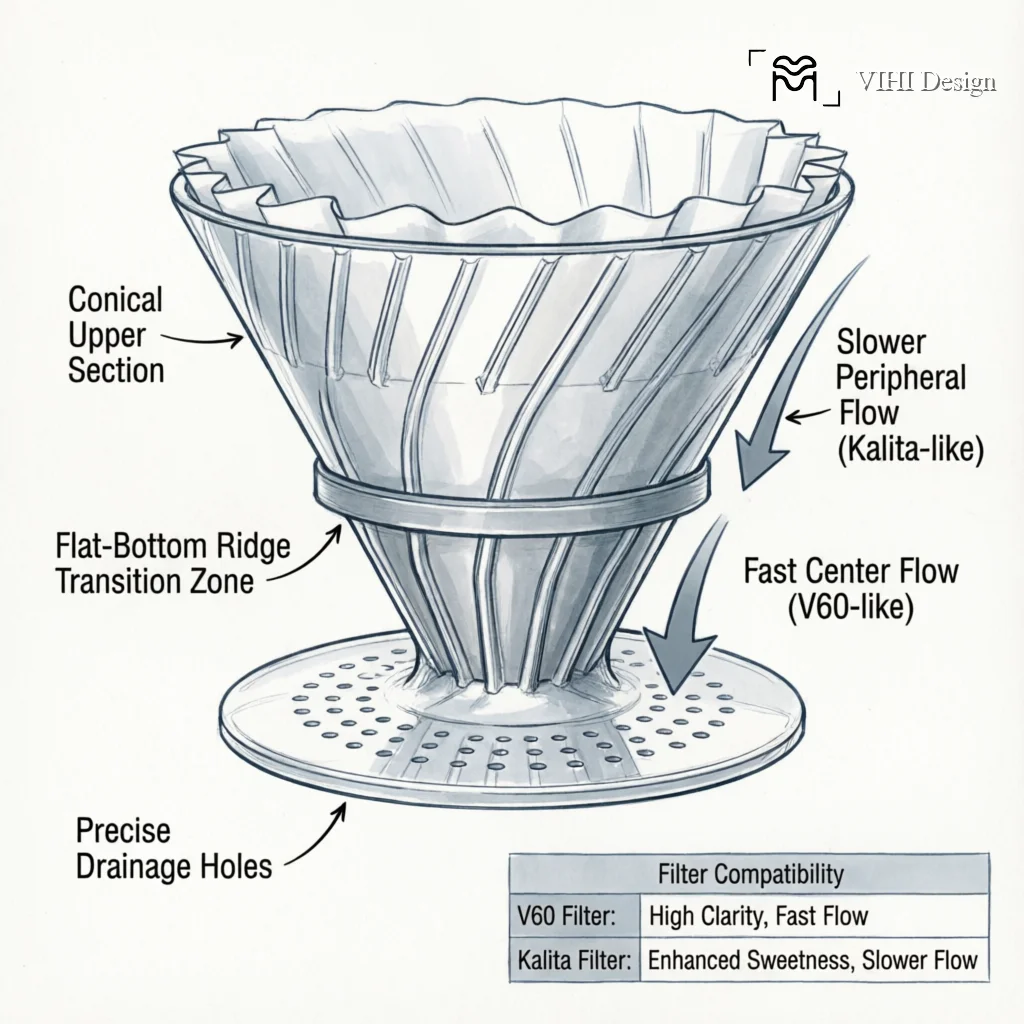
In filter coffee brewing, the geometry of the coffee bed is a primary determinant of extraction uniformity. A classic V60 cone promotes a deep, tapered bed where water flow is accelerated by gravitational potential and channeling along the central axis is a common risk. A flat-bottom brewer, like the Kalita Wave, creates a shallow, wide bed with more consistent flow paths but potentially slower drawdown. The Origami Dripper’s design is a hybrid. When used with a pointed cone filter, it approximates a V60’s deep bed. With a flat-bottom filter, the ribs create a suspended, corrugated bed with significant wall-flow interaction. This choice directly sets the initial conditions for the coffee bed’s depth, diameter, and porosity, which are critical variables in the Darcy-Weisbach equation for fluid flow through a porous medium.
2. Hydraulics and Flow Dynamics
The pronounced ribs of the Origami Dripper are not merely aesthetic; they serve a critical hydraulic function. They create channels of lower flow resistance between the filter paper and the brewer wall. This design mitigates the “sealing” effect common in brewers where a wet filter adheres completely to a smooth wall, which can stall drawdown. The ribs ensure a consistent air gap, promoting predictable and often faster water egress. This controlled bypass influences the contact time between water and coffee grounds. Furthermore, the wide opening at the base reduces the Venturi effect seen in narrow-spouted brewers, allowing for a less turbulent, more laminar final exit flow. The practitioner manipulates these dynamics through pour pattern, flow rate, and agitation, making the brewing act a direct intervention in the system’s hydraulics.
3. The Kinetics of Soluble Yield and Flavor Modulation
The ultimate goal of manipulating geometry and flow is to control the extraction of soluble compounds from the coffee matrix. Different compounds (organic acids, sugars, melanoidins, phenolic compounds) extract at different rates and under different conditions. A fast-flowing, high-agitation brew in the cone-filter configuration may preferentially highlight bright, acidic notes by efficiently extracting fruity organic acids before more bitter compounds fully dissolve. Conversely, a slower, more immersive brew with the flat-filter configuration may promote greater sweetness and body through extended contact time and increased colloidal suspension. The Origami Dripper, by enabling these distinct brewing regimes, allows the user to target specific segments of the extraction yield curve, thereby modulating the flavor balance with scientific intent rather than guesswork.
In summary, the Origami Dripper is a laboratory for applied coffee science. Its mastery requires viewing each brew as an experiment where the independent variables—filter type, grind size, pour protocol—are inputs into a system defined by geometric and hydraulic constants. The dependent variable is the flavor profile in the cup, a direct result of the controlled dissolution kinetics enabled by the brewer’s intelligent design. The following sections of this guide will build upon this theoretical framework to establish rigorous methodologies for measurement, recipe development, and sensory validation.
The Origami Dripper Mastery Guide: From Geometric Design to Flavor Precision
Part 2: Practical Methodology & Sensory Validation
Having established the Origami Dripper as a system of geometric constants and hydraulic variables, we now transition from theory to practice. This section provides the actionable methodologies to harness that design, transforming your brewing from an art into a repeatable, precision-driven science.
Establishing Your Baseline: The Measurement Protocol
Precision begins with measurement. To navigate the target extraction zone of 18–22% Extraction Yield (EY) and a 1.15–1.45% Total Dissolved Solids (TDS), you must first know your starting point. This requires two tools: a reliable refractometer and a quality scale with a 0.1g resolution.
Before every brewing session, calibrate your scale to zero with your brewer and decanter in place. For your refractometer, use distilled water for a 0.0% Brix reading. This 60-second ritual eliminates instrumental drift, the silent killer of reproducible results.
The measurement protocol is straightforward but non-negotiable:
- Weigh Input & Output: Record your dry coffee mass (e.g., 15.0g) and your final beverage mass (e.g., 250.0g). The difference is your water loss retained by the coffee grounds (typically 2-3g per gram of coffee).
- Sample & Measure TDS: Stir the brewed coffee thoroughly, let it cool slightly, and take a refractometer reading to get your TDS percentage.
- Calculate EY: Use the standard formula:
EY% = (Brewed Coffee Mass * TDS%) / Dry Coffee Mass. For our example: (250.0g * 1.30%) / 15.0g = 21.7% EY.
Inputs (You Control): Coffee Dose, Grind Size, Water Temp, Pour Structure
System Constants (Origami Design): Rib Geometry, Base Angle, Flow Path
Measured Output (The Result): TDS %, Extraction Yield %
Sensory Output (The Goal): Flavor Profile (Balance, Clarity, Intensity)
The Iterative Recipe Development Loop
With a measurement baseline, you enter the iterative development loop. This is where the Origami’s flexibility shines. Your primary levers are grind size and pour protocol, each directly influencing contact time and extraction kinetics.
The Grind Size Lever: Start with a medium-fine grind (similar to table salt). If your EY is below 18% and the cup tastes sour/vegetal, make a single, slight adjustment finer. If EY is above 22% with harsh/bitter notes, adjust coarser. The Origami’s fast flow often requires a slightly finer grind than a V60 to achieve the same contact time.
The Pour Structure Lever: This is your tool for managing energy and agitation. A standard approach is the “Pulsed Pour”:
- Bloom (0:00): 2-3x the coffee mass in water (30-45g for 15g coffee). Gentle swirl to saturate.
- First Main Pour (0:45): Pour steadily to 60% of total weight, aiming for a gentle bed agitation.
- Second Main Pour (1:30): Pour the remaining 40% as the bed just begins to drain. This maintains temperature and a consistent flow rate.
Target a total brew time between 2:15 and 3:00 minutes for a 15-18g dose. A time significantly outside this range suggests your grind size is the first variable to correct.
Your filter is part of the system. The Origami accepts both cone (V60-style) and flat-bottom (Kalita-style) papers.
- Cone Filters: Faster flow, accentuates clarity and brightness. Can benefit from a slightly finer grind.
- Flat-Bottom Filters: Slightly restricted flow, promotes greater body and uniformity. Can be more forgiving.
Choose one filter type and master it before switching. The change in flow dynamics will require you to re-calibrate your grind size.
Sensory Validation: From Data to Flavor Narrative
Numbers are a map, but the flavor is the territory. The final, critical step is linking your TDS/EY data to the sensory experience. This validation closes the loop, making you a true operator of the system.
Perform a structured tasting immediately after measurement. Ask:
- At 18-19% EY / Lower TDS (~1.15%): Are the acidic notes vibrant and fruity, or sharp and sour? Is the body thin? This is the “underdeveloped” zone.
- At 20-21% EY / Ideal TDS (~1.30%): Is there a harmony between sweetness, acidity, and bitterness? Can you clearly identify the coffee’s origin notes (e.g., stone fruit, chocolate, floral)? This is the target “balance” zone the Origami excels at delivering.
- At 22%+ EY / Higher TDS (~1.45%): Has the bitterness become dry or astringent, overpowering sweetness? Are the flavors muddled? This is the “over-extracted” zone.
By correlating these sensory checkpoints with your hard data, you build an internal compass. Soon, you’ll be able to taste a cup and accurately predict its EY range, and conversely, see a number and know what to expect in the cup. This is the essence of mastery: when the geometric theory of the Origami dissolves into an intuitive, precise, and profoundly rewarding brewing experience.