
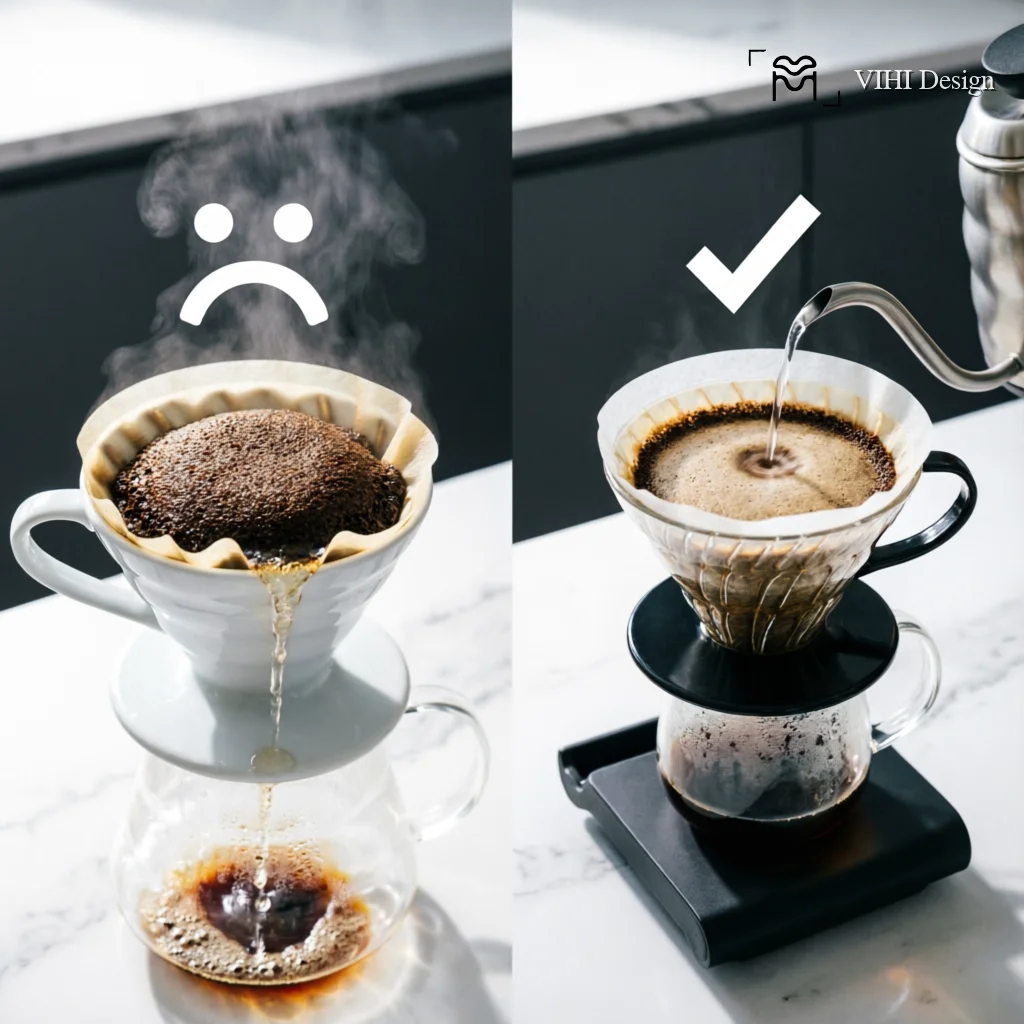
Common Kalita Wave and V60 Mistakes (And How to Fix Them): Phase 1 – Introduction & Theoretical Background
Introduction
The pour-over method represents a pinnacle of manual coffee brewing, offering unparalleled control over extraction variables to highlight the nuanced flavors of specialty coffee. Among the myriad of devices available, the Hario V60 and the Kalita Wave have emerged as dominant tools in both professional and home settings. Their design philosophies, however, are fundamentally divergent: the V60 utilizes a single, large extraction hole and conical spirals to promote a fast, directed flow, while the Kalita Wave employs a flat-bottomed design with three small holes to encourage a slower, more uniform, and immersion-like brew. Despite their widespread adoption, a significant gap exists between potential and consistent execution. Empirical observation in cafes and consumer reports indicates that suboptimal technique with these brewers is pervasive, leading to inconsistent and often underwhelming cups that fail to express the intrinsic quality of the coffee.
This investigation posits that most errors are not failures of equipment but of process, stemming from a misunderstanding of the core hydrodynamic and extraction principles each brewer leverages. The objective of this analysis is to systematically identify, categorize, and rectify the most common technical mistakes associated with the Kalita Wave and V60. By grounding corrective strategies in established coffee science, we aim to provide a framework for brewers to achieve greater consistency, intentionality, and sensory reward in their pour-over practice, ultimately bridging the gap between bean potential and beverage reality.
Theoretical Background
To critically analyze brewing mistakes, one must first establish the scientific framework governing extraction in pour-over coffee. The process is primarily an exercise in solid-liquid extraction, where hot water acts as a solvent, dissolving soluble compounds (approximately 30% of the coffee bean’s mass) from the roasted and ground matrix. The goal is a harmonious extraction of desirable compounds (organic acids, sugars, and certain melanoidins) while limiting the dissolution of undesirable, slow-extracting compounds (primarily quinine and other bitter alkaloids). The target extraction yield (EY) for optimal flavor typically falls between 18-22%, with a total dissolved solids (TDS) concentration of 1.15% to 1.45% for most filter coffee preferences.
Key Variables and Their Interdependence
Extraction is controlled by a set of interdependent variables, often conceptualized in models such as the “Coffee Brewing Control Chart.” For pour-over, the critical parameters are:
1. Grind Size: The largest determinant of surface area and thus extraction rate. Finer grinds increase resistance to flow, prolong contact time, and accelerate extraction, risking over-extraction and channeling if not managed. Coarser grinds have the opposite effect, risking under-extraction.
2. Water Temperature: Governs the kinetic energy of the solvent. Higher temperatures (92-96°C) increase extraction efficiency, beneficial for dense, light-roast coffees. Lower temperatures (85-90°C) can mitigate excessive bitterness in darker roasts or more soluble coffees.
3. Contact Time: The total duration water is in contact with coffee grounds. In pour-over, this is a function of grind size, pour rate, and brewer hydrodynamics. An optimal contact time ensures complete extraction without leaching excessive bitterness.
4. Agitation: Mechanical disturbance of the coffee bed during pouring. Agitation ensures even saturation, prevents dry pockets, and can increase extraction uniformity. Excessive agitation, however, can cause fines migration and clog the filter, disrupting flow.
Brewer-Specific Hydrodynamics
The design of the brewer itself is a master variable that dictates how the above parameters interact:
Hario V60 (Conical, Single Hole): Its design promotes a faster, vortex-like flow directed toward the apex. This creates a pronounced bypass effect where water can channel down the sides if the bed is uneven. The spiraled interior is intended to slow the water’s path by creating surface tension against the filter paper, but this effect is highly technique-dependent. The V60 is inherently less forgiving; it requires precise pouring and grind management to achieve an even, controlled extraction without channeling.
Kalita Wave (Flat-Bottom, Multi-Hole): The flat bed provides a more consistent geometry for water to pass through the entire coffee mass uniformly. The three small holes restrict flow, creating a degree of immersion even during active pouring. This design naturally promotes a more uniform extraction with a wider tolerance for variation in pouring technique, as the water level above the bed (head pressure) helps push water through the entire bed evenly rather than finding a single path of least resistance.
Core Thesis: Most common mistakes with these brewers arise from applying a technique suited for one hydrodynamic model to the other, or from a failure to adjust other variables (especially grind size) to compensate for the inherent flow characteristics of the device. Understanding this dichotomy is the foundation for effective troubleshooting.
Common Kalita Wave and V60 Mistakes (And How to Fix Them)
Core Thesis: Most common mistakes with these brewers arise from applying a technique suited for one hydrodynamic model to the other, or from a failure to adjust other variables (especially grind size) to compensate for the inherent flow characteristics of the device. Understanding this dichotomy is the foundation for effective troubleshooting.
Mistake 2: The “Set-and-Forget” Pour on the V60
Many brewers, especially those coming from the forgiving Kalita Wave, treat the V60 like a showerhead: they do one big, slow pour to saturate the grounds and then just let it drain. This often leads to a flat, hollow, or overly sharp cup. Why? The V60’s wide-open, single-hole design encourages bypass—where water finds a clear path down the sides of the filter, avoiding the coffee bed entirely. A single, passive pour exacerbates this.
Barista Fix: Master the Pulse Pour. Instead of one continuous pour, break your total water volume into 3-5 smaller pulses. After your initial bloom (using 2-3x the coffee weight in water), add water in stages, allowing the water level to drop by about 50-75% before adding the next pulse. This does two critical things:
- Agitates the Bed: Each new pour gently stirs the grounds, preventing them from settling into a compact, impermeable layer at the bottom and promoting even extraction.
- Manages Flow Rate: It gives you active control over the brew time and ensures the coffee bed remains suspended and engaged throughout the brew, minimizing channeling and bypass.
Pro Tip: Listen and watch. A healthy pulse pour should create a flat, “swirling” bed. If you hear a loud “glugging” sound, your grind may be too fine and is clogging the filter.
Mistake 3: Over-Agitating the Kalita Wave
In an attempt to ensure even extraction, brewers often aggressively swirl or stir their Kalita Wave. This is a classic case of applying V60 logic to the Wave. The Wave’s flat bottom and multiple small holes already promote a slow, even, and immersion-like environment. Vigorous agitation here can force fine particles to migrate to the filter paper’s edges and clog the tiny drainage holes, leading to a painfully slow drawdown and a bitter, over-extracted cup.
Barista Fix: Gentle Nudges, Not Stirs. Your agitation on the Wave should be minimal and purposeful.
- During the Bloom: Use a small spoon or chopstick to gently make a few “wells” in the bed to ensure all dry grounds are wet. A very gentle side-to-side swirl is acceptable.
- During Main Pours: Pour gently and steadily from a low height, aiming for the center. The goal is to raise the water level to create an immersion bath, not to stir the grounds. The design of the brewer will handle the even extraction.
- Final Bed Check: If you have a visible high-and-dry ring of grounds at the end, one last, extremely gentle horizontal swirl can level the bed. If your bed is already flat, do nothing.
Experience Check: If your total brew time is consistently exceeding 4:00 for a 15-18g dose, you are likely agitating too much or need to coarsen your grind. Target a Total Dissolved Solids (TDS) of 1.15% – 1.45% and an Extraction Yield (EY) of 18% – 22% for a balanced cup.
The Universal Fix: Grind Size is Your Primary Lever
Whether you’re fixing a V60 that’s too sour or a Wave that’s too bitter, your first and most powerful adjustment should always be grind size. Technique adjustments (like pulse pouring or gentle agitation) set the stage, but grind size fine-tunes the performance.
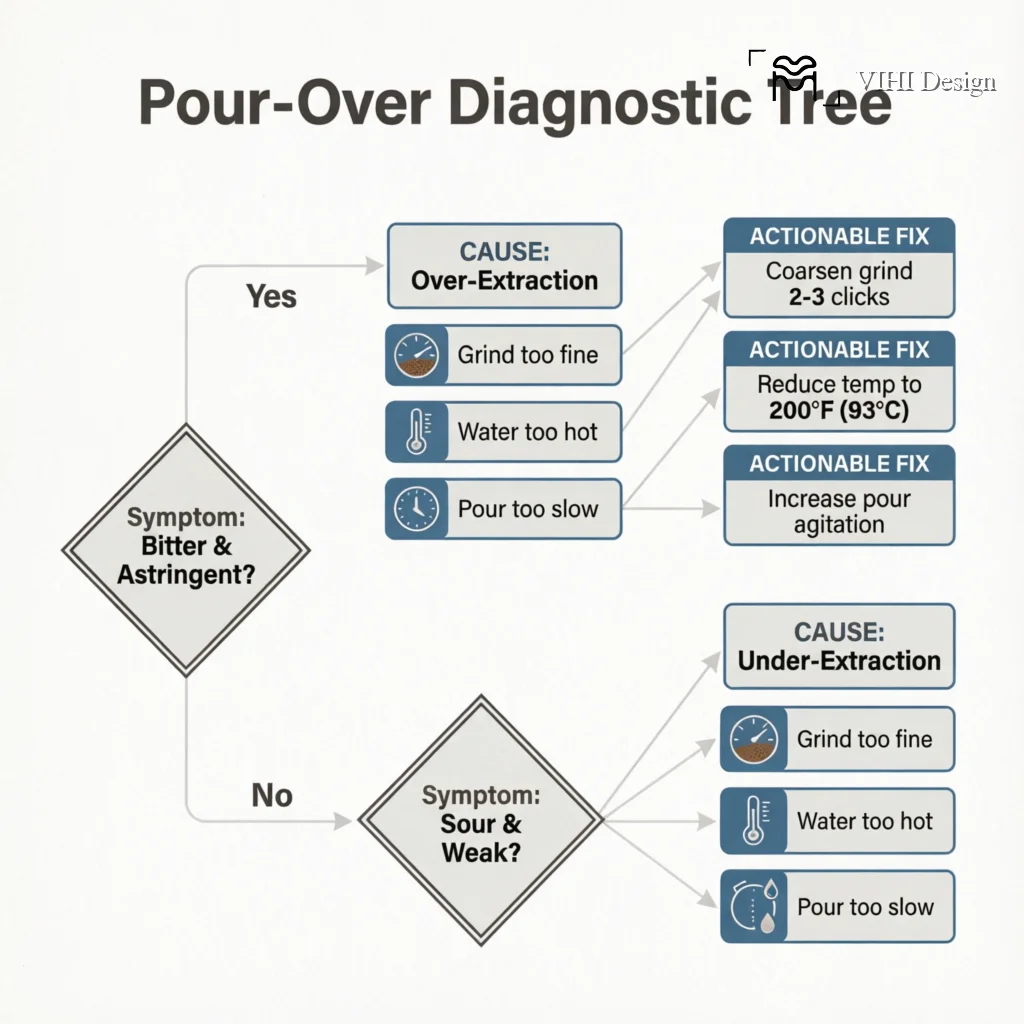
The Diagnostic Flowchart:
- V60 tastes weak, sour, watery? This is often under-extraction. First, ensure you’re using the pulse pour technique. If the problem persists, make your grind finer. This increases surface area, slows the flow, and boosts extraction.
- Kalita Wave tastes harsh, bitter, astringent? This is often over-extraction. First, stop swirling so much. If the problem persists, make your grind coarser. This will open up the bed, prevent clogging, and speed up the drawdown to a proper range.
- Remember the Numbers: Use your taste and brew time as guides, but the objective targets are an EY of 18-22% and a TDS of 1.15-1.45%. A refractometer can confirm if your adjustments are moving you in the right direction.
By respecting the inherent design of each brewer—embracing the V60’s need for active flow management and the Wave’s preference for a steady, gentle hand—and using grind size as your master tuning key, you’ll transform these common frustrations into consistent, delicious results. Happy brewing!
Learn More: For a comprehensive understanding, explore our main guide on Kalita Wave vs V60: The Ultimate Dripper Comparison for Home Brewers.