Introduction
The pursuit of the perfect cup of coffee at home has evolved from a simple morning ritual into a sophisticated exploration of variables, each contributing to the final sensory profile in the cup. Central to this exploration is the pour-over brewing method, celebrated for its capacity to yield a clean, articulate, and nuanced expression of specialty coffee. Among the myriad of pour-over brewers available, two designs have achieved canonical status within the specialty coffee community: the Hario V60 and the Kalita Wave. While both are single-serve, manual drip brewers that utilize paper filters, their fundamental geometries and resultant hydrodynamics diverge significantly, leading to distinct brewing philosophies and cup profiles.
This comparative analysis seeks to move beyond anecdotal preference and subjective review, grounding the discussion in the principles of coffee extraction science. The objective is to provide the dedicated home brewer with a rigorous, evidence-based framework for understanding how the structural differences between the conical V60 and the flat-bottomed Kalita Wave influence key brewing parameters—namely, water flow dynamics, bed geometry, extraction uniformity, and thermal stability. By elucidating these theoretical underpinnings, this paper aims to empower brewers to make informed equipment choices and refine their technique, ultimately facilitating greater control and consistency in achieving their desired flavor outcomes.
Theoretical Background
The extraction of soluble compounds from roasted and ground coffee is a complex physicochemical process governed by principles of mass transfer and fluid dynamics. In pour-over brewing, this process is not uniform; it is mediated by the interaction between water, coffee grounds, and the physical brewer itself. Two primary theoretical concepts are paramount for this comparison: extraction uniformity and flow rate dynamics.
Extraction Uniformity and Bed Geometry
The shape of the coffee bed during brewing is a critical, yet often overlooked, variable. A conical brewer like the V60 creates a deep, tapered bed where water enters at a narrow point and travels a longer, variable path to the exit. This geometry inherently promotes a faster flow rate at the center (the path of least resistance) and a slower flow along the walls, a phenomenon that can lead to channeling and uneven extraction if not meticulously managed by pour technique. Conversely, the Kalita Wave employs a flat-bottomed design with a shallower, more uniformly wide bed. This geometry presents a more consistent resistance to water flow across the entire cross-section of the bed, theoretically promoting a more even saturation and extraction, with a reduced tendency for dominant channels to form.
Flow Rate Dynamics and Brewer Design
Flow rate, the speed at which water passes through the coffee bed, is a direct function of the differential pressure between the top of the bed and the exit point, as described by Darcy’s law. The V60’s single, large exit hole and pronounced internal ribs, designed to create an air gap between brewer and filter, facilitate a relatively unrestricted flow. This grants the brewer significant control over contact time, but places a high demand on the user’s pour technique (e.g., pulse pouring) to regulate that flow and ensure proper saturation. The Kalita Wave, with its three small exit holes and wave-patterned filter that sits flush against the brewer walls, intentionally restricts and regulates flow. This design creates a more consistent, self-buffering hydrostatic pressure, leading to a more predictable and often slower draw-down time, which can enhance extraction stability, particularly for novice brewers.
Thermal Management
Heat loss during the brewing process is a non-trivial factor affecting extraction efficiency. The materials of construction—typically ceramic, glass, metal, or plastic—influence the thermal mass of the brewer system. A brewer with higher thermal mass (e.g., ceramic) can absorb more heat from the brewing water, potentially cooling the slurry unless adequately pre-heated. Both the V60 and Kalita Wave are available in various materials, introducing another variable for comparison. Furthermore, the flat, wide bed of the Kalita Wave presents a larger surface area for radiative and convective heat loss compared to the deeper V60 cone, a factor that must be considered in relation to total brew time and slurry temperature stability.
Conclusion of Theoretical Background
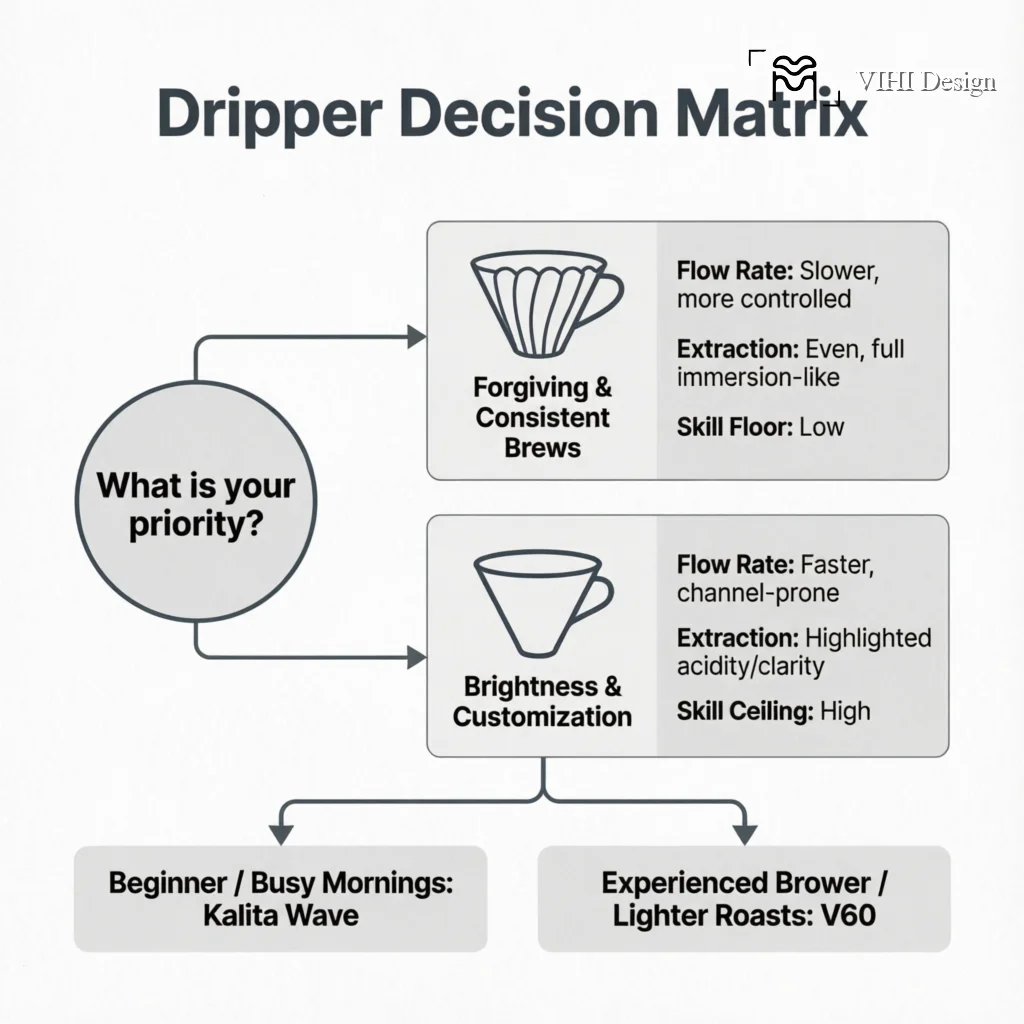
In summary, the V60 can be characterized as a high-control, high-variability tool. Its design maximizes the influence of the brewer’s technique, offering the potential for high clarity and dynamic flavor separation but requiring skill to achieve uniform extraction. The Kalita Wave, in contrast, can be characterized as a high-consistency, high-forgiveness tool. Its design inherently promotes extraction uniformity and buffers against technique variables, often yielding a cup with greater body and balanced sweetness, albeit sometimes at the expense of extreme clarity. The following analysis will apply these theoretical principles to a direct, parametric comparison of the two brewers in practice.
Head-to-Head: A Practical Parameter Comparison
To translate theory into practice, let’s compare the two brewers across key parameters. Remember, the target for a well-extracted, balanced filter coffee typically falls within a Total Dissolved Solids (TDS) range of 1.15% – 1.45% and an Extraction Yield (EY) of 18% – 22%. Both brewers can hit these marks, but their paths differ.
| Parameter | Hario V60 | Kalita Wave |
|---|---|---|
| Flow Rate | Fast, unrestricted. Highly dependent on grind size and pour technique. | Slower, regulated by the flat bed and three small holes. More consistent. |
| Grind Size | Medium to medium-fine. Requires adjustment to control brew time (typically 2:30 – 3:30 mins). | Medium-coarse to medium. The restricted flow means you can grind coarser than you think. |
| Technique Demand | High. Pour pattern, speed, and agitation are critical for even extraction. | Low to Moderate. The design does much of the work. A simple, steady pour is often sufficient. |
| Typical Cup Profile | High clarity, pronounced acidity, layered complexity. Can be tea-like. | Balanced sweetness, fuller body, rounded acidity. Often described as “juicy” or “rounded.” |
| Best For | Brewers who enjoy the process, want to highlight a coffee’s delicate notes, and don’t mind a steeper learning curve. | Consistency seekers, those new to pour-over, or anyone wanting a reliably sweet, balanced cup every morning. |
Brewing Guides: Actionable Tips for Each Brewer
Based on years of professional brewing and training, here are foundational recipes to get the best from each tool. These are starting points designed for 15g of coffee to 250g of water (a 1:16.6 ratio).
Kalita Wave (185 Size) Recipe: The Sweet Spot
Grind: Medium (like coarse sand).
Water: 93°C (200°F).
Process: 1) Rinse filter. 2) Add coffee, make a shallow well. 3) Bloom: Pour 45g of water, gently swirl to wet all grounds. Wait 30 seconds. 4) Main Pour: Slowly pour in concentric circles up to 250g total by 1:15. 5) Let draw down completely. Total time should be ~2:45 – 3:15.
Pro Tip: The Kalita is forgiving, but avoid pouring directly on the filter paper edges. Aim for the center of the slurry to prevent bypass. If your brew is too fast/slow, adjust grind size in small increments.
Hario V60 (02 Size) Recipe: The Controlled Clarity
Grind: Medium-fine (like table salt).
Water: 96°C (205°F) for lighter roasts.
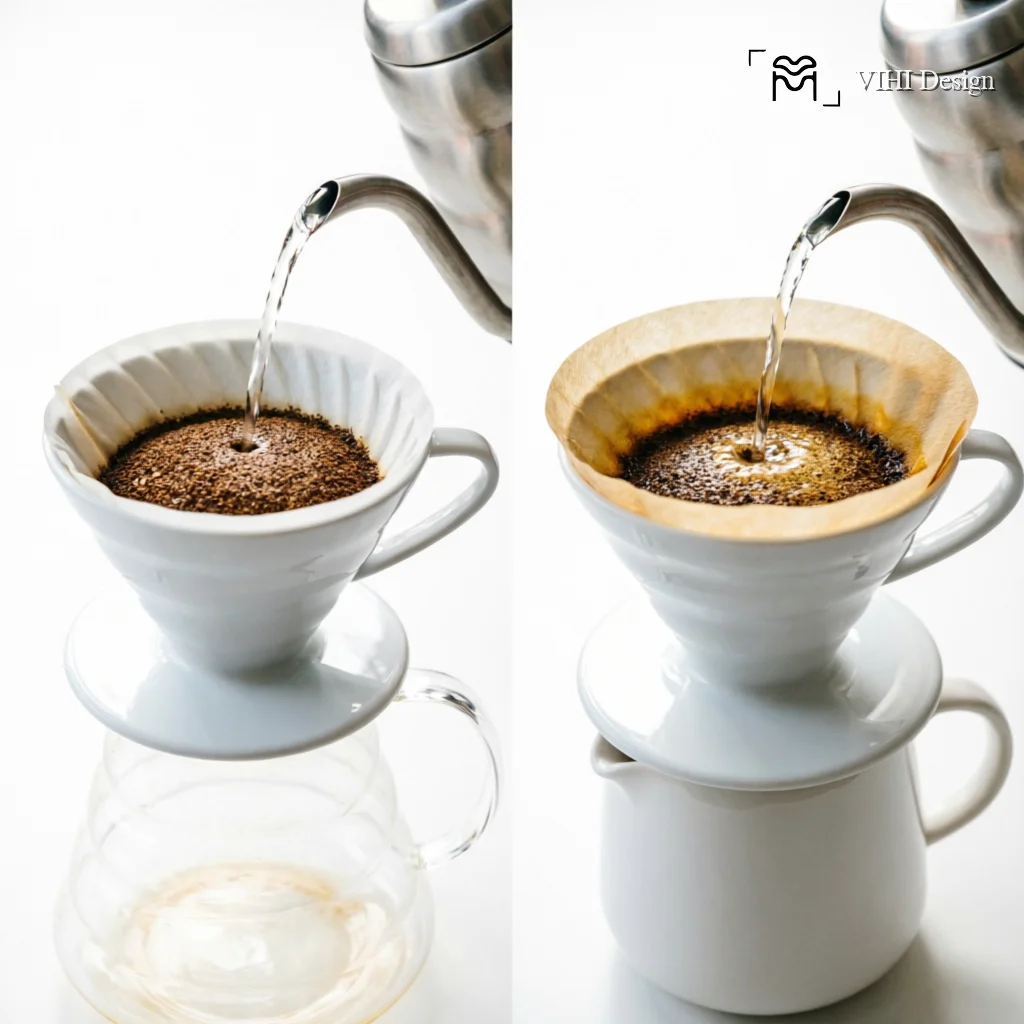
Process (Classic 4:6 Method Variation): 1) Rinse filter. 2) Add coffee, tap to level. 3) Bloom: Pour 45g of water, stir gently with a spoon to ensure full saturation. Wait 45 seconds. 4) Pulse Pours: Pour in 5 equal pulses of about 40g each, waiting for the bed to drain 50-75% between pours. Target finish around 3:00 – 3:30.
Pro Tip: Agitation is your tool. A gentle stir during the bloom ensures no dry clumps. Your pour height controls agitation—higher pours increase it (extracting more), lower pours decrease it. Use this to fine-tune balance.
Making Your Choice: Which Brewer is Right for Your Kitchen?
Your decision ultimately hinges on your personal brewing philosophy and lifestyle.
Choose the Hario V60 if: You view brewing as an engaging ritual. You love tinkering with variables to unlock different flavors from the same bean. You primarily drink light-roasted, complex coffees from Africa or Panama and want to highlight their sparkling acidity and floral notes. You don’t mind an occasional “off” cup in pursuit of a transcendent one.
Choose the Kalita Wave if: You value reliability and a smooth workflow, especially first thing in the morning. You prefer a cup with inherent sweetness and body, often found in coffees from Colombia, Brazil, or Honduras. You want a brewer that performs well even when you’re not perfectly dialed in. It’s the ultimate “set it and forget it” pour-over that still produces exceptional results.
For the truly dedicated home barista, there’s no need to choose just one. Many enthusiasts own both, using the Kalita for a dependable daily driver and the V60 for weekend exploration. Understanding their inherent behaviors—the V60’s expressive fluid dynamics versus the Kalita’s steady, uniform extraction—makes you a more adaptable and knowledgeable brewer, capable of showcasing any coffee at its best.