
Flat Bottom vs Conical Filters: How Filter Shape Changes Your Coffee
Introduction: The Unseen Architect of Flavor
In the pursuit of the perfect cup of specialty coffee, immense attention is rightly paid to bean origin, roast profile, grind size, and water quality. However, one critical and often overlooked variable resides in the brewing device itself: the geometry of the paper filter. The debate between flat-bottom (e.g., Kalita Wave, Fellow Stagg X) and conical (e.g., Hario V60, Chemex) brewers is more than a matter of aesthetic preference; it is a fundamental divergence in hydraulic design that directly governs extraction dynamics. This paper posits that filter shape is a primary determinant of coffee bed structure, flow rate, and ultimately, the sensory profile of the final brew. Understanding this variable allows the practitioner to move from arbitrary recipe following to principled extraction engineering.
Theoretical Background: Principles of Coffee Extraction
To appreciate the impact of filter geometry, one must first establish the core scientific principles of coffee extraction. Brewing is essentially a process of solid-liquid extraction, where hot water dissolves soluble compounds—acids, sugars, lipids, and bitter alkaloids like caffeine—from the roasted coffee matrix. The goal is a balanced extraction, typically targeting 18-22% of the coffee mass, to achieve harmony between sweetness, acidity, and body. Two key interrelated concepts govern this process: extraction yield (the percentage of coffee mass dissolved) and extraction uniformity (the evenness of dissolution across the entire coffee bed). Non-uniform extraction, often manifesting as simultaneous under- and over-extraction, is a primary source of undesirable astringency and muddled flavors.
Fluid Dynamics in Immersion vs. Percolation Brewing
While both flat-bottom and conical filters operate primarily on the percolation principle (water flowing through a stationary coffee bed), their interaction with immersion methods like the French Press is instructive. Immersion brewing promotes high uniformity by allowing all grounds equal time in a saturated environment, often at the cost of clarity. Percolation, by contrast, introduces a temporal element—water passes through the bed in a sequence—creating a gradient of extraction. The geometry of the filter chamber critically influences this gradient by dictating the water’s path, residence time, and interaction with the coffee particles, making it the defining variable for percolation brews.
The Role of Coffee Bed Geometry and Structure
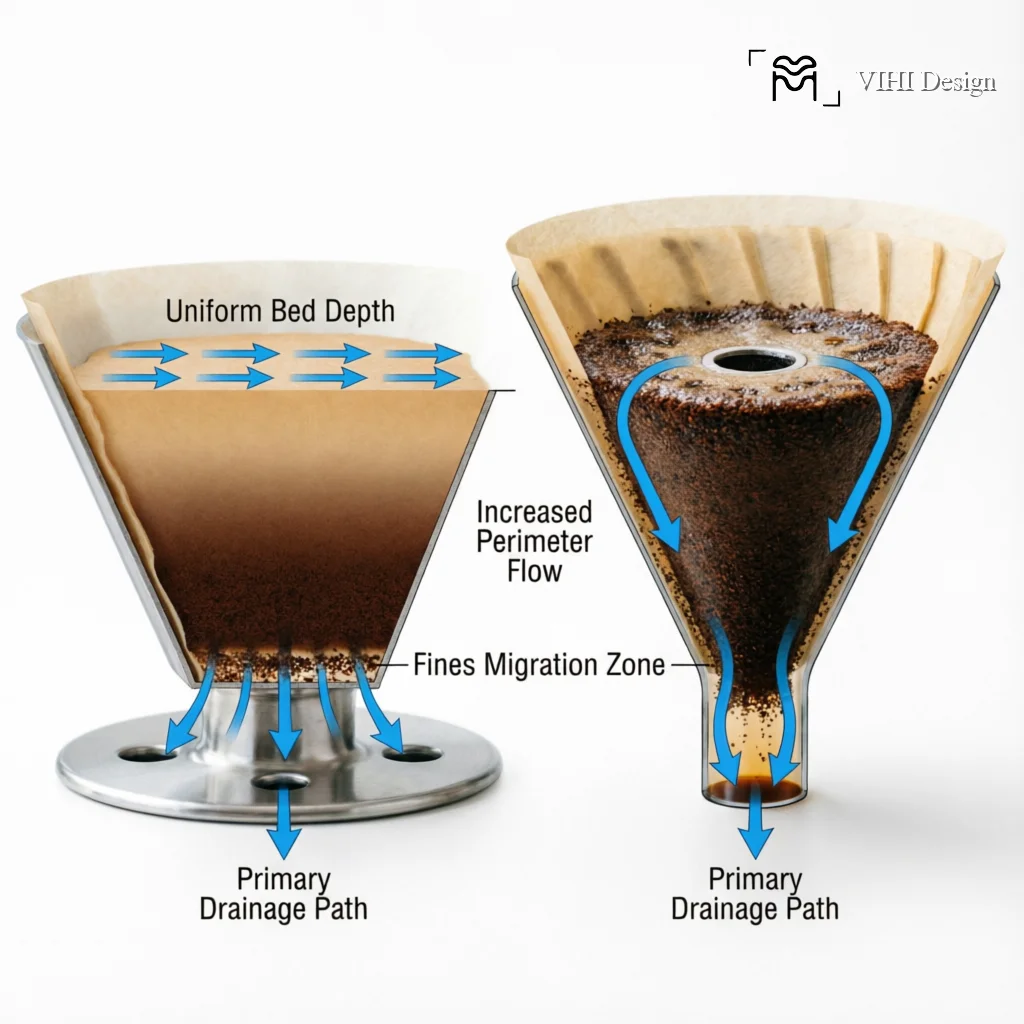
The physical shape of the coffee bed is not a passive consequence but an active extraction parameter. A conical bed is inherently deeper at its center than its edges. This depth gradient creates a corresponding flow resistance gradient, encouraging water to seek the path of least resistance along the shallower walls—a phenomenon known as channeling, unless meticulously managed via pour technique. A flat bed, by design, aims for a uniform depth across its entire plane. This promotes a more consistent packing density of grounds and, theoretically, a more even distribution of water as it percolates downward, reducing inherent channeling tendencies.
Hydrostatic Pressure and Flow Rate Fundamentals
Flow rate is the observable outcome of complex interactions between grind size, bed permeability, and hydrostatic pressure—the pressure exerted by a fluid due to gravity. In a conical filter, the water column is deepest at the apex, creating a localized high-pressure zone that can accelerate flow through the center. In a flat-bottom brewer, the water pool distributes its weight over a broader area, generally resulting in a lower, more consistent pressure head across the bed. This fundamental difference means that, all else being equal, a conical brewer will typically drain faster than a flat-bottom brewer, directly influencing contact time and extraction kinetics.
Interplay of Variables: A Systems View
It is crucial to understand that filter shape does not act in isolation. It exists in a tightly coupled system with grind size, pour protocol (pulse vs. continuous), and agitation. A conical filter’s propensity for faster flow can be counteracted by using a finer grind, which increases resistance. Conversely, a flat-bottom brewer’s tendency toward slower, more controlled drainage allows for effective extraction with a slightly coarser grind, which can enhance clarity. Thus, the filter geometry establishes the baseline hydraulic conditions with which all other brewing parameters interact, setting the stage for either accentuating or mitigating its inherent extraction profile.
Targeting Your Sweet Spot: TDS, EY, and Practical Adjustments
Understanding the interplay between filter shape and extraction allows you to deliberately target the industry’s gold-standard metrics: a Total Dissolved Solids (TDS) of 1.15% to 1.45% and an Extraction Yield (EY) of 18% to 22%. This “sweet spot” represents a balanced, flavorful cup. Your filter choice dictates your starting strategy.
A conical brewer, with its faster flow, often produces a cup with lower TDS (lighter body) but can still achieve a high EY due to efficient percolation through the coffee bed. The risk is under-extraction (sour, sharp) if the flow is too fast. To counteract this and raise TDS into the target zone, a finer grind is your primary lever. This increases resistance, slows the brew, and boosts extraction.
Conversely, a flat-bottom brewer naturally yields a higher TDS (fuller body) and even extraction. The risk here is over-extraction (bitter, dry) if the brew stalls. To prevent this while maintaining a high EY, you can confidently use a slightly coarser grind than you would in a cone. This ensures clean, unimpeded flow while still extracting thoroughly due to the filter’s geometry.
Barista Tips for Mastering Both Styles
Your experience and technique are the final variables in this equation. Here are practical tips to harness each filter’s potential.
For Conical Filters (e.g., Hario V60, Kalita Wave 185)
- Grind Fine, Pour Slow: Start with a medium-fine grind. Use a controlled, slow pour (especially a spiral pour from the center outward) to saturate the entire bed and manage flow rate.
- Mind the Bed: Avoid pouring directly onto the paper. Agitation from high, hard pours can create channels. Aim for a flat, even coffee bed at the end of the brew.
- Pre-Heat Aggressively: Rinse the filter thoroughly with hot water to pre-heat the entire cone and server, ensuring your slurry temperature stays in the ideal 195°F–205°F range.
For Flat-Bottom Filters (e.g., Kalita Wave 155, Fellow Stagg [X], Classic Drip Machine)
- Embrace the Coarse Side: Don’t be afraid to go a click or two coarser than your conical grind. This promotes clarity and prevents astringency.
- Pour with Confidence: You can pour more freely and aggressively. The flat bed is forgiving and distributes water evenly, reducing channeling risk.
- Watch the Drawdown: The final drawdown should be steady. If it stalls completely, your grind may be too fine for this brewer. A flat, even bed is your goal here as well.
Choosing Your Filter: A Matter of Preference and Purpose
There is no universal “best” choice. Your decision should be guided by the coffee’s origin, your desired cup profile, and your brewing style.
Reach for a Conical Filter when brewing bright, complex coffees like Ethiopian Yirgacheffe or Kenyan AA. Its design accentuates clarity, acidity, and layered flavors, letting delicate notes shine. It rewards meticulous technique and is ideal for the barista who enjoys hands-on, recipe-driven brewing.
Opt for a Flat-Bottom Filter for balanced, sweet, and full-bodied cups. It’s excellent for chocolatey Brazilians, rich Sumatrans, or any blend where you want to emphasize sweetness and texture. Its consistency and forgiveness make it perfect for busy mornings, batch brewing, or anyone seeking a reliably excellent and balanced cup with less fuss.
Ultimately, mastering both tools expands your coffee repertoire. By understanding the hydraulic blueprint of your filter, you can manipulate grind, pour, and ratio to consistently hit your target TDS and EY, transforming technical parameters into an exceptional sensory experience in the cup.

Learn More: For a comprehensive understanding, explore our main guide on Kalita Wave vs V60: The Ultimate Dripper Comparison for Home Brewers.