
Introduction
The manual pour-over method represents a pinnacle of engagement in specialty coffee preparation, emphasizing clarity, control, and the nuanced expression of coffee origin. For the novice enthusiast, selecting an appropriate brewing device is a critical first step that can significantly influence the learning curve, consistency of results, and ultimate satisfaction. Among the plethora of available brewers, the Hario V60 and the Kalita Wave have emerged as two dominant and highly regarded designs, each embodying a distinct philosophical approach to extraction hydrodynamics. This investigation seeks to provide a foundational, evidence-based comparison of these two systems, with a specific focus on their suitability for beginners. The core thesis posits that while both brewers are capable of producing exceptional coffee, their inherent design differences—particularly in filter geometry and flow rate—create divergent user experiences that impact initial accessibility, consistency, and the development of fundamental brewing skills.
Theoretical Background
To objectively evaluate the Kalita Wave and V60, one must first understand the core principles of pour-over extraction. The process is governed by the interplay of several physical and chemical parameters: grind size distribution, water temperature, pour kinetics, and most critically for this comparison, brewer geometry and its effect on flow dynamics.
The Hario V60, characterized by its single, large apical aperture and pronounced spiral ribs, is designed to promote a relatively unrestricted and fast drawdown. This design encourages a higher degree of bypass (water flowing through channels rather than fully permeating the coffee bed) and requires the user to actively manage flow rate through pour technique and grind size modulation. The resulting extraction is often described as highlighting clarity, acidity, and complex flavor separation, but it places a greater demand on the brewer’s skill to achieve balanced and repeatable results.
Conversely, the Kalita Wave employs a flat-bottomed brew bed and a filter with crimped, wavy sides and three small drainage holes. This geometry is engineered to create a more restricted and consistent flow rate, fostering a more immersion-style environment where water residence time is less dependent on pour technique. The flat bed promotes a more even and predictable extraction by minimizing channeling and reducing the influence of pour pattern variability. The resultant cup profile tends toward greater body, sweetness, and consistency, albeit sometimes with a perceived reduction in the highest registers of aromatic clarity compared to an optimally brewed V60.
From a pedagogical standpoint, these differences translate directly to the beginner’s experience. A brewer that is more forgiving of technique and provides a narrower window for error can accelerate early success and reinforce positive feedback. This analysis will therefore proceed by examining the two systems through the lenses of mechanical forgiveness, consistency yield, and skill acquisition pathway, providing a scientific framework for the initial brewer selection.
Mechanical Forgiveness: The Built-In Safety Net
For a beginner, the physical design of the brewer is your first and most important teacher. This is where the Kalita Wave and Hario V60 diverge most significantly.
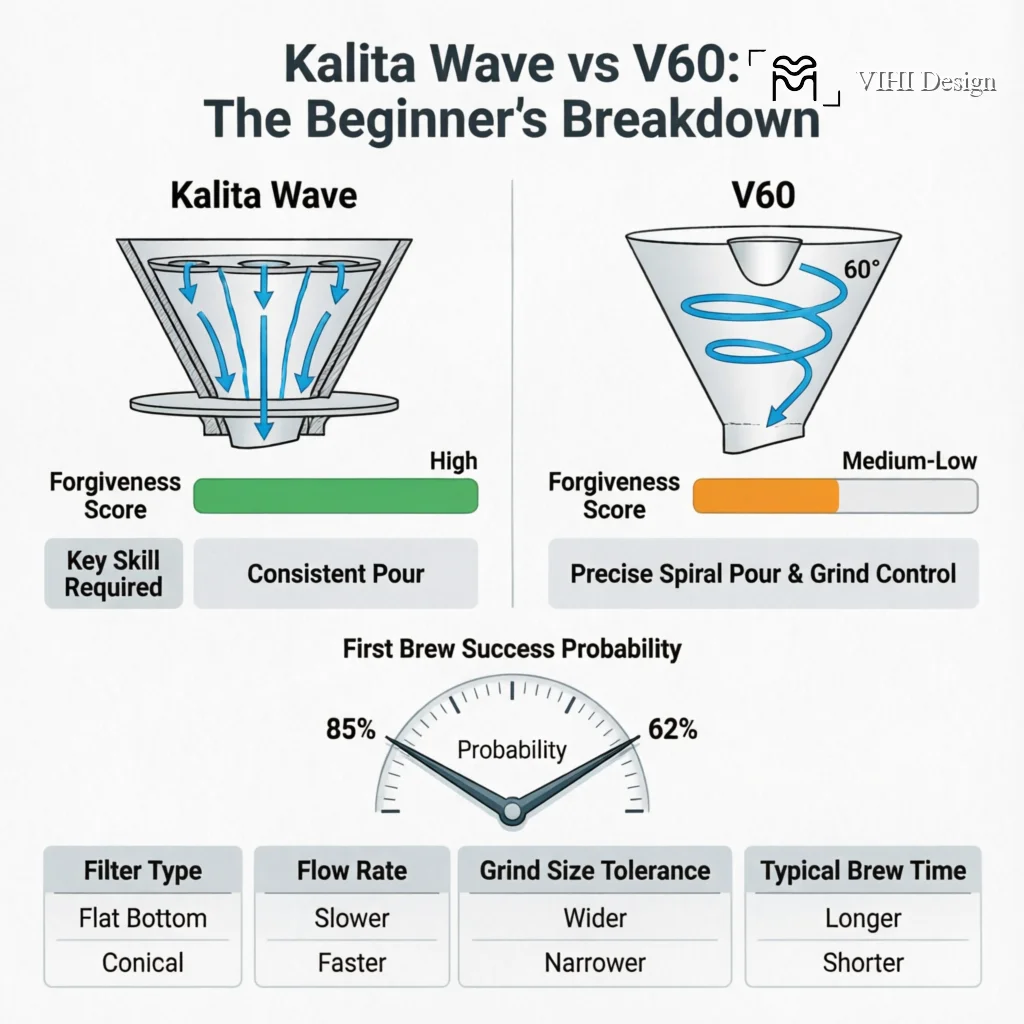
The Kalita Wave’s flat-bottom bed and triple-hole design create a natural resistance to water flow. This acts as a regulator, slowing the brew and giving the user more time to pour without drastically altering the extraction. It’s forgiving of uneven pouring or slight inconsistencies in grind size. The brewer itself is managing a key variable—contact time—for you.
Conversely, the V60’s single, large hole and conical design offer minimal resistance. The brewer is a pure tool, placing full control of flow rate and contact time directly in the hands of the user via pouring technique. A fast pour leads to underextraction (sour, thin); a slow or halted pour leads to overextraction (bitter, harsh). For a beginner, this wide-open design presents a steeper initial learning curve.
Consistency Yield: The Path to Reliable Results
Consistency builds confidence. A brewer that more easily delivers coffee within the target Total Dissolved Solids (TDS: 1.15% – 1.45%) and Extraction Yield (EY: 18% – 22%) range will make the beginner’s journey more rewarding.
The Kalita Wave, with its regulated flow, naturally produces a more consistent brew bed. The flat bottom promotes even saturation and a uniform extraction path. It’s common for beginners to achieve balanced, sweet cups within this optimal range early on, even with modest technique. The “window” for a good cup is simply wider.
The V60 can produce exceptional clarity and nuanced flavors, but its consistency is directly tied to the user’s skill. An unsteady pour creates channels (paths of least resistance), leading to a mix of over- and under-extracted flavors in the same cup, often pushing EY outside the ideal zone. Achieving consistent results requires practiced, repeatable pouring.
| Aspect | Kalita Wave 185 | Hario V60 |
|---|---|---|
| Primary Consistency Factor | Brewer design (flat bed, restricted flow) | User technique (pour control, agitation) |
| Typical Beginner Result | Consistently balanced, full-bodied cups within target TDS/EY. | Variable; can swing between sour and bitter as technique is learned. |
| Key to Hitting 18-22% EY | Use a medium grind and follow a simple pour recipe. The brewer does the rest. | Requires precise grind size adjustment and controlled pouring to manage contact time. |
Skill Acquisition Pathway: Building a Foundation
The choice of a first brewer shapes how you learn. Think of it as choosing between learning to drive in an automatic versus a manual transmission car.
The Kalita Wave offers a structured, success-oriented pathway. It allows a beginner to first internalize core concepts—coffee-to-water ratio, bloom importance, general grind size—without being overwhelmed by advanced pour technique. Early successes reinforce the fundamentals. After mastering the Wave, a transition to the V60 feels like adding a new, advanced skill set (precise pouring) onto a solid foundation.
The V60 demands a parallel learning pathway. From day one, you must juggle grind size, water temperature, and intricate pour control simultaneously. While this can be immersive, it can also be frustrating. The feedback loop is less clear: is a sour cup due to grind, pour speed, or both? This requires more systematic troubleshooting from the outset.
The Verdict: Which Brewer is Better for You?
If your primary goal is enjoyable, consistent coffee with a gentler learning curve, the Kalita Wave is the superior choice for most beginners. Its design provides a safety net, accelerating early wins and building the foundational knowledge necessary for any brew method. It turns the complex science of extraction into a more approachable, reliable practice.
Choose the Hario V60 if you are a hands-on learner, deeply curious about technique, and less frustrated by initial inconsistency. It offers unparalleled transparency and high potential, but be prepared for a steeper climb. Your first truly great V60 cup will be hard-won and immensely satisfying.
Ultimately, both are excellent tools that can brew world-class coffee. The Kalita Wave builds a confident barista; the V60 demands one. For the first step on that journey, the Wave’s forgiving nature most reliably transforms curiosity into a lasting passion.
Learn More: For a comprehensive understanding, explore our main guide on Kalita Wave vs V60: The Ultimate Dripper Comparison for Home Brewers.