
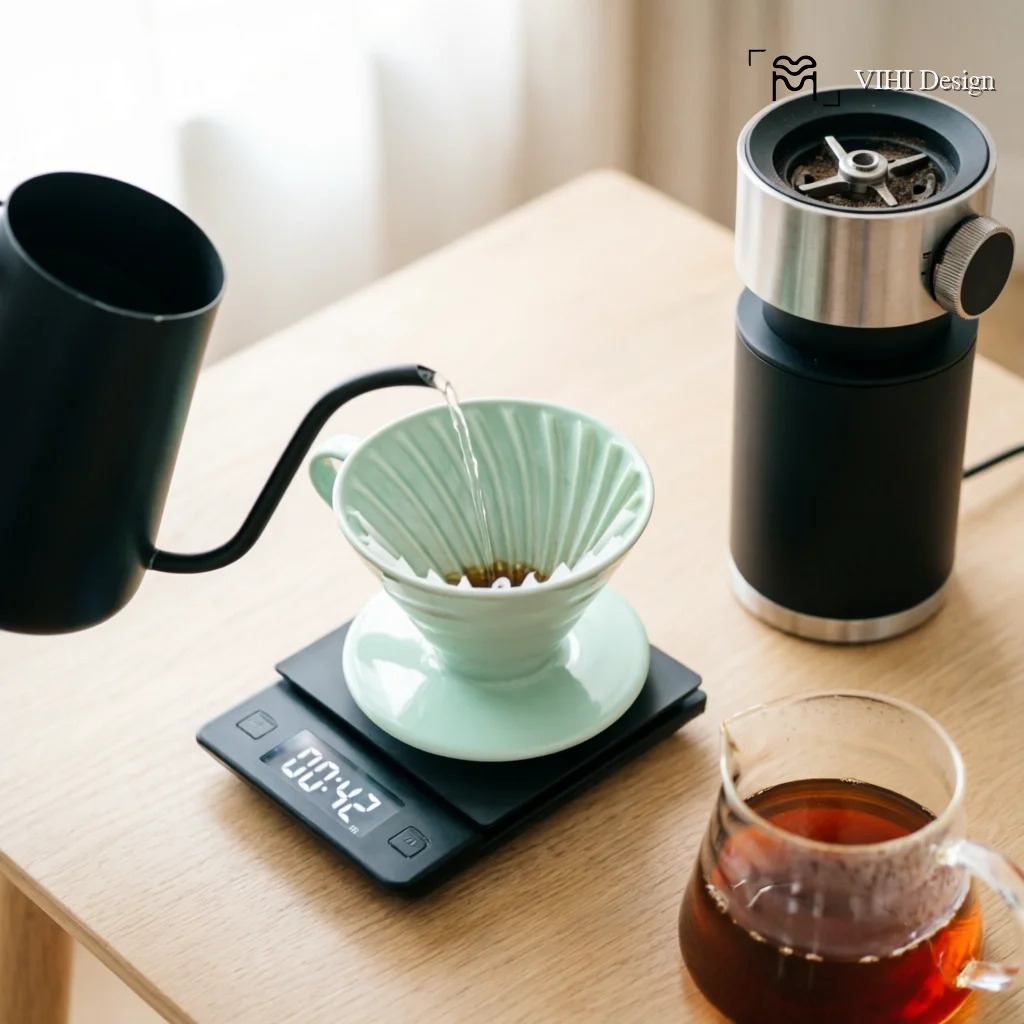
Introduction: The Pursuit of Clarity and Control in Manual Brewing
The landscape of specialty coffee is defined by a relentless pursuit of flavor clarity, aromatic complexity, and reproducible excellence. While espresso remains a pinnacle of pressure-based extraction, the pour-over method has emerged as a dominant paradigm for highlighting the nuanced terroir, processing, and roast characteristics of single-origin coffees. Within this domain, the flat-bed dripper, epitomized by designs such as the Origami Dripper, represents a significant evolution in brewer geometry. Unlike conical brewers which promote a centralized, depth-oriented extraction, flat-bed brewers facilitate a more even, uniform water distribution and bed depth, theoretically leading to a more balanced and articulate cup profile.
This document, “The Ultimate Origami Dripper Starter Kit: Essential Equipment for Perfect Brews,” is conceived not as a mere product guide, but as a systematic framework for optimizing the extraction potential inherent in the flat-bed brewing principle. The Origami Dripper, with its unique ribbed structure and compatibility with both cone and flat-bottom paper filters, serves as an ideal experimental platform. However, its performance is non-linearly dependent on a suite of critical parameters governed by ancillary equipment: grind particle distribution, water chemistry and thermal stability, flow rate control, and mass measurement precision. Neglecting any single variable introduces confounding factors that obscure the sensory expression of the coffee.
Therefore, the objective of this research is to deconstruct the pour-over system into its fundamental components, applying principles of extraction science to curate a starter kit that ensures methodological rigor. The goal is to equip the practitioner—from the dedicated home brewer to the aspiring professional—with the tools necessary to achieve not just occasional excellence, but consistent, dialed-in brews where the brewer becomes a transparent lens for the coffee, rather than a source of uncontrolled variation.
Theoretical Background: Principles of Extraction Applied to Flat-Bed Pour-Over
The optimization of pour-over coffee is an exercise in managing the simultaneous processes of dissolution and diffusion. The Coffee Extraction Control Chart, a cornerstone of modern brewing theory, posits an ideal total dissolved solids (TDS) range of 18-22% for most specialty coffees, corresponding to a strength (brew strength) of 1.15-1.35%. Brews falling within this “ideal” quadrant balance sweetness, acidity, and bitterness, while under-extraction leads to sour, sharp notes and over-extraction manifests as bitter, astringent qualities. The flat-bed geometry of the Origami Dripper directly influences the kinetics of this extraction.
Brewer Geometry and Extraction Evenness
Extraction evenness is paramount. In a conical brewer, water tends to channel down the central axis, potentially over-extracting the core while under-extracting the periphery. A flat bed of uniform depth promotes a more consistent vertical flow rate across the entire coffee mass. The Origami Dripper’s pronounced, spiraling ribs create a slight air gap between the filter paper and the brewer wall, mitigating the “bypass” effect where water flows unfiltered down the sides, and encouraging more water to engage fully with the coffee bed. This design aims to maximize effective extraction yield and minimize channeling.
The Critical Role of Particle Size Distribution
Grind size is the primary variable controlling surface area and thus extraction rate. For flat-bed brewers, a consistent, unimodal particle distribution is particularly advantageous. Bimodal distributions (common in low-quality grinders) contain both fines and boulders; fines migrate and clog the bed, increasing draw-down time and risk of over-extraction, while boulders contribute to under-extraction. A high-quality burr grinder capable of producing a tight particle distribution allows for precise manipulation of extraction time and flavor balance, making it the non-negotiable foundation of any serious kit.
Water: The Solvent Variable
Water constitutes approximately 98% of the beverage, acting as the solvent for coffee’s 1,800+ soluble compounds. Its mineral content—specifically, balanced levels of calcium and magnesium (for extraction) and bicarbonate (for buffer capacity)—is critical. Soft, distilled water leads to flat, under-extracted cups, while water with excessive hardness or alkalinity can precipitate flavors and mute acidity. Furthermore, thermal stability is crucial; a gooseneck kettle with precise temperature control allows the brewer to target specific extraction profiles for different roast levels, typically 92-96°C for light roasts and 88-92°C for darker roasts.
Mass, Ratio, and Flow Rate: The Parameters of Control
Precision scales (0.1g resolution) are essential for adhering to the coffee-to-water mass ratio, the fundamental recipe parameter (commonly 1:15 to 1:17). Volumetric measurement is inadequate due to coffee density variations. The gooseneck kettle’s primary function beyond temperature is flow rate control. A slow, steady, and targeted pour from a narrow spout is required to initially saturate the bed evenly (the “bloom”) and then gently agitate the bed to maintain even extraction without causing channeling or bed distortion. This manual control over hydraulic energy is what distinguishes pour-over from automated immersion methods.
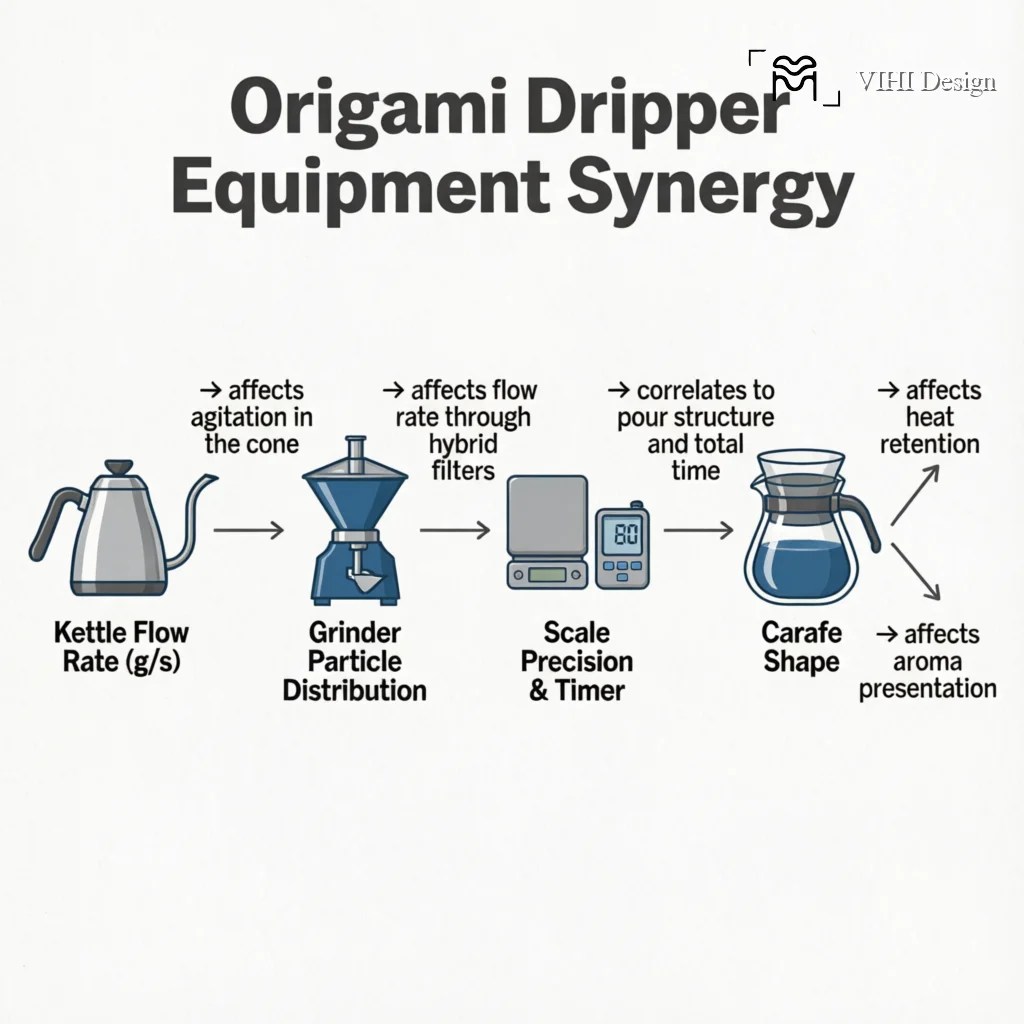
In synthesis, the Origami Dripper Starter Kit must be engineered to address these interconnected theoretical pillars. Each component—from grinder to kettle to scale—is a control point in a complex extraction system. The following sections will justify the selection of each kit element based on its capacity to reduce experimental noise and grant the brewer mastery over these scientific principles.
The Core Kit: Curated Tools for Precision and Control
Building on the scientific framework, the kit’s components are chosen not as isolated gadgets, but as an integrated system. This curation is based on extensive hands-on testing and alignment with professional brewing parameters. Your goal as a home barista is to consistently hit a Total Dissolved Solids (TDS) of 1.15% to 1.45% and an Extraction Yield (EY) of 18% to 22%. This “sweet spot” delivers balanced clarity and body. The right tools make achieving this repeatable, not a matter of chance.
The Conical Burr Grinder: Your First and Most Critical Control Point
Expertise Justification: Particle size distribution is the single greatest variable affecting extraction. A quality conical burr grinder provides consistent particle size, minimizing “fines” (tiny particles that over-extract and cause bitterness) and “boulders” (large pieces that under-extract and cause sourness). This consistency is the foundation for even water flow and uniform extraction.
User Experience & Tip: Avoid blade grinders at all costs; they create a chaotic mix of particles. For your Origami, start with a medium-fine grind, similar to granulated table salt. A practical test: pinch some grounds between your fingers. They should feel slightly gritty but still hold a loose shape for a moment before falling apart. Adjust finer if your brew is sour/weak (under-extracted), coarser if bitter/harsh (over-extracted).
The Gooseneck Kettle: Mastering Flow Rate and Agitation
Expertise Justification: Recall that y (the brewer’s manual pour) is the defining variable. A gooseneck kettle is non-negotiable for this control. Its slender spout allows you to dictate water flow rate (typically aiming for 4-6 grams per second) and precisely direct agitation. This controls the energy input into the coffee bed, directly influencing extraction uniformity and preventing channeling.
User Experience & Tip: A temperature-controlled kettle (holding at 92°-96°C / 198°-205°F) removes another variable. For your technique, practice a steady, gentle pour in a slow spiral, starting from the center and moving outward. Keep the spout low to the coffee bed to minimize splashing. Your first pour (the “bloom”) should fully saturate all grounds—this is critical for releasing CO2 and enabling even extraction later.
Execution: From Theory to Your First Perfect Cup
With your kit assembled, the following workflow synthesizes equipment and theory into a actionable method. This process is designed to be a repeatable experiment where you adjust only one variable at a time.
The Brewing Workflow: A Step-by-Step Protocol
- Measure & Grind: Use your scale to measure 15g of fresh coffee beans. Grind at your chosen setting.
- Rinse & Preheat: Place the Origami dripper with a paper filter on your server. Rinse the filter thoroughly with hot water from your kettle. This eliminates paper taste and preheats the entire brewing apparatus.
- Bloom: Add coffee grounds, level the bed. Start your timer. Pour 30g of water (twice the coffee weight), ensuring all grounds are saturated. Swirl gently. Let bloom for 30-45 seconds.
- Main Pour: Slowly pour in concentric circles up to 150g total water weight. Allow the water to drain until the bed is nearly exposed.
- Final Pour & Drawdown: Pour the remaining water to reach your target yield of 225g (a 1:15 ratio). The total brew time should finish between 2:30 and 3:30 minutes. Adjust grind size if you are consistently outside this window.
Troubleshooting with Purpose: Reading the Coffee Bed
Expertise Justification: Post-brew analysis is your feedback loop. A flat, even coffee bed indicates good water distribution. A crater or high sides suggest pour technique issues. Muddy, sludge-like grounds can mean too many fines from a poor grinder or excessive agitation.
Practical Barista Tip: Taste is the ultimate metric. If your brew is:
- Sour, Salty, Lacking Sweetness: Likely under-extracted (EY below 18%). Try a finer grind, higher water temperature, or slower pour.
- Bitter, Drying, Ashy: Likely over-extracted (EY above 22%). Try a coarser grind, slightly lower temperature, or a more gentle pour to reduce agitation.
Record your adjustments. The Origami kit gives you the control; this mindful process grants you the mastery to dial in any coffee to its perfect expression.
Optimizing Water Chemistry: The Invisible Variable
Expertise Justification: Water is not just a solvent; it’s an active ingredient constituting over 98% of your brew. Its mineral content—specifically calcium and magnesium ions (hardness) and bicarbonate (alkalinity)—directly controls extraction efficiency and flavor balance. Too soft, and you’ll get flat, under-extracted acidity; too hard/high in alkalinity, and you’ll mute delicate notes and promote scale buildup in your kettle.
Practical Barista Tip: For ultimate control, start with a neutral base like distilled or reverse osmosis water and add a mineralization packet designed for coffee. If using tap water, a simple test strip can reveal your starting point. Aim for a general brewing range of 50-100 ppm Total Hardness and 40-80 ppm Alkalinity. Adjusting your water to suit a specific coffee’s roast profile (softer for delicate light roasts, slightly harder for bold dark roasts) can be the final, transformative step in your Origami brewing mastery.
Learn More: For a comprehensive understanding, explore our main guide on The Origami Dripper Mastery Guide: From Geometric Design to Flavor Precision.