
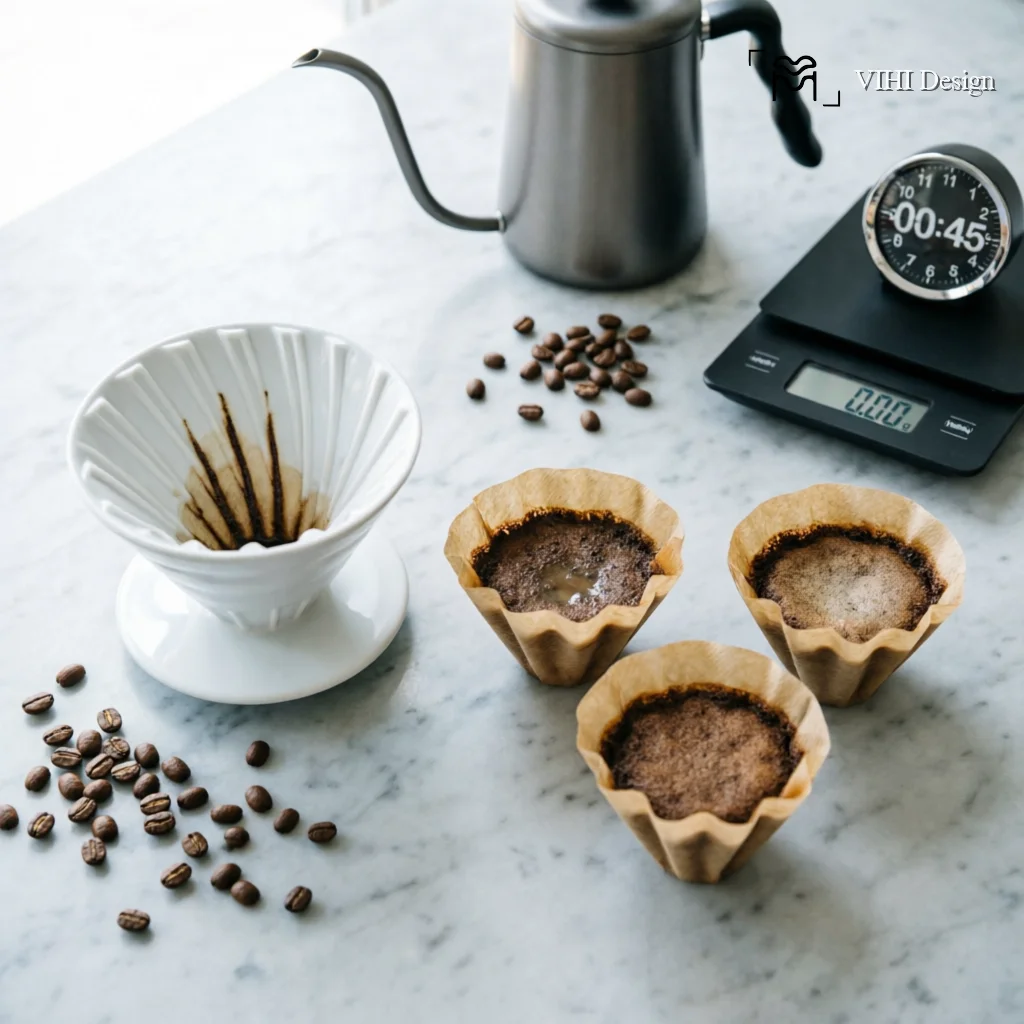
On the Optimization of Brew Parameters in Conical Paper-Filter Drippers: A Case Study on Common User Errors with the Origami Dripper
Introduction
The pursuit of the optimal cup of specialty coffee has driven significant innovation in manual brew methods, with pour-over techniques occupying a central role in both consumer and professional spheres. Among the diverse array of drippers available, the Origami Dripper represents a unique synthesis of design and function. Its distinctive fluted, conical structure, compatible with both flat-bottom and conical paper filters, offers a versatile platform for extraction. However, this very versatility introduces a complex parameter space where user technique becomes a critical, and often unregulated, variable. While the specialty coffee community has extensively documented the theoretical principles of extraction (e.g., the Coffee Brewing Control Chart), a persistent gap exists in translating these principles into robust, error-resistant practices for specific brew devices.
This paper posits that the perceived inconsistency or suboptimal results often attributed to the Origami Dripper are frequently not a function of the device itself, but of systematic user errors in three key operational domains: filter preparation and seating, pour dynamics and agitation, and thermal management. These errors introduce uncontrolled variables that disrupt the uniform, predictable extraction necessary for highlighting the nuanced flavor profiles of high-quality, lightly roasted coffees.
Therefore, the objective of this analysis is to identify, deconstruct, and provide empirically-grounded corrective protocols for these three common mistakes. By applying established principles of coffee extraction science to the specific geometry and material properties of the Origami Dripper, we aim to transform user practice from a source of variance to a pillar of reproducible quality.
Theoretical Background
The extraction of coffee is a complex physicochemical process governed by the dissolution and diffusion of soluble compounds from roasted, ground coffee particles into water. The quality of the resultant beverage is primarily a function of Extraction Yield (EY)—the percentage of the coffee mass dissolved into the cup—and Solubles Concentration (TDS). The ideal target range of 18-22% EY and 1.15-1.45% TDS, as defined by the Specialty Coffee Association, provides a scientific framework for optimization. Deviation from this “ideal” zone, often due to channeling (preferential flow paths) or bypass (water flowing around the coffee bed), leads to simultaneous under-extraction of sour, salty notes and over-extraction of bitter, astringent compounds.
Key Principles Governing Pour-Over Performance
Several interrelated principles are paramount for understanding optimal Origami Dripper operation:
1. Uniform Saturation and Flow Dynamics: A conical filter’s performance hinges on creating a hemispheric coffee bed where water enters at the apex and permeates radially outward and downward. Any disruption to bed integrity—such as a poorly seated filter creating a gap, or uneven pouring causing erosion—compromises this flow. Channeling occurs when water finds a path of least resistance, leading to localized over-extraction, while the surrounding grounds undergo under-extraction.
2. The Role of Agitation: Agitation, induced by pouring force or pattern, is a primary tool for increasing extraction uniformity and efficiency. It disrupts the coffee bed, preventing grounds from clumping and ensuring all particles are exposed to water. However, excessive or misdirected agitation can cause fines migration to the filter bottom, creating a dense, impermeable layer that drastically slows drawdown and leads to over-extraction.
3. Thermal Mass and Stability: The ceramic construction of the Origami Dripper possesses significant thermal mass. Without proper pre-heating, this mass acts as a heat sink, robbing the brew water of critical thermal energy during the initial, most soluble phase of extraction. Brew water temperature is a first-order kinetic driver; a drop of even 3-5°C at the coffee bed can significantly reduce extraction efficiency, yielding a flat, underdeveloped cup.
4. Filter Interaction: The choice between conical (V60-style) and flat-bottom (Kalita-style) filters in the Origami Dripper alters the geometry of the coffee bed and the flow rate. Conical filters promote a faster, more focused flow, while flat-bottom filters encourage a slower, more uniform percolation. Each requires subtle adjustments in grind size and pouring technique to achieve equivalent extraction outcomes.
Hypothesis
Based on this theoretical framework, it is hypothesized that the three most detrimental yet correctable mistakes in Origami Dripper usage are: (A) inadequate filter preparation and seating, leading to bypass and unstable bed structure; (B) non-optimized pour dynamics, resulting in either channeling or fines migration; and (C) failure to manage the thermal mass of the brewer, causing a non-isothermal extraction environment. Addressing these errors with specific, principle-based protocols will significantly increase brewing consistency and cup quality.
3 Common Origami Dripper Mistakes That Ruin Your Coffee (And How to Fix Them)
In Part 1, we identified the three critical, correctable mistakes that hinder your Origami Dripper’s potential: inadequate filter prep, non-optimized pour dynamics, and poor thermal management. Now, let’s move from diagnosis to cure. By applying these principle-based fixes, you’ll transform your process, achieving the sweet spot of extraction—a Total Dissolved Solids (TDS) of 1.15% to 1.45% and an Extraction Yield (EY) of 18% to 22%—for a balanced, complex, and delicious cup every time.
Mistake A: The Fix for Inadequate Filter Preparation
The fluted, conical design of the Origami is its genius, but it demands a perfectly seated filter. A gap or fold isn’t just cosmetic; it’s a highway for water to bypass the coffee grounds, leading to uneven, weak extraction. Here’s how to lock it in.
The Barista Protocol: First, always use the correct filter. The Origami works beautifully with both cone-shaped (Hario V60-style) and flat-bottom (Kalita Wave-style) papers, but each requires a slightly different approach. For cone filters, place the dripper on your server or mug, insert the filter, and use a generous amount of hot water (200°F/93°C+) to fully saturate it. Pour in a spiral, ensuring water contacts every pleat. This does three things: it rinses the paper taste, heats the brewer, and most importantly, the hydraulic pressure of the water seals the filter to the ribs of the dripper. Let the water fully drain before adding coffee. For flat-bottom filters, pay extra attention to the base, ensuring it’s fully opened and seated against the brewer’s walls.
Mistake B: Mastering Pour Dynamics to Avoid Channeling
Channeling and fines migration are two sides of the same coin: uncontrolled water flow. The Origami’s wide opening and sharp ribs are designed for high, even flow, but this requires intentional pouring.
The Barista Protocol: Your goal is to maintain a flat, stable coffee bed. After your bloom (using 2-3x the coffee weight in water, agitating gently to ensure all grounds are wet), begin your main pours.
- Pour Height & Speed: Keep your kettle spout 2-4 inches above the bed. A higher pour increases agitation, which can be useful early on to ensure even extraction, but a lower, gentler pour is better for the final stages to settle fines. Pour at a steady, moderate rate—aim to complete your total water volume in 2-4 pours, depending on your recipe.
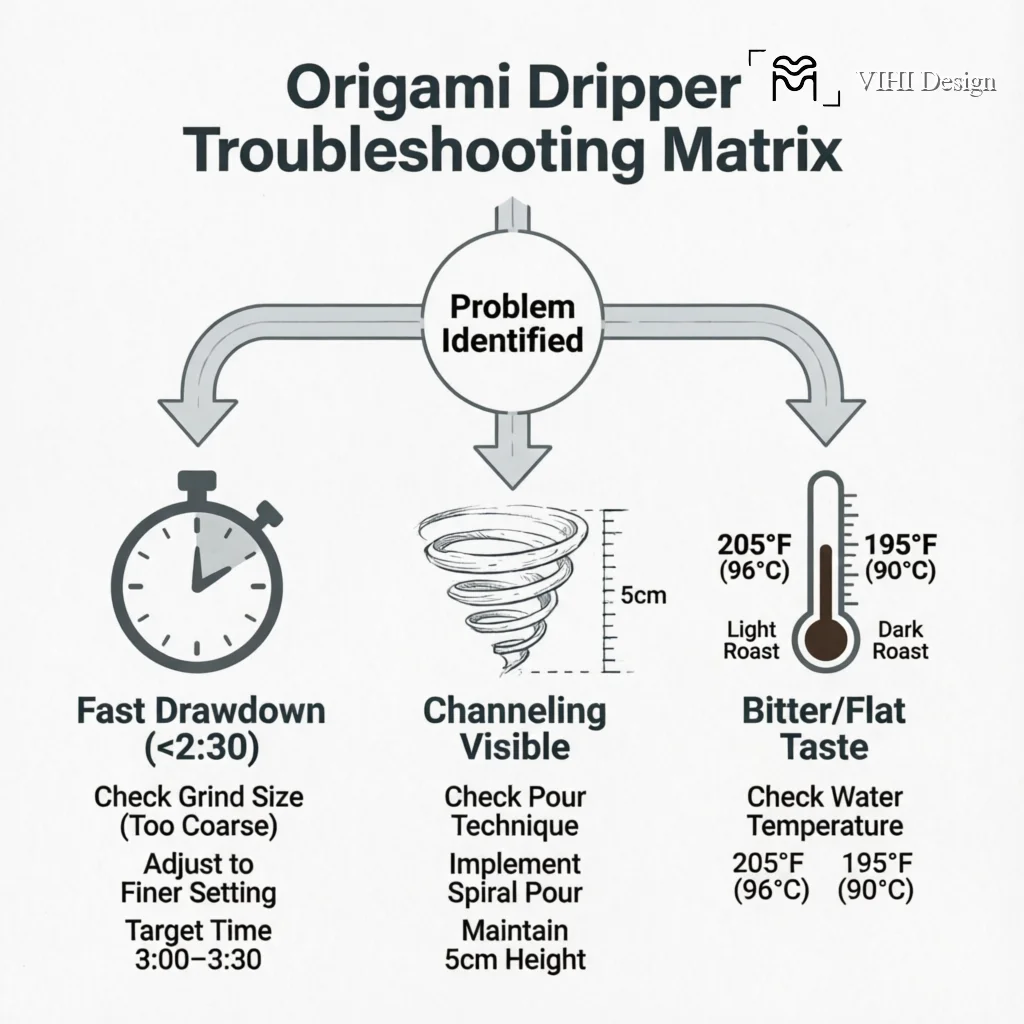
- Pour Pattern: Start at the center and spiral outward to about 1cm from the edge, then spiral back in. Avoid pouring directly onto the filter paper. This circular motion, combined with the dripper’s ribs, promotes a consistent draw-down and prevents side-channeling.
- Observe the Bed: Between pours, let the water level drop to about ¼ inch above the bed. This “pulse pouring” gives you control over agitation and temperature. A finished bed should be flat or slightly domed, not cratered or mounded.
Mistake C: Winning the Battle Against Thermal Mass
The Origami’s beautiful ceramic or resin construction holds heat—but that can work against you if not managed. A cooling brewer creates a declining temperature profile, unevenly extracting compounds and leading to a flat, underwhelming cup.
The Barista Protocol: You must create an isothermal (consistent temperature) environment. Pre-heating is non-negotiable. The rinse step for your filter is your first weapon. Use more water than you think—at least 150g of boiling water. Let it sit for 30 seconds before draining. This brings the entire brewer up to temperature.
Your second weapon is a pre-heated server or mug. Pouring into a cold vessel will shock and cool the coffee immediately. Rinse it with hot water too.
Your third weapon is a kettle at the right temperature. Start with water off the boil (205°F/96°C for most light to medium roasts). Because the brewer is fully pre-heated, the slurry temperature will remain in the ideal 195°F-205°F (90°C-96°C) range for the entire brew, ensuring a complete and even extraction.
Putting It All Together: Your Path to Consistency
Fixing these mistakes isn’t about memorizing a single recipe; it’s about understanding the principles of even extraction, flow, and heat. When you properly seat your filter, you establish the foundation for even water passage. When you master your pour, you become the conductor of that flow, guiding it evenly through the coffee bed. When you manage thermal mass, you ensure every part of the extraction happens under ideal conditions.
Start by integrating one fix at a time into your routine. Taste the difference. Use the TDS and EY ranges as your compass, not your cage—they indicate when your technique is producing a balanced extraction. With practice, these protocols will become second nature, unlocking the full, vibrant potential of your Origami Dripper and the exquisite coffee it can produce. Happy brewing!
Learn More: For a comprehensive understanding, explore our main guide on The Origami Dripper Mastery Guide: From Geometric Design to Flavor Precision.