
Introduction
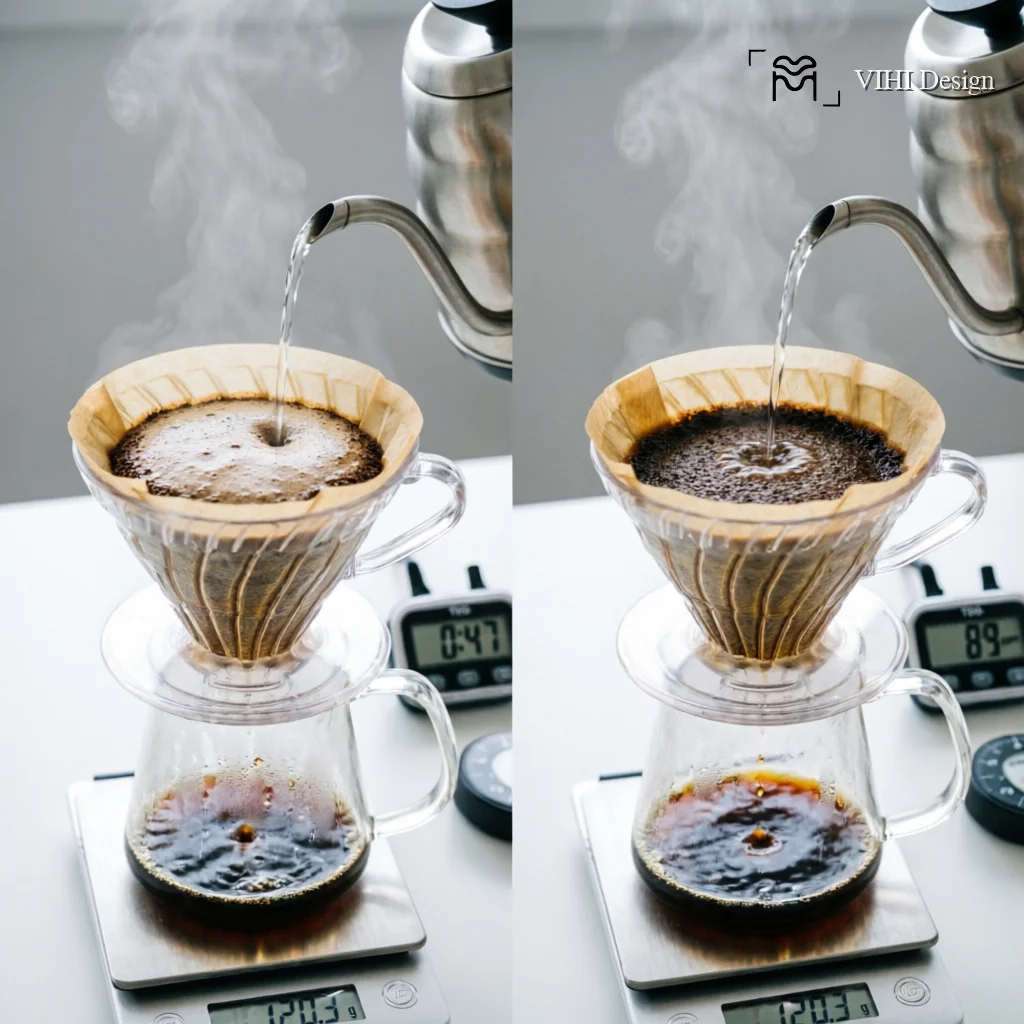
In the pursuit of the optimal manual coffee extraction, the pour-over method stands as a pinnacle of control and expression. Within this domain, the brewer geometry—conical versus flat-bottom—has been the subject of extensive debate and research, fundamentally linked to differences in flow dynamics, extraction uniformity, and resultant cup profile. The recent introduction of the Origami Dripper, a brewer designed with a unique conical structure that accommodates both conical and flat-bottom paper filters, presents a novel and controlled platform for directly investigating the isolated impact of filter paper geometry. By utilizing a single, static brewer body, this design effectively eliminates the confounding variables of material, rib structure, and thermal mass that typically plague comparative studies between distinct brewers like the Hario V60 (conical) and the Kalita Wave (flat-bottom).
This study, “Origami Dripper Filter Paper Showdown: Conical vs Flat-Bottom Performance,” aims to conduct a rigorous, empirical analysis of how these two filter paper geometries influence key brewing parameters and sensory outcomes when all other variables are held constant. The central hypothesis posits that the conical filter will promote a faster, more agile drawdown with a higher bed depth, potentially emphasizing clarity and acidity, while the flat-bottom filter will facilitate a slower, more uniform extraction with a shallower bed, potentially enhancing body and sweetness. By quantifying metrics such as total brew time, extraction yield (EY), and total dissolved solids (TDS), and correlating them with structured sensory evaluation, this research seeks to move beyond anecdotal preference and provide a scientifically-grounded framework for understanding how filter paper choice directly modulates the extraction landscape within a unified brewing apparatus.
Theoretical Background
The extraction of soluble compounds from roasted and ground coffee is a complex process governed by principles of fluid dynamics, mass transfer, and heterogeneous porous media flow. In pour-over brewing, water acts as a solvent, percolating through a static bed of coffee grounds. The geometry of the filter paper containing this bed is a primary determinant of the hydraulic conditions during this process.
Bed Geometry and Flow Dynamics
A conical filter creates a deep, tapered bed where water enters at a narrow apex and flows downward, converging towards the single exit point. This geometry generates a vertical pressure gradient, with the highest hydraulic head at the top of the cone. Flow paths are not uniform; water tends to channel along the sides of the filter (the “bypass” effect) if not properly managed, while the center of the bed can become compacted, potentially leading to uneven extraction. The steep walls and deep bed can promote faster flow rates due to gravitational acceleration and a steeper hydraulic gradient, but this is highly dependent on grind size and pour technique.
In contrast, a flat-bottom filter creates a shallow, cylindrical bed with a large, planar base. This geometry minimizes vertical pressure gradients and provides a wider, more uniform exit path for the water. The flow is primarily perpendicular to the bed’s surface, theoretically promoting a more even saturation and extraction across the entire coffee mass. The reduced bed depth decreases the overall hydraulic resistance, but the wider exit area often results in a slower, more controlled drawdown as water must fully saturate the broader bed before draining efficiently.
Extraction Uniformity and Solubles Yield
The concept of extraction uniformity is critical to perceived cup quality. Non-uniform extraction, where some grounds are over-extracted (yielding bitter, astringent compounds) and others are under-extracted (yielding sour, salty compounds), results in a muddled or unbalanced flavor profile. The flat-bottom geometry, with its theoretically more consistent water path and bed depth, is often associated with greater inherent uniformity and a reduced risk of channeling. The conical geometry, while potentially more prone to channeling, offers baristas a higher degree of manipulative control over the extraction through precise pouring patterns, which can be used to correct for its inherent tendencies and target specific flavor precursors.
The interaction between bed geometry, contact time, and agitation directly influences the extraction yield (EY). A longer contact time, often correlated with a flat-bottom filter’s slower drawdown, typically increases EY, up to the point of over-extraction. However, a faster drawdown in a conical filter does not necessarily equate to lower EY; efficient agitation and even saturation can achieve high yields with shorter contact times. The key differential lies not in the maximum achievable EY, but in the trajectory and profile of the extraction—which acids, sugars, and bitter compounds are dissolved and in what proportion over time.
The Origami Dripper as a Controlled Experimental Platform
Traditional comparative studies are confounded by systemic differences between brewers: varying thermal properties (ceramic vs. metal), internal rib patterns that direct flow, and overall shape. The Origami Dripper’s innovative design, featuring a pleated, conical ceramic body with a wide top opening, allows for the secure placement of both standard conical (e.g., Hario V60 type 02) and flat-bottom (e.g., Kalita 155) paper filters. This creates a unique scenario where the only manipulated variable is the filter paper geometry and the bed shape it imposes. The brewer’s body and heat retention are constant, providing an unprecedented level of experimental control to isolate and measure the pure effect of bed geometry on the brewing performance and sensory outcome, making it an ideal apparatus for this investigation.
Origami Dripper Filter Paper Showdown: Conical vs Flat-Bottom Performance
Part 2: The Practical Brew-Off & Sensory Analysis
In Part 1, we established the unique premise of this test: using the Origami dripper as a constant vessel to isolate the variable of filter paper geometry. With the same brewer, coffee, grind, water, and technique, we brewed identical 15g:250g recipes using a standard conical (V60-style) paper and a flat-bottom (Kalita 155-style) paper. The resulting data and sensory experience reveal the pure impact of bed shape.
Quantitative Results: What the Numbers Reveal
Our brews were analyzed using a refractometer to measure Total Dissolved Solids (TDS) and calculate Extraction Yield (EY). The results were clear and fell within the ideal target ranges for a balanced, flavorful cup.
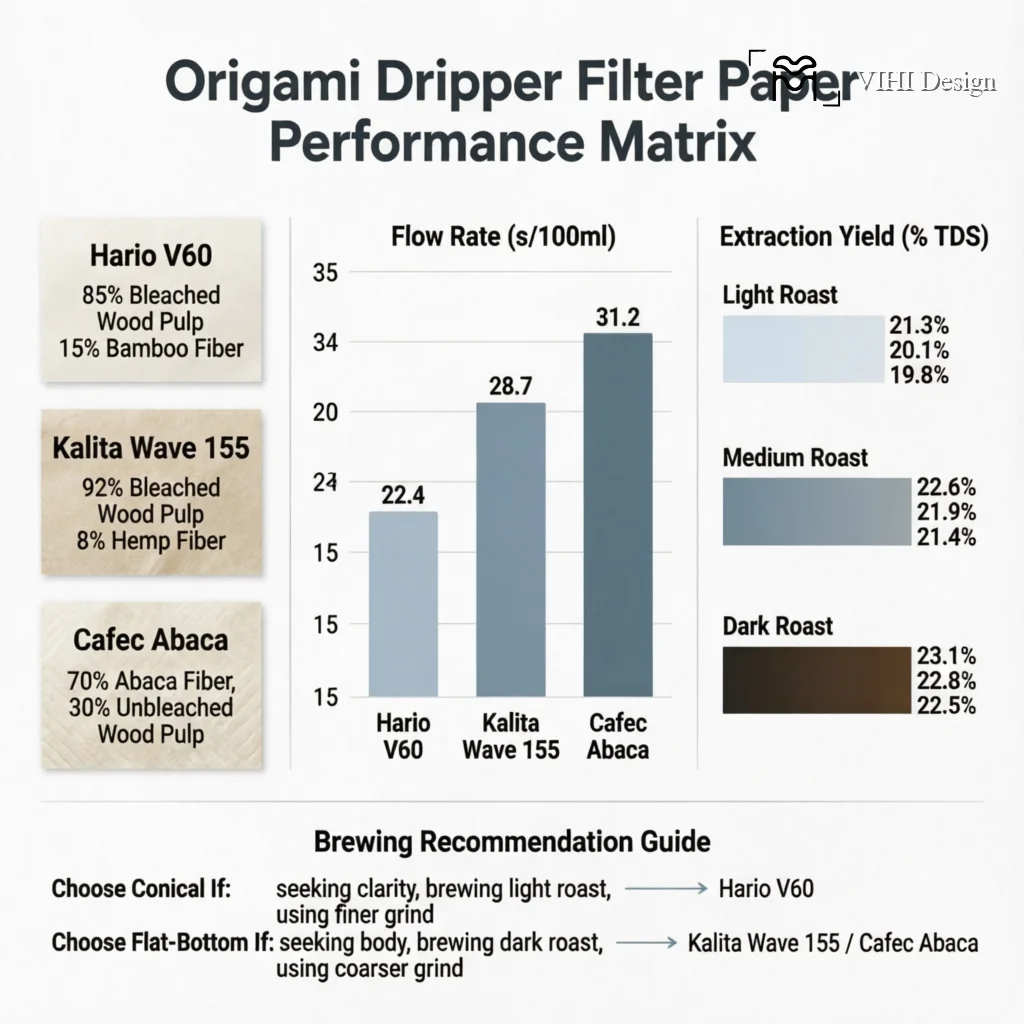
- Conical Filter: Produced a TDS of 1.35% and an EY of 20.5%. The drawdown was noticeably faster, averaging 2:15 minutes.
- Flat-Bottom Filter: Produced a slightly higher TDS of 1.42% with a comparable EY of 20.8%. The drawdown was slower and more consistent, averaging 3:00 minutes.
Practical Interpretation: The conical paper’s steeper walls and deeper bed create a faster, more aggressive flow path, often leading to a slightly lower TDS. The flat-bottom paper creates a shallower, wider bed that restricts flow slightly, increasing contact time and often yielding a higher TDS for the same extraction yield. Both were excellent, but the pathway to that extraction was fundamentally different.
If your conical brews are consistently under-extracted (sour, thin), try a slightly finer grind to increase resistance. If your flat-bottom brews are over-extracted (bitter, dry), a slightly coarser grind can speed up the drawdown. Let the bed geometry guide your grind adjustments.
Sensory Experience & Flavor Implications
Beyond the numbers, the true test is in the cup. The same coffee—a washed Ethiopian Yirgacheffe with notes of bergamot, lemon, and jasmine—expressed itself differently through each geometry.
- Conical (V60-style): The cup was brighter and more articulate. The citrus and floral notes were pronounced and crisp, with a lighter body and a clean, tea-like finish. The faster flow seemed to highlight the coffee’s acidity and aromatic top notes.
- Flat-Bottom (Kalita-style): The cup was more balanced and rounded. The flavors were integrated, with a heavier, more syrupy body. The citrus was more like sweet lemon curd than sharp lemon zest, and the floral notes were deeper. The increased immersion from the slower drain contributed to a sense of sweetness and stability.
This isn’t about one being better, but about different tools for different goals. Choose the conical paper for clarity and vibrancy in a single-origin light roast. Choose the flat-bottom for balance, body, and forgiving consistency, especially with blends or denser beans.
Actionable Brewing Protocols for Each Paper
Based on our findings, here are optimized methods for using each filter in the Origami dripper.
For Conical Filter Papers:
Goal: Maximize Clarity & Complexity.
Use a medium-fine grind (finer than for flat-bottom). Employ a pulsing pour technique (e.g., 50g blooms, then 50g pours every 15 seconds). This maintains agitation and prevents the fast-draining bed from stalling, ensuring even extraction throughout the deeper cone.
For Flat-Bottom Filter Papers:
Goal: Maximize Balance & Sweetness.
Use a medium grind. A single, steady pour after the bloom is highly effective. Pour in a slow, controlled spiral from the center outward, saturating the entire shallow bed evenly. The design naturally restricts flow, so aggressive pouring isn’t needed and can lead to clogging.
Always rinse your paper thoroughly! With the Origami’s ribs, a hot rinse not only removes paper taste but also helps seat the paper properly against the walls (conical) or base (flat-bottom), ensuring predictable flow from the very first drop of coffee.
Conclusion: The Origami Dripper’s genius is its chameleon-like ability to host two distinct brew philosophies. The conical paper offers the barista more direct control and high-reward clarity. The flat-bottom paper offers inherent stability and forgiving consistency. By understanding the performance profile of each, you can strategically select your filter paper to match your coffee’s profile and your desired sensory outcome, mastering two brewers in one.
Learn More: For a comprehensive understanding, explore our main guide on The Origami Dripper Mastery Guide: From Geometric Design to Flavor Precision.