
Origami Dripper vs V60 vs Kalita Wave: A Comparative Analysis of Brewing Dynamics
Introduction
The pour-over method represents a pinnacle of manual coffee brewing, emphasizing clarity, nuance, and brewer control. Within this domain, the choice of dripper is not merely aesthetic; it is a fundamental variable that dictates extraction kinetics and, ultimately, sensory profile. While the Hario V60 and Kalita Wave have established themselves as canonical references in both specialty coffee shops and research, the recent introduction of the Origami Dripper presents a novel hybrid design that challenges traditional categorization. This paper seeks to conduct a systematic, comparative analysis of these three distinct brewers: the conical, single-hole V60; the flat-bottomed, multi-hole Kalita Wave; and the versatile, hybrid-conical Origami Dripper. The primary objective is to elucidate the theoretical and practical implications of their geometric and hydrodynamic differences on key brewing parameters—flow rate, extraction uniformity, and thermal management—to provide a scientific framework for brewer selection based on desired sensory outcomes.
Theoretical Background
The extraction of coffee is a complex process involving the dissolution and diffusion of soluble solids from roasted, ground coffee particles into water. In pour-over brewing, this process is governed by a series of interrelated physical principles, with dripper geometry serving as a critical constraint.
Hydrodynamics and Flow Rate
The flow rate of water through the coffee bed is a primary determinant of contact time and extraction. It is described by Darcy’s law for flow through porous media, where the rate is proportional to the pressure head and the permeability of the bed, and inversely proportional to the fluid viscosity. Dripper design directly influences the exit flow condition. A single, large aperture (e.g., V60) creates a point sink, leading to a faster, more variable flow rate highly dependent on grind size and barista technique. In contrast, multiple smaller apertures (e.g., Kalita Wave) distribute the exit points, creating a more consistent, restricted flow that is less sensitive to grind variation and promotes a more predictable brew time.
Bed Geometry and Extraction Uniformity
The shape of the coffee bed—conical versus flat-bottomed—profoundly affects the water’s path and the uniformity of extraction. In a conical brewer, water follows a path of increasing cross-sectional area as it descends, which can lead to channeling along the walls if pouring is not meticulously controlled (a phenomenon described by the “bypass” effect). A flat bed, as in the Kalita Wave, presents a more consistent cross-section, promoting an even vertical flow front and reducing the risk of preferential channels, theoretically leading to more uniform extraction across the entire particle size distribution.
Thermal Mass and Heat Loss
Maintaining an optimal brew temperature (typically 92-96°C) is crucial for efficient extraction. The material (ceramic, glass, plastic, metal) and mass of the dripper act as a heat sink. Thick ceramic brewers require significant pre-heating to avoid heat loss, while thinner plastic or metal designs exhibit lower thermal mass. Furthermore, an exposed conical design (V60, Origami) has a greater surface area for convective and radiative heat loss compared to a brewer that nests closely into a cup or carafe (Kalita Wave).
The Hybrid Design Paradigm
The Origami Dripper introduces a unique variable: modular bed geometry. Its fluted, origami-inspired structure allows it to accommodate both conical and flat-bottomed paper filters. This design effectively decouples the dripper’s structural form from the filter’s bed shape, enabling a single device to simulate the hydrodynamic conditions of both a V60 (with a conical filter) and a Kalita Wave (with a flat-bottomed filter). This presents a novel test case for isolating the effect of bed geometry from other variables like aperture design, as the exit holes (a series of small openings around the base) remain constant.
By examining these three brewers through the lenses of fluid dynamics, heat transfer, and extraction chemistry, we can move beyond anecdotal preference to a principled understanding of how design dictates function in pour-over coffee preparation.
Origami Dripper vs V60 vs Kalita Wave: Which Should You Choose?
In Part 1, we established the scientific framework. Now, let’s translate theory into practice. How do these geometric differences manifest in your cup, and more importantly, at your brewing station?
The Practical Pour: User Experience & Brew Workflow
Your interaction with each brewer is as crucial as its design. Here’s how they differ in daily use, informed by professional barista workflows.
Hario V60: The Conductor’s Tool
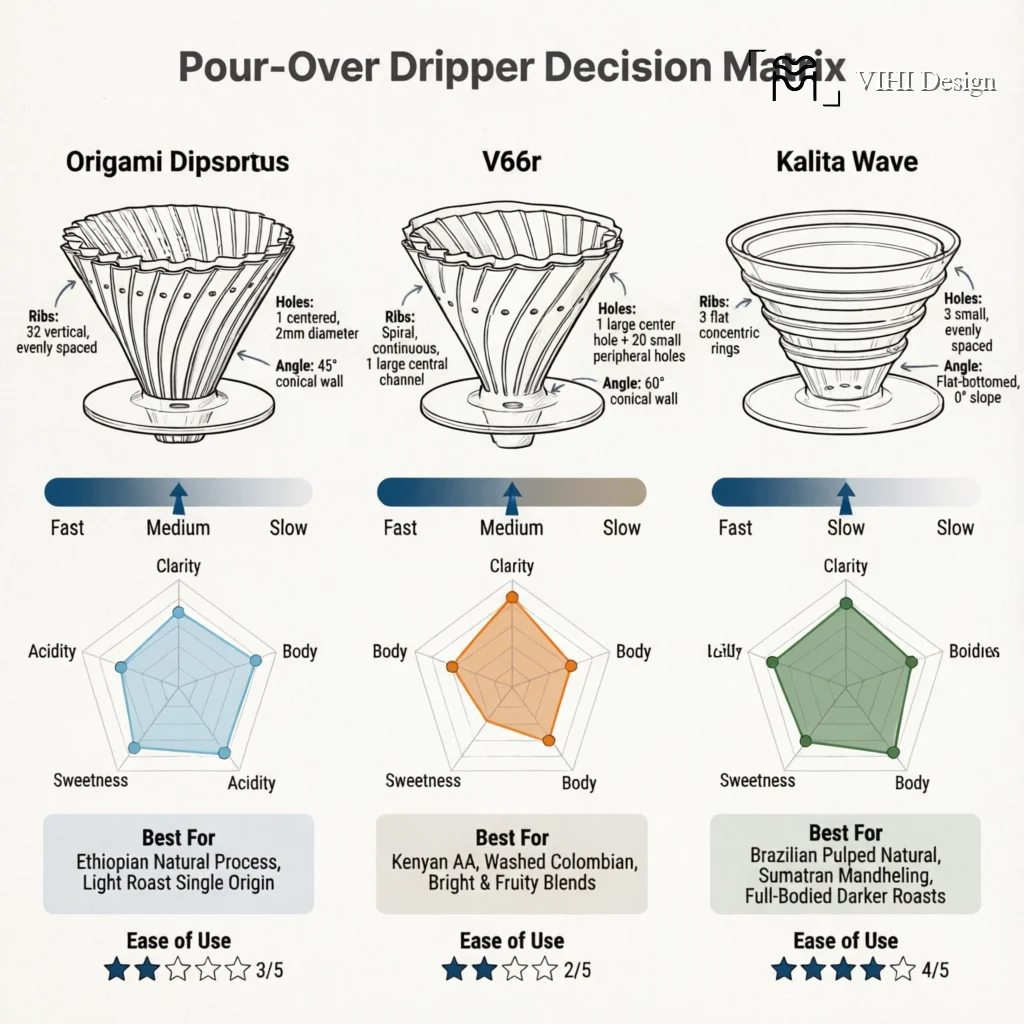
The V60 demands active management. Its large, single aperture and fast flow require a precise, controlled pour to avoid under-extraction. You are directly controlling the water level and agitation. This makes it rewarding for enthusiasts who enjoy mastering technique, but it has a steeper learning curve. Consistency relies heavily on the brewer’s skill.
Kalita Wave: The Steady Performer
The Kalita Wave is designed for consistency and forgiveness. The flat bed and restricted flow create a more predictable, immersion-like environment. It’s less sensitive to pouring technique, making it ideal for beginners, busy cafes, or anyone seeking reliable results with less fuss. The flat-bottom paper also tends to trap fewer fines, reducing risk of clogging.
Origami Dripper: The Flexible Hybrid
The Origami’s unique value is its paper compatibility. With cone papers (like V60), you get fast, high-clarity flow. With flat-bottom papers (like Kalita 155), you get a more restricted, even extraction. This lets you experiment with profile without a new brewer. The experience is a blend: it requires more technique than the Kalita but offers more variables to play with.
Interpreting Your Results: TDS, EY, and Flavor Profile
How do these workflows translate to measurable outcomes and, ultimately, taste? Let’s connect the dots to Total Dissolved Solids (TDS) and Extraction Yield (EY).
- V60 (High-Clarity Profile): Often excels at highlighting bright, delicate notes. It typically produces a cup with a moderate TDS (1.15% – 1.30%) but can achieve a full EY (20% – 22%) through skillful agitation, pulling out complex acids and florals without excessive body.
- Kalita Wave (Balanced/Full-Bodied Profile): Promotes even extraction and higher saturation, often yielding a cup with more body and consistent sweetness. It commonly lands in a slightly higher TDS range (1.25% – 1.40%) while maintaining a solid EY (19% – 21%). The flavor profile tends to be integrated and rounded.
- Origami Dripper (Variable Profile): Your results depend on your filter choice. With a cone filter, aim for V60-like TDS/EY targets. With a flat-bottom filter, expect Kalita-like results. This makes it a powerful tool for dialing in a specific bean to your preference.
The Final Verdict: Which Brewer Chooses You?
There is no single “best” brewer. The choice is a function of your goals, experience, and taste preference.
Choose the Hario V60 if: You enjoy the process of perfecting a technique, love bright, tea-like clarity, and want to highlight the nuanced top notes of very high-quality, lightly roasted coffees.
Choose the Kalita Wave if: You value consistency and forgiveness above all, prefer a balanced, sweet, and full-bodied cup, or are brewing in a high-volume or beginner-friendly environment.
Choose the Origami Dripper if: You are an experimenter who wants one tool to explore both conical and flat-bed extraction styles. It’s perfect for the curious home barista who enjoys tweaking variables and appreciates both design and function.
Ultimately, understanding the principles behind each design empowers you to make better coffee with any of them. Start with the brewer that matches your current approach, master it, and let your curiosity guide you to the next.
Material Matters: How Ceramic, Plastic, and Metal Affect Your Brew
Beyond shape and filter type, the construction material of your dripper is a critical, often overlooked variable. Each material interacts with heat differently, directly impacting extraction stability and the resulting cup profile.
Ceramic & Glass: These materials have high thermal mass, meaning they absorb a significant amount of heat from your water during pre-heating. Once saturated with heat, they provide excellent stability, minimizing heat loss throughout the brew. This leads to a consistent, even extraction, ideal for highlighting delicate aromatics. The trade-off is they require thorough pre-heating to avoid acting as a “heat sink” and cooling the slurry.
Plastic (e.g., Tritan): Plastic has very low thermal mass and conductivity. It requires minimal pre-heating, as it doesn’t steal heat from the brew water. This can result in a slightly higher average slurry temperature throughout the brew cycle compared to an under-preheated ceramic brewer. Many competition baristas favor plastic for this thermal efficiency and consistency, often yielding a brighter, more vibrant cup.
Stainless Steel: Metal is an excellent heat conductor. While it has moderate thermal mass, it can lose heat to the surrounding air more quickly than ceramic if the environment is cool. Its key advantage is extreme durability and, in models like the Kalita Wave, its ribbed design promotes consistent flow regardless of filter fit.
This material science directly intersects with your brewer choice: the Origami is commonly found in ceramic, emphasizing heat retention for its dual-purpose design. The Hario V60 is widely available in all three materials, allowing you to select your preferred thermal property. The Kalita Wave is most iconic in stainless steel, leveraging its durability and consistent performance for its forgiving flat-bed brews. Choosing your material is the final step in dialing in your perfect extraction.
Learn More: For a comprehensive understanding, explore our main guide on The Origami Dripper Mastery Guide: From Geometric Design to Flavor Precision.