
Essential Accessories for Kalita Wave and V60 Brewing: An Analytical Framework
Introduction: The Pursuit of Reproducible Excellence
The manual pour-over method, epitomized by brewers such as the Hario V60 and the Kalita Wave, represents a critical intersection of craft and science in specialty coffee preparation. Unlike fully automated systems, these brewers offer the practitioner direct control over a multitude of extraction variables. However, this freedom introduces a significant challenge: inconsistency. The central thesis of this research is that the strategic implementation of specific, non-brewer accessories is not merely supplementary but fundamental to transforming the pour-over from an artisanal ritual into a reproducible, scientific process. This document establishes the theoretical and practical framework for identifying and utilizing accessories that mitigate variability and optimize extraction parameters for the V60 (a conical, single-hole dripper) and the Kalita Wave (a flat-bottomed, multi-hole dripper), thereby enabling the consistent expression of a coffee’s intrinsic sensory profile.
Theoretical Background: Foundational Principles of Coffee Extraction
To rationally evaluate the utility of any brewing accessory, one must first understand the core physical and chemical processes it seeks to influence. Coffee brewing is fundamentally an extraction process, where hot water acts as a solvent, dissolving soluble compounds (approximately 30% of the coffee bean’s mass) from the roasted and ground matrix. The goal is to achieve an optimal extraction yield (typically 18-22%) with a balanced concentration of desirable compounds (organic acids, sugars, lipids) while minimizing the dissolution of undesirable, over-extracted compounds (primarily certain bitter phenolics and alkaloids).
Key Variables in Manual Pour-Over Brewing
The pour-over method uniquely manipulates several interdependent variables: Grind Size Distribution (surface area and particle uniformity), Water Temperature (solvent kinetic energy), Brew Time/Contact Time (duration of solvent action), and Agitation (turbulence affecting diffusion). Crucially, the design of the brewer itself—the geometry and flow rate of the V60 versus the Kalita Wave—creates distinct hydrodynamic environments. The V60’s deep cone and large hole promote faster flow and greater center-focused channeling, while the Kalita Wave’s flat bed and restricted flow encourage a more uniform, slower, and predictable percolation. Accessories must therefore be evaluated for their efficacy within these specific hydrodynamic contexts.
The Role of Accessories in Process Control
In a scientific framework, accessories are tools for process control. Their primary functions can be categorized as: 1) Standardization (reducing random error), 2) Optimization (shifting the mean of a variable towards its ideal value), and 3) Stabilization (dampening fluctuations during the brew). For instance, a precision scale standardizes coffee and water mass, a gooseneck kettle optimizes pour trajectory and flow rate control, and a pre-heated brewer stabilizes slurry temperature. The absence of such tools introduces uncontrolled variables that confound the relationship between input parameters and the final beverage quality.
Brewer-Specific Hydrodynamics and Accessory Requirements
The divergent designs of the V60 and Kalita Wave necessitate accessory considerations tailored to their inherent extraction dynamics. The V60’s propensity for channeling requires accessories that promote even saturation and bed stability, such as specific pouring techniques (aided by a gooseneck kettle) or tools for intentional agitation. Conversely, the Kalita Wave’s design naturally resists channeling but can be prone to stalling if grind distribution is poor or if the filter clogs; thus, accessories that ensure consistent grind quality and facilitate even water dispersion become paramount. This analysis will proceed from the understanding that an “essential” accessory is one that addresses a critical vulnerability or amplifies a key strength in each brewer’s extraction logic.
Defining “Essential”: A Criteria-Based Approach
For the purposes of this research, an accessory will be classified as “essential” if it meets one or more of the following criteria: (1) It directly controls a primary extraction variable (mass, temperature, time) with a precision unattainable by human estimation alone. (2) It corrects for a known, systematic flaw or limitation in the standard brewing setup of either the V60 or Kalita Wave. (3) Its use demonstrably reduces inter-brew variability (standard deviation) in key metrics, as supported by empirical measurement. (4) It enables the practical implementation of a brewing protocol derived from established extraction theory. This criteria move the discussion beyond subjective preference towards an evidence-based taxonomy of tools.
The Hierarchy of Impact: From Foundational to Refinement
Not all essential accessories exert equal influence on the brewing outcome. A logical hierarchy can be proposed. Foundational Tier accessories (e.g., precision scale, grinder, thermometer) address the most fundamental and high-impact variables—dose, grind size, and temperature—without which controlled experimentation is impossible. Process Control Tier accessories (e.g., gooseneck kettle, timer) govern the execution of the brew itself, directly influencing flow rate and contact time. Refinement Tier accessories (e.g., specific filter types, agitation tools, water filtration systems) allow for fine-tuning of sensory attributes and addressing brewer-specific quirks. This phased model provides a logical structure for both understanding and acquiring a complete brewing toolkit.
Objective and Scope of the Subsequent Analysis
The objective of the subsequent phases of this work is to apply the theoretical framework established here to a systematic evaluation of individual accessories. Each will be analyzed for its mechanism of action, its relative importance for the V60 versus the Kalita Wave, and its placement within the hierarchy of impact. The scope is limited to manual pour-over brewing with these two specific devices, focusing on tools that interface directly with the brewing apparatus and process. By grounding this analysis in extraction science and principles of measurement and control, we aim to provide a definitive, rational guide to building a pour-over station capable of achieving reproducible excellence.
Essential Accessories for Kalita Wave and V60 Brewing: The Core Toolkit
Building on our foundation of measurement and control, we now turn to the physical tools that directly shape water flow, coffee bed structure, and ultimately, extraction. While the grinder is paramount, these accessories are the levers a barista pulls to translate a great grind into a great cup, targeting the ideal Total Dissolved Solids (TDS: 1.15% – 1.45%) and Extraction Yield (EY: 18% – 22%) window.
The Pouring Kettle: Precision as an Extension of the Hand
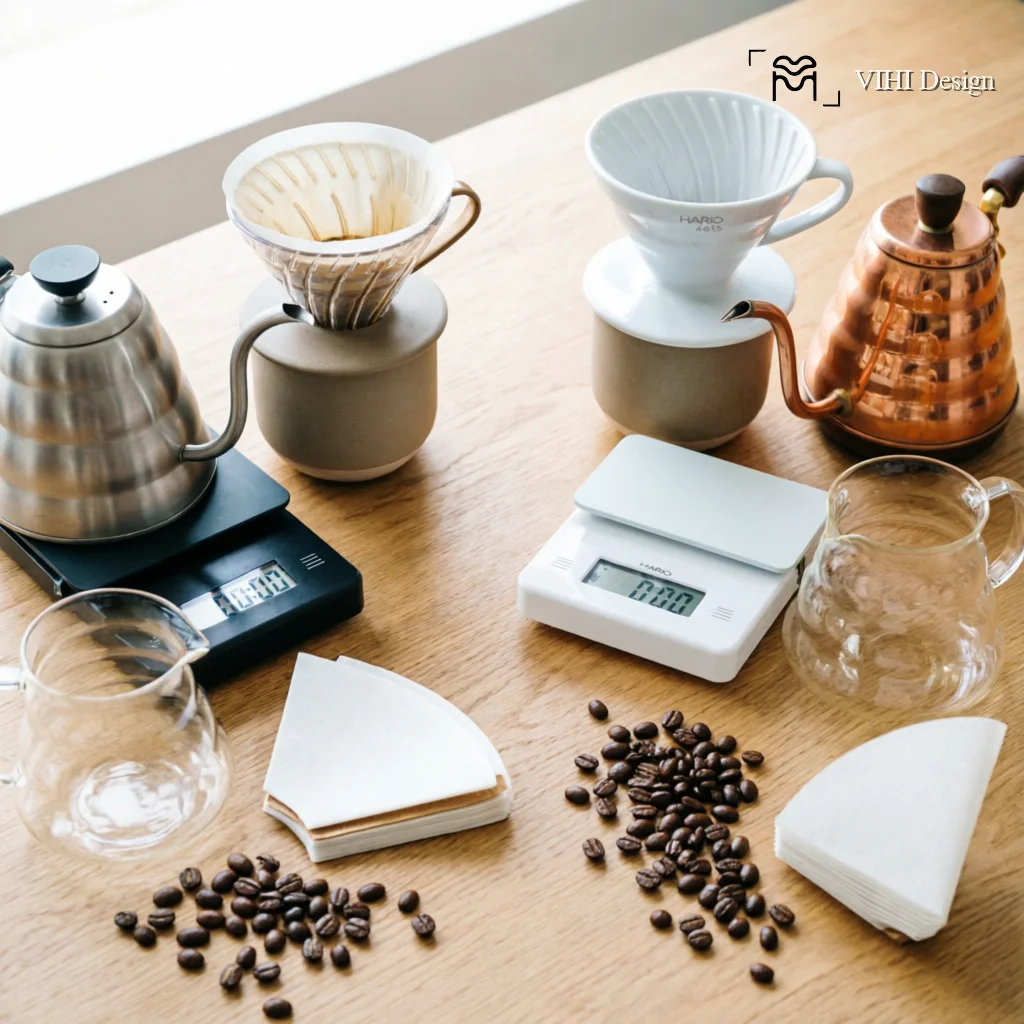
The gooseneck kettle is non-negotiable for pour-over mastery. Its thin, curved spout provides unparalleled control over water flow rate and pour placement—two variables critical for even extraction.
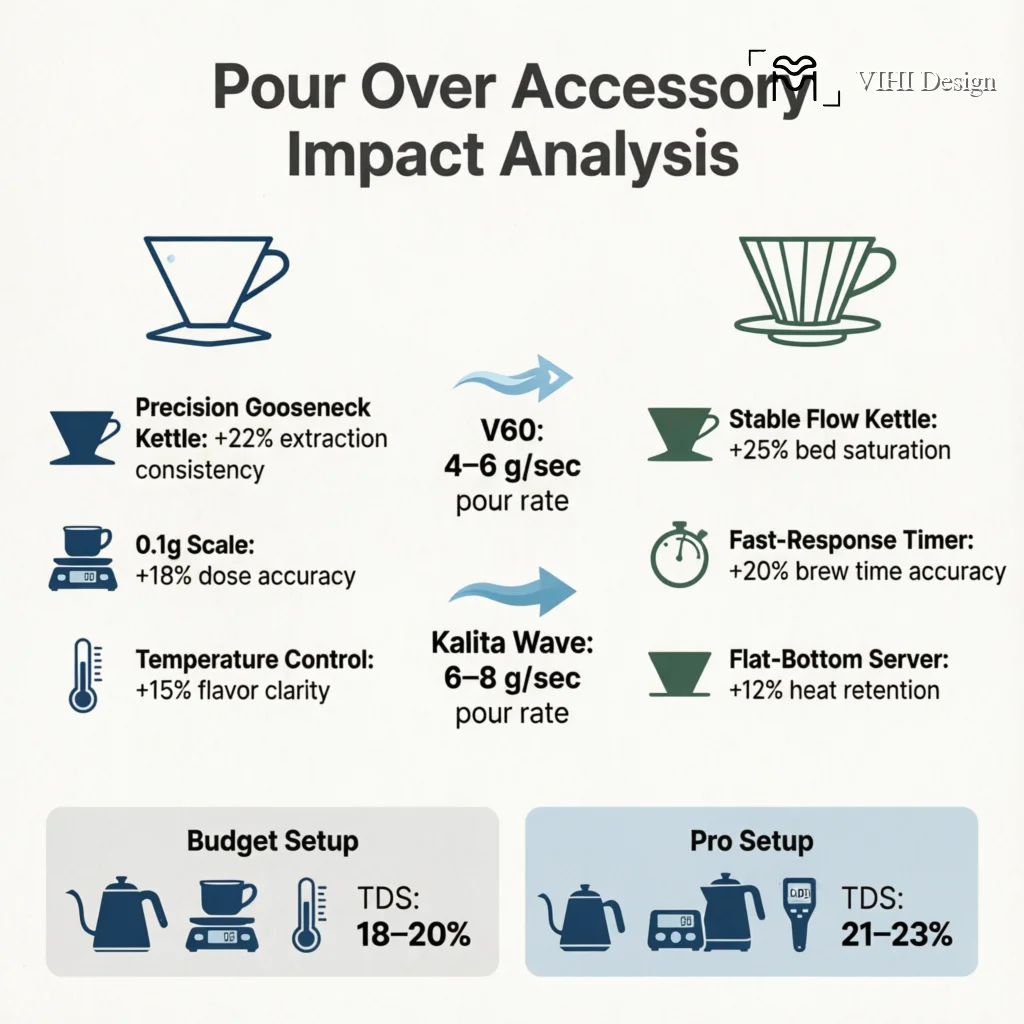
- Flow Rate Control: A steady, moderate flow (typically 4-6g/sec) ensures consistent agitation and even saturation. A rapid dump from a standard kettle leads to channeling and uneven extraction.
- Pour Placement & Agitation: The gooseneck allows you to gently spiral from center to edge, ensuring all grounds are evenly wetted. For the V60, this control is vital for managing the faster drawdown and preventing a flat, bypass-prone bed. The Kalita Wave, with its flat bed and slower flow, is more forgiving, but precision pouring still maximizes uniformity.
The Scale: The Unseen Foundation of Consistency
If the grinder defines the potential of your coffee, the scale is what allows you to realize it consistently. Brewing by weight, not volume, is the first and most critical step toward reproducible results.
- Real-Time Feedback: A responsive scale (0.1g resolution) allows you to precisely hit your coffee dose and water weight targets. This directly controls your brew ratio, the primary lever for adjusting strength (TDS).
- Flow Rate Monitoring: By watching the weight increase over time, you can actively manage your pour rate and total brew time, key factors influencing extraction (EY). A stalled weight increase signals a clogged bed, while a rapid rise indicates a fast, potentially under-extracting pour.
Brewing Vessels & Servers: The Final Interface
The carafe or server you brew into is more than a container. Its design can affect thermal stability, aeration, and your ability to monitor the drawdown.
- Material & Insulation: Glass servers are standard, but double-walled or insulated servers keep coffee hotter for longer tasting sessions. This is a practical consideration for enjoyment.
- Design for Observation: A server with clear markings and a shape that allows you to see the bottom of the dripper is invaluable. Watching the final drops fall from the Kalita Wave or the final spiral of the V60 bed is diagnostic.
- The Decanter Advantage: A server with a pronounced lip promotes smooth, drip-free pouring and can lightly aerate the coffee as you serve, enhancing aroma.
Together, these core tools—kettle, scale, and server—form the essential interface between the barista and the coffee. They translate intention into action, providing the control necessary to navigate the complex variables of pour-over brewing. With this toolkit, grounded in the principles of measurement, you are equipped not just to follow a recipe, but to understand and manipulate the extraction process itself, inching ever closer to that sweet spot of balanced, delicious coffee.
Learn More: For a comprehensive understanding, explore our main guide on Kalita Wave vs V60: The Ultimate Dripper Comparison for Home Brewers.