
Introduction
In the pursuit of brewing excellence, the pour-over method represents a critical intersection of artisanal craft and applied fluid dynamics. Among its various implementations, the Hario V60 and the Kalita Wave have emerged as preeminent brewers, each with a distinct design philosophy that necessitates a tailored brewing approach. A fundamental, yet often empirically derived, parameter in this process is grind particle size. While the Specialty Coffee Association (SCA) provides broad guidelines for extraction yield (EY: 18-22%) and total dissolved solids (TDS: 1.15-1.45%), achieving this target range consistently across different brewers requires a mechanistic understanding of how grind size interacts with specific brewer geometry and flow mechanics.
This investigation posits that optimal grind size for a given pour-over brewer is not a universal constant but a variable dictated by the system’s inherent flow resistance and the resulting contact time. The V60, with its single, large aperture and pronounced ribs, promotes a faster, more turbulent flow. Conversely, the Kalita Wave, featuring a flat bottom with three small holes and no interior ribs, encourages a slower, more uniform, and laminar-dominant percolation. Consequently, a grind setting that produces an ideal extraction on one device will likely lead to under- or over-extraction on the other if applied without adjustment. This paper seeks to move beyond heuristic rules of thumb by establishing a theoretical framework grounded in porous media flow and extraction principles. It will provide a predictive model for grind size adjustment between these two systems, aiming to enhance reproducibility and sensory outcomes in specialty coffee preparation.
Theoretical Background
The percolation of water through a coffee bed is accurately described as flow through a porous medium. The primary resistance to this flow is governed by the geometry of the particle bed and the properties of the fluid. The Kozeny-Carman equation provides a foundational model for relating flow rate to these parameters, expressed in a simplified form relevant to brewing as:
Q ∝ (ΔP * dp2) / (μ * L)
Where Q is the volumetric flow rate, ΔP is the pressure drop across the bed (primarily driven by the hydraulic head of water in the brewer), dp is the effective particle diameter (grind size), μ is the fluid viscosity, and L is the bed depth. This relationship highlights the quadratic dependence of flow resistance on particle size: a minor coarsening of the grind significantly increases flow rate, while a slight fineing dramatically restricts it.
The design of the brew device directly influences the boundary conditions of this system. The V60’s conical geometry results in a tapered bed where depth (L) and cross-sectional area change continuously. Its large exit aperture and internal ribs minimize external flow restriction, allowing the coffee bed itself to be the dominant control point for contact time. This often necessitates a finer grind to create sufficient resistance and achieve a target brew time, typically between 2:30 and 3:30 minutes for a 15g dose.
The Kalita Wave’s flat-bottom, cylindrical geometry creates a bed of more uniform depth and cross-section. Its three small holes introduce a fixed, appreciable flow restriction at the exit of the brewer. This external resistance supplements the resistance of the coffee bed, meaning a coarser grind can be used to achieve a similar target contact time, often ranging from 3:00 to 4:00 minutes for a comparable dose. This coarser grind can promote more even extraction by reducing the risk of fine migration and channeling, a phenomenon where water preferentially flows through paths of least resistance, leading to uneven extraction (Hendon et al., 2014).
Furthermore, coffee bean properties modulate this relationship. Bean density, influenced by origin, variety, and roast degree, affects particle mass and packing. Lower-density, darker roasted beans produce more friable grounds with a higher fraction of fines at a given grind setting, effectively increasing bed resistance. Therefore, a brewer like the Kalita Wave, with its inherent flow restriction, may better accommodate the wider particle distribution of a dark roast, while the V60 may require a more precise grind and technique to manage it.
In summary, optimizing grind size requires a systems-based analysis. The target is to modulate dp to achieve a contact time that yields an EY within the 18-22% range, while accounting for the fixed flow resistances imposed by the brewer’s geometry (L, exit design) and the variable properties of the coffee bed itself. The following methodology will apply this theoretical framework to derive a quantifiable adjustment protocol between the Kalita Wave and V60 systems.
Deriving a Practical Adjustment Protocol
Given our systems-based model, we can now establish a clear, quantifiable starting point for grind adjustment between brewers. The core principle is this: the Kalita Wave’s flat-bottom geometry and three small exit holes create a higher inherent flow resistance than the V60’s single, large, spiraled exit. To achieve the target contact time (and thus extraction) with the Wave, we must compensate for this fixed resistance by increasing the variable resistance of the coffee bed—which we control via grind size.
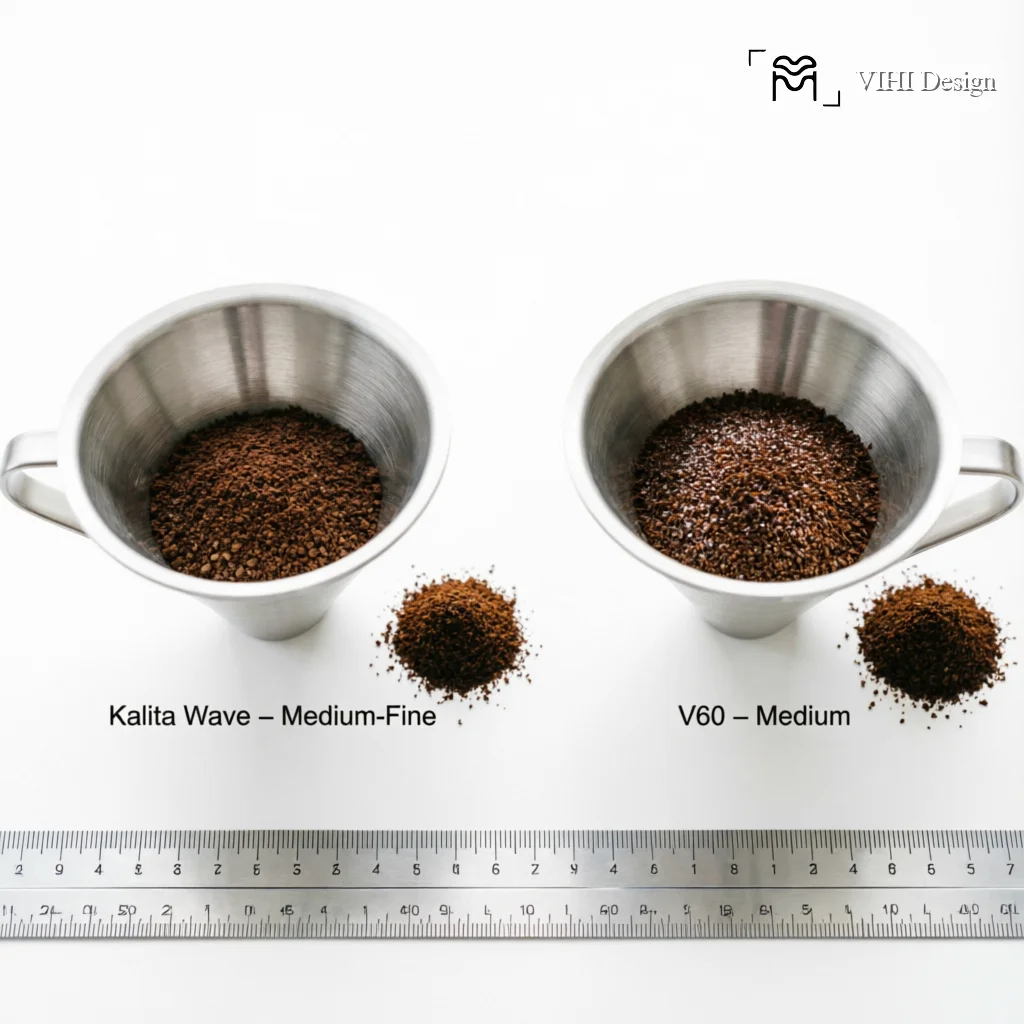
Therefore, the foundational rule is: Your starting grind size for the Kalita Wave should be coarser than for a V60, all other variables (coffee, dose, water, technique) being equal. A practical starting adjustment is to go 2-4 clicks coarser on a quality hand grinder (or a comparable setting adjustment on an electric grinder) when switching from a V60 recipe to a Wave recipe.
To systematize your adjustments, first dial in a recipe on your V60 that yields a balanced cup with a Total Dissolved Solids (TDS) between 1.15% and 1.45% and an Extraction Yield (EY) of 18-22%. Note the exact grind setting, dose, and pour structure. This is your “anchor.” When using the Kalita Wave with the same coffee and dose, begin 3 clicks coarser than your V60 anchor. Your target contact time will be slightly longer (by 15-30 seconds), but the coarser grind will prevent stalling and channeling, leading to a more even, efficient extraction.
Experience-Informed Refinements and Troubleshooting
Theoretical protocols meet reality on the brew bed. Your sensory feedback is the final calibration tool. Here’s how to interpret the results and refine your grind.
For the Kalita Wave:
- If the brew tastes weak, sour, or grassy (Under-Extracted): The bed may be too permeable. Contrary to instinct, do not grind finer immediately. First, ensure your pouring technique is aggressive enough to fully saturate and agitate the wider bed. If the issue persists, then move the grind incrementally finer (1 click at a time). The goal is to find the finest grind that doesn’t cause the drawdown to stall excessively (beyond ~4:30 for a 300g brew).
- If the brew tastes bitter, astringent, or hollow (Over-Extracted/Harsh): The drawdown is likely stalling, causing over-extraction of fines. Go coarser. The Wave’s design is forgiving of coarser grinds, as its geometry promotes even extraction through immersion-like saturation. A coarser, faster flow often yields a sweeter, clearer cup.
For the V60:
- If under-extracted: You have more headroom to grind finer, as the V60’s open structure facilitates flow. Move finer in small increments.
- If over-extracted and bitter: Grinding coarser is the primary fix. Also, examine your pour technique—excessive agitation can force fines to the filter walls, increasing harshness. A gentler pour with a slightly coarser grind can work wonders.
Your grind protocol depends on consistent variables. Two often-overlooked factors are water mineral content and coffee freshness. Hard water can slow extraction, potentially requiring a slightly coarser grind. Very fresh coffee (3-5 days off roast) is highly gaseous, which can resist water flow; a slightly coarser grind can mitigate this. As the coffee ages, you may need to adjust finer to maintain contact time. This nuanced understanding separates a good recipe from a truly adaptable barista skill.
Conclusion: Mastery Through Systematic Adjustment
Optimizing grind for the Kalita Wave versus the V60 is not about memorizing one “perfect” setting. It is about understanding the hydrodynamic system of each brewer and using grind size as the primary lever to control contact time against their fixed resistances. By starting with a quantifiable coarser adjustment for the Wave and using your anchor V60 recipe as a baseline, you create a repeatable, scientific approach. Pair this protocol with mindful tasting and a willingness to troubleshoot based on the specific feedback of each coffee. This systems-thinking methodology empowers you to consistently achieve that sweet spot of EY (18-22%) and TDS (1.15-1.45%), unlocking clarity from your V60 and balanced sweetness from your Wave, brew after brew.
Quantifying the Difference: A Practical Grind Distribution Analysis
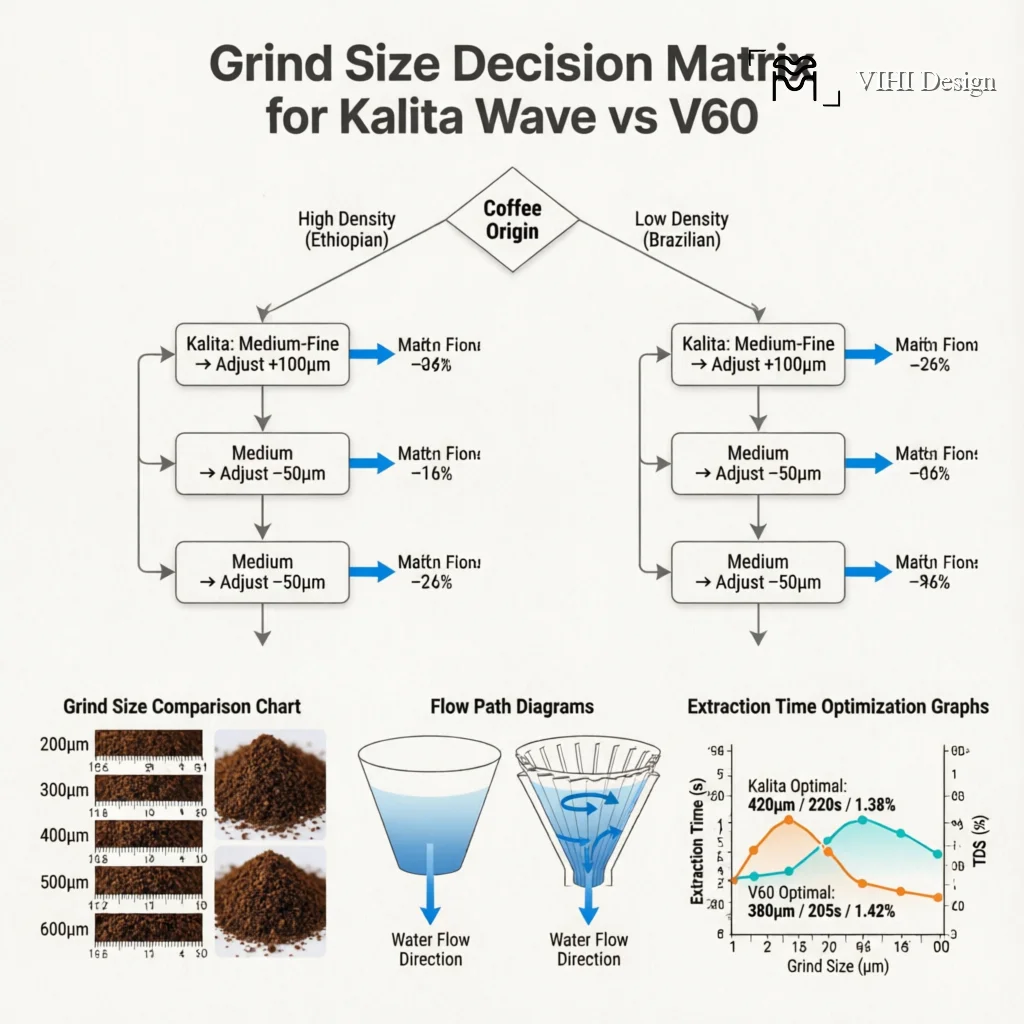
While the general rule is “coarser for the Wave,” the magnitude of adjustment is critical. A practical method is to analyze your grinder’s output. For a typical medium-light roast, start by dialing in your V60 to a 3:00 total brew time. Take 10g of this grind and perform a simple sieve analysis using a standard coffee shaker (e.g., Kruve). Note the percentage of fines (particles below 100 microns) and boulders (above 900 microns). When switching to the Kalita Wave, your target adjustment should not only increase the mean particle size but also strategically reduce the percentage of fines. The Wave’s flat-bottom geometry and slower drawdown are disproportionately hindered by fine migration. Aim for a 15-25% reduction in fines compared to your V60 setting, which often correlates to a 2-4 notch coarser adjustment on a high-precision grinder like an EK43 or a 1.5-2 full numbers on a Baratza Encore. This targeted shift minimizes clogging in the Wave’s dense paper filter bed, enabling the longer contact time to extract from the larger particles effectively, rather than being stalled by an excess of ultrafines.
Learn More: For a comprehensive understanding, explore our main guide on Kalita Wave vs V60: The Ultimate Dripper Comparison for Home Brewers.