
Introduction
The pursuit of the optimal brew for high-quality, light roast coffee represents a fundamental challenge in specialty coffee extraction. Among the diverse array of manual brewing devices, the Origami Dripper has emerged as a uniquely versatile tool, distinguished by its conical geometry and ribbed structure, which accommodates both flat-bottom and conical filter papers. This adaptability allows for a wide spectrum of extraction profiles, making it an ideal candidate for methodical recipe development. When applied to the delicate and complex flavor spectrum of light roast Ethiopian coffees—renowned for their floral aromatics, vibrant acidity, and nuanced tea-like or berry-forward notes—the interplay between brewer design and extraction parameters becomes critically significant.
This study aims to establish a scientifically-grounded, reproducible recipe for the Origami Dripper that maximizes the desirable sensory attributes of light roast Ethiopian coffees while minimizing astringency and unbalanced acidity. The investigation will focus on the triangulation of key variables: grind particle size distribution, water temperature kinetics, and pour structure. The objective is not merely to produce a palatable cup, but to engineer a protocol that reliably translates the intrinsic chemical potential of these beans into a balanced, articulate, and expressive beverage, thereby defining a new standard for manual brewing of this specific coffee category.
Theoretical Background
The extraction of coffee is a process of dissolving soluble compounds—including organic acids, sugars, melanoidins, and caffeine—from the roasted and ground matrix into water. The target extraction yield, typically between 18-22% by weight for specialty coffee, must be balanced to capture desirable compounds while avoiding excessive dissolution of harsh polyphenols and quinic acid. Light roast Ethiopian coffees present a particular challenge: their higher density and preserved organic acid content require more energy for efficient extraction, yet their delicate aromatic volatiles are susceptible to degradation or masking by over-extraction.
Brewer Geometry and Flow Dynamics
The Origami Dripper’s design directly influences extraction kinetics. Its steep, conical angle (when using a conical filter) promotes a faster drawdown and increased flow rate compared to many flat-bottom brewers, potentially requiring a finer grind to increase contact time. Conversely, when used with a Kalita-style flat filter, the flow is restricted, creating a more immersive, slower extraction akin to a flat-bottom brewer. This study will utilize the conical filter configuration to leverage faster flow, allowing for greater control via pour rate and avoiding the “stalling” common in very light roasts. The ribbed interior also ensures consistent air flow and water channeling, reducing the risk of bypass.
Key Extraction Variables
Grind Particle Size: For light roasts, a slightly finer grind than medium is often recommended to increase surface area and counteract the beans’ lower solubility. However, an excessively fine grind in a fast-flowing cone can lead to uneven extraction and channeling. A unimodal particle distribution is hypothesized to be beneficial for achieving even extraction and clarity.
Water Temperature: Higher water temperatures (92-96°C) are generally prescribed for light roasts to provide sufficient energy for dissolving sugars and balancing acids. The temperature decline throughout the brew cycle must be managed, as a significant drop can lead to under-extraction of the coffee bed’s lower layers.
Pour Structure and Agitation: The pour protocol governs agitation, which is the primary driver of extraction uniformity in percolation brewing. A multi-pulse approach, as opposed to a single pour, allows for better control of bed temperature and can manage extraction by targeting different phases: an initial bloom to degas, followed by controlled pulses to maintain a consistent water level and thermal mass. Optimal agitation minimizes fines migration and channeling while ensuring all grounds are fully saturated and participating in extraction.
Sensory Targets for Ethiopian Coffee
The success of any recipe will be evaluated against the canonical sensory profile of high-grade Ethiopian coffees. The target profile emphasizes clarity (the distinct separation of flavors), a pronounced yet integrated acidity (citric, malic, or phosphoric), dominant perceived sweetness (to balance acidity), and the clear expression of origin-characteristic flavors (jasmine, bergamot, stone fruit, or blueberry). The body should be light to medium, with a tea-like or silky mouthfeel, avoiding heaviness that can obscure nuance.
The Perfect Origami Dripper Recipe for Light Roast Ethiopian Coffee: Part 2
In Part 1, we defined our target profile: one of clarity, integrated acidity, perceived sweetness, and pristine origin-characteristic flavors. Achieving this with a light roast Ethiopian coffee in the Origami dripper—a brewer renowned for its ability to highlight acidity and complexity—requires a precise and thoughtful approach. Let’s translate that theory into a practical, repeatable recipe.
The Core Recipe & Brewing Parameters
This recipe is designed for a single-serving, highlighting the delicate nuances of the coffee. The Origami’s ribbed design and fast-flow base, paired with a fast-flow paper filter (like Kalita Wave filters), are ideal for our clarity-focused goal.
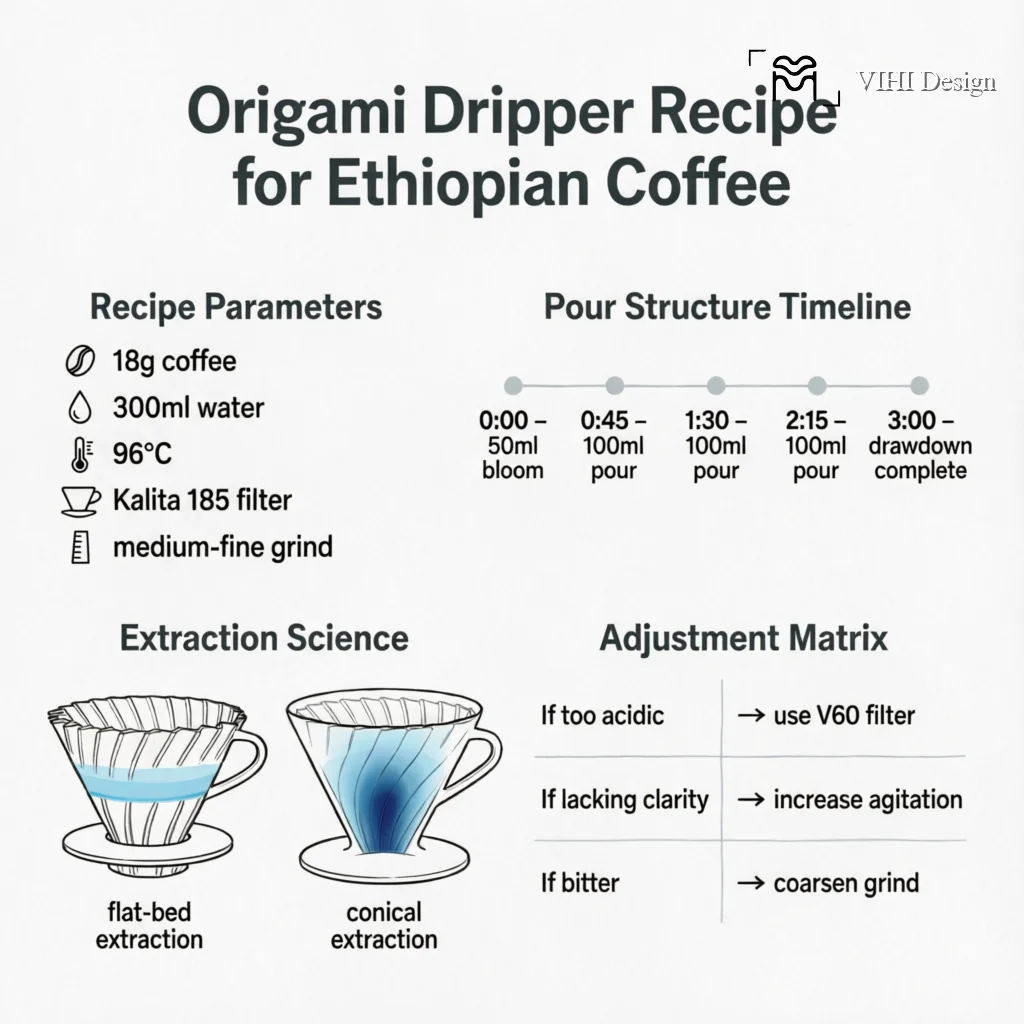
Origami Dripper Recipe: Light Roast Ethiopian
- Coffee: 15g light roast Ethiopian (e.g., Yirgacheffe, Guji)
- Water: 250g (1:16.7 ratio), soft & clean (e.g., 50-100 ppm)
- Grind Size: Medium-fine (finer than typical V60, comparable to table salt)
- Water Temperature: 96°C – 99°C (205°F – 210°F)
- Target TDS: 1.15% – 1.45%
- Target Extraction Yield (EY): 18% – 22%
- Brew Time: 2:15 – 2:45 total
The Pouring Structure: A Bloom & Pulse Approach
The pouring technique is where you directly influence extraction and flavor balance. We use a pulse-pour method to maintain high water temperature and control agitation.
- 0:00 – Bloom: Pour 45g of water (3x the coffee weight) in a gentle spiral, ensuring all grounds are saturated. Swirl the dripper gently to level the bed. Let degas for 30-45 seconds.
- 0:45 – First Main Pour: Pour slowly in concentric circles up to 120g. Aim to finish this pour by 1:15.
- 1:15 – Second Main Pour: Continue pouring steadily up to 195g. Finish by 1:45.
- 1:45 – Final Center Pour: Pour the remaining 55g of water gently into the center of the bed. This final pour should raise the water level slightly but not cause excessive agitation.
- Drawdown: Allow the water to fully drain. Give the dripper one final, gentle horizontal shake as the bed is exposed to flatten it. Total brew time should land between 2:15 and 2:45.
Troubleshooting & Dialing-In for Your Palette
Even with a perfect recipe, small adjustments make the difference between a good cup and a spectacular one. Use these cues to dial in.
If your coffee tastes…
- Sour, Sharp, Thin (Under-Extracted, likely low TDS/EY): The acidity is dominant but not sweet. Solutions: Use a slightly finer grind, increase water temperature, or extend the bloom time. Ensure your pours are aggressive enough to create gentle agitation.
- Muddy, Bitter, Astringent (Over-Extracted, likely high TDS/EY): The clarity is lost, and the finish is dry. Solutions: Coarsen your grind slightly, reduce pouring agitation (pour more gently, closer to the bed), or lower water temperature by a degree or two.
- Flat, Lacking Flavor (Low EY): The coffee is inoffensive but boring. Solutions: Focus on your bloom. Ensure full saturation and consider a longer bloom (45 seconds) for these dense light roasts. A finer grind is also your primary tool here.
Mastering this recipe will allow the Ethiopian coffee to sing. You’ll be rewarded with a cup where jasmine aroma leads to a bright, sweet citrus acidity, a silky mouthfeel, and a clear, lingering note of blueberry or peach. The Origami dripper, with its unique design, is your perfect partner in this pursuit of clarity.
Learn More: For a comprehensive understanding, explore our main guide on The Origami Dripper Mastery Guide: Unlocking Flavor Versatility Through Geometry.