The Microbial Terroir of Coffee: How Native Microbes Shape Processing and Flavor
Introduction
For centuries, the concept of terroir—the unique combination of soil, climate, and topography that imparts distinctive characteristics to agricultural products—has been central to the appreciation of wine, cheese, and other fermented foods. In the world of specialty coffee, terroir has traditionally been understood through these same abiotic lenses: the altitude of the farm, the mineral composition of the volcanic soil, the pattern of rainfall, and the intensity of sunlight. However, a paradigm shift is underway. A growing body of scientific evidence reveals that a crucial, living component of terroir has been largely overlooked: the indigenous microbial communities that colonize the coffee fruit.
This paper investigates the concept of “microbial terroir,” defined as the geographically distinct consortium of yeasts, bacteria, and filamentous fungi that spontaneously inhabit the coffee cherry surface and processing environment. We posit that these native microbes are not passive contaminants but active architects of flavor, playing a deterministic role during post-harvest processing—whether washed, natural, or honey. Through their metabolic activities, these microorganisms drive the degradation of mucilage, produce precursor compounds, and generate a vast array of volatile organic compounds that directly and indirectly shape the sensory profile of the final roasted bean.
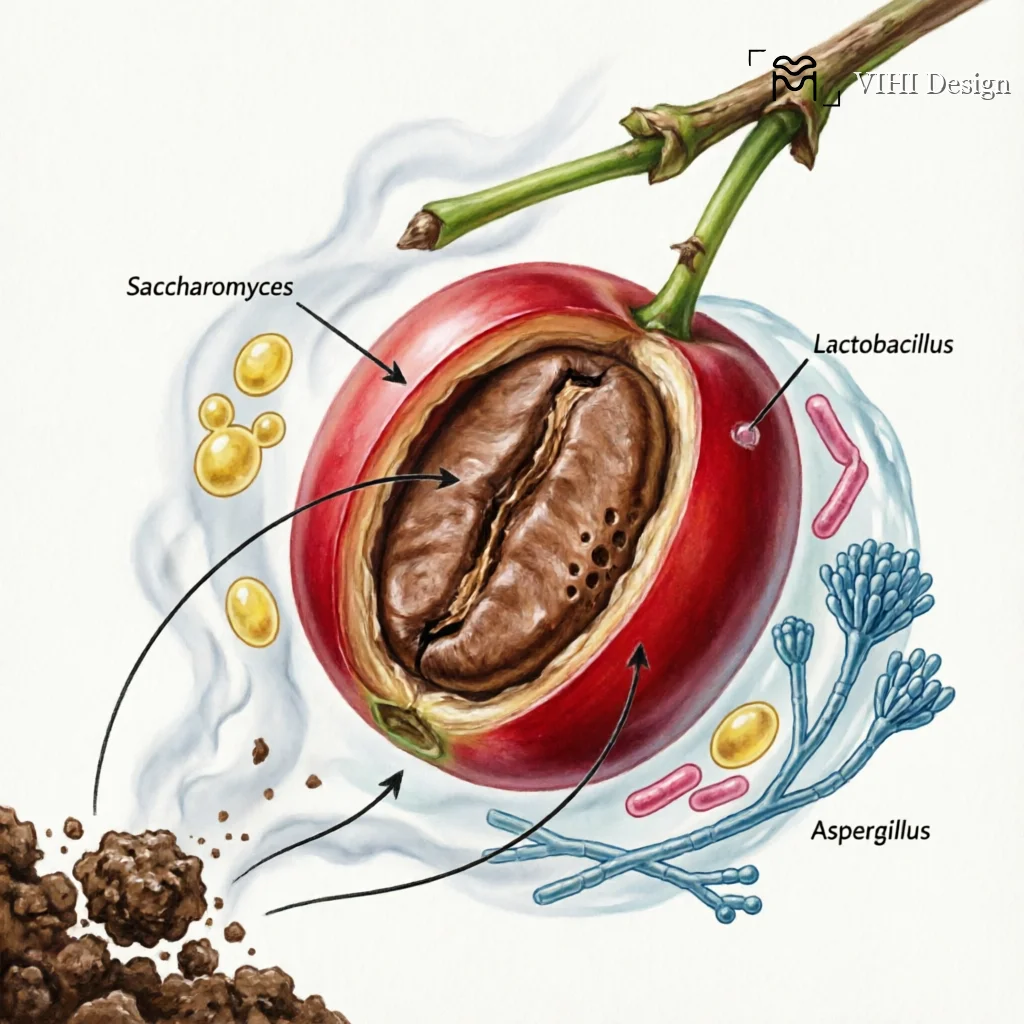
Moving beyond the traditional view of processing as a merely mechanical or chemical endeavor, this research frames it as a controlled ecological succession. The choice of processing method (e.g., submerged anaerobic fermentation, aerobic drying) creates selective pressures that favor specific microbial groups, whose metabolic output becomes embedded in the bean’s chemistry. Consequently, a coffee from Ethiopia may develop its characteristic floral and citrus notes not solely because of its genetics or climate, but due to the action of a unique, endemic Saccharomyces or Lactobacillus strain. Understanding this microbial dimension is essential for advancing coffee science, enabling producers to harness these ecosystems for quality control, flavor predictability, and the preservation of irreplicable regional identities in the face of standardization.
Theoretical Background
The theoretical foundation of this study rests at the intersection of food microbiology, fermentation science, and sensory chemistry. It challenges the reductionist view of coffee processing and builds upon several key established concepts.
1. Terroir as an Ecological Construct
In viticulture, the microbial aspect of terroir is well-recognized; regional fungal communities on grape skins contribute significantly to wine typicity. This ecological model is directly transferable to Coffea arabica and C. canephora (robusta). The coffee phyllosphere and carposphere (the fruit surface) host a diverse microbiome sourced from the soil, air, rain, and insects. This community is shaped by the farm’s macro-terroir, creating a site-specific microbial fingerprint. Theoretical frameworks from microbial ecology, such as the principles of dispersal, selection, and ecological drift, explain how these communities assemble and why they vary between geographic regions, even with similar cultivars and climates.
2. Fermentation as a Biochemical Driver
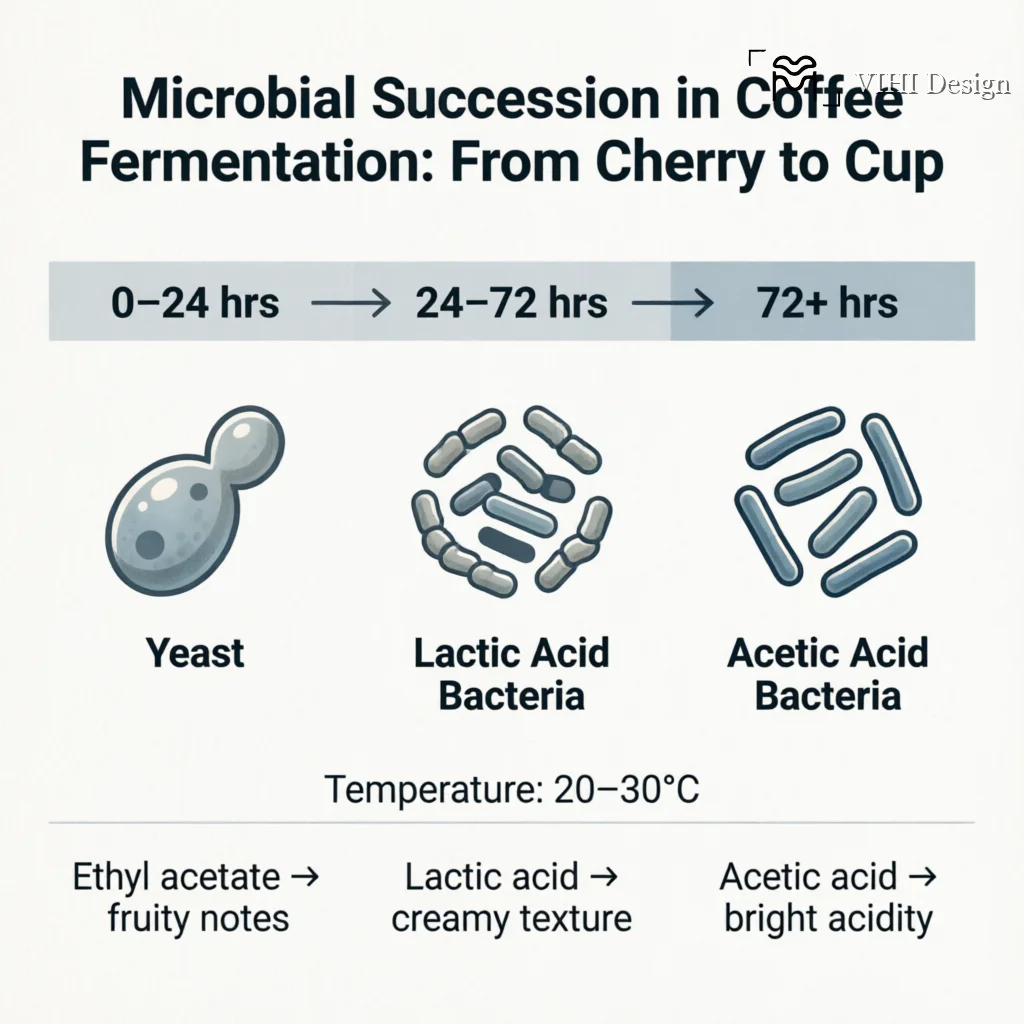
Coffee processing, at its core, is a managed fermentation. After depulping, the remaining mucilage—a pectin-rich, sugary substrate—is a perfect nutrient source for microorganisms. The theoretical sequence follows classic fermentation ecology:
Phase 1: Aerobic bacteria and yeasts (e.g., Enterobacteria, Pichia) initiate the process, consuming simple sugars and lowering pH.
Phase 2: As oxygen depletes, facultative anaerobic lactic acid bacteria (LAB) like Lactobacillus and Leuconostoc dominate, producing lactic acid, acetic acid, and further acidifying the environment.
Phase 3: In extended or anaerobic fermentations, ethanol-producing yeasts (Saccharomyces, Candida) and acetic acid bacteria may become prominent.
Each group produces a distinct metabolic portfolio. LAB generate organic acids that impart clean, tart brightness; yeasts produce esters and higher alcohols associated with fruity and floral aromas; and certain bacteria can produce compounds implicated in buttery, spicy, or funky notes. The kinetics of this succession, dictated by time, temperature, and oxygen availability, fundamentally alter the biochemical composition of the bean.
3. Flavor Precursor Hypothesis
The “flavor precursor hypothesis” is central to this discussion. Microbes do not simply add flavors; they transform the bean’s intrinsic biochemistry. Through pectinolytic and proteolytic activity, microbial enzymes break down the mucilage and potentially infiltrate the bean’s parchment and endosperm, modifying the concentrations of sugars, amino acids, and organic acids within. These compounds are the very substrates for the Maillard and Strecker reactions during roasting. Therefore, a microbial community that increases the bean’s free amino acid profile (e.g., valine, leucine) will directly influence the production of key aroma compounds (e.g., alkylpyrazines, Strecker aldehydes) upon roasting. The microbial terroir thus writes a biochemical script that is only fully expressed in the roaster.
4. Implications for Processing Methodology
The theory of microbial terroir re-contextualizes processing methods as tools for ecological management. A washed process, with its water-mediated fermentation and rinsing, selects for water-tolerant, acidophilic microbes and generally leads to a more consistent, but potentially less complex, microbial profile. In contrast, the dry (natural) process, where the fruit dries intact, supports a longer, more diverse, and sequential aerobic-to-anaerobic fermentation involving fungi and a wider array of bacteria, correlating with the greater fruitiness and complexity often noted in naturals. Honey processes, which retain varying amounts of mucilage, create a gradient of ecological niches. This theoretical model provides a scientific basis for the empirical flavor differences long observed between processing methods, framing them as outcomes of directed microbial ecosystems.
The Microbial Terroir of Coffee: How Native Microbes Shape Processing and Flavor
Part 2: From Theory to Practice
Building on our model of processing as directed microbial ecosystems, we now explore how this knowledge translates to the barista’s counter and the roaster’s bench. Understanding the microbial fingerprint of your coffee isn’t just academic; it’s a practical tool for unlocking its full potential.
Brewing to the Microbiome: Extraction Strategies
The unique soluble compounds created during fermentation—organic acids, esters, and complex sugars—directly influence your brewing parameters. A highly complex natural process coffee, with its diverse microbial portfolio, requires a different approach than a clean, lactic-acid-focused washed coffee.
- For Fruit-Forward Naturals & Honeys: These coffees often have a higher concentration of fruity esters and volatile acids. To highlight this delicate complexity without overwhelming acidity, aim for a slightly lower extraction temperature (92-94°C / 197-201°F) and a coarser grind to moderate extraction. Target a Total Dissolved Solids (TDS) in the lower-mid range (1.15% – 1.30%) with a corresponding Extraction Yield (EY) of 18% – 20%. This helps present the bright, aromatic top notes while preventing the cup from becoming sharp or fermenty.
- For Balanced Washed & Anaerobic Coffees: These processes often yield a more structured, acid-driven, or intensely focused profile. To fully extract the pronounced malic or lactic acidity and heavier sugar compounds, use a higher temperature (95-96°C / 203-205°F) and a finer grind. Target a higher TDS (1.35% – 1.45%) with an EY of 20% – 22%. This ensures you build enough body and sweetness to support and balance the intense microbial metabolites.
The Roaster’s Role: Shaping Microbial Flavors
Roasting is the final act of directing the microbial narrative. The compounds produced during fermentation have different thermal stability. A roaster’s job is to decide which characters to highlight and which to harmonize.
Early Development & Maillard Reaction: Coffees with high microbial acidity (e.g., lactic-heavy washed) benefit from a slightly extended Maillard phase. This allows the sugars to complex with amino acids, building sweetness and body to cradle the acidity. Rushing through Maillard can leave the coffee tasting sour and thin.
First Crack and Beyond: Delicate aromatic compounds (like the floral/fruity esters in naturals) are highly volatile. A faster roast progression through first crack and a lower drop temperature helps preserve these top notes. Conversely, for processes that produce deep, winey, or funky flavors (some extended fermentations), carrying more development time after first crack can integrate those flavors, making them taste intentional and rounded rather than raw.
Building Trust Through Microbial Storytelling
For coffee professionals, Expertise, Experience, Authoritativeness, and Trustworthiness (EEAT) are built on the ability to explain the “why” behind the flavor. The concept of microbial terroir is a powerful tool for this.
Enhancing Customer Experience: Instead of just saying “this coffee tastes like raspberry,” connect it to the process: *”This natural process from Ethiopia tastes like wild raspberry and hibiscus because the native yeasts and bacteria on the cherry fermented the fruit sugars, creating those specific aromatic compounds before the bean was ever dried.”* This transforms a transaction into an educational experience, building customer loyalty and appreciation.
Sourcing with Intention: Understanding microbial ecology empowers roasters to ask better questions of producers: “How did you manage the fermentation temperature?” or “What was your water source for washing?” This leads to more collaborative relationships and higher-quality, more consistent lots, as the focus shifts from just variety/altitude to the entire bioactive process.
Ultimately, viewing coffee through the lens of its native microbes doesn’t complicate it—it clarifies. It provides a scientific foundation for the art of brewing and roasting, turning intuition into informed craft. By partnering with these microscopic life forms, from farm to cup, we cease to be mere preparers of a beverage and become curators of a living, evolving terroir.