
Introduction: The Evolution of Coffee Labels from Simple Descriptors to Detailed Processing ‘Recipes’
For decades, the information presented on a bag of specialty coffee was minimal and functionally categorical. Labels served primarily to denote origin, roast level, and a broad processing method—typically “Washed,” “Natural,” or “Honey.” This tripartite classification system provided a foundational, albeit grossly oversimplified, understanding of post-harvest handling. The “Washed” label implied the removal of the coffee cherry’s mucilage through fermentation and mechanical washing, generally associated with clarity and acidity. “Natural” indicated the drying of the intact coffee cherry, a process linked to pronounced fruitiness and body. “Honey,” a mid-point method, involved the removal of the skin but left varying amounts of mucilage during drying. While useful for initial consumer orientation, these terms obscured the vast spectrum of biochemical and mechanical interventions that occur within each category, rendering them insufficient for describing the nuanced sensory outcomes of modern coffee production.
The contemporary landscape of specialty coffee is characterized by a paradigm shift from these broad categories to the explicit documentation of processing “recipes.” This shift represents a move towards transparency, technical specificity, and an acknowledgment of processing as a primary determinant of flavor, equal to or surpassing the influence of terroir or variety. A label no longer states merely “Natural”; it may now specify “Anaerobic Natural with 120-hour whole cherry maceration at 18°C.” This granularity functions as a technical protocol, detailing controlled variables such as fermentation type (aerobic vs. anaerobic), substrate (whole cherry, depulped bean, mucilage), duration, temperature, pH management, and often the subsequent drying kinetics. This paper will analyze the drivers and implications of this evolution, arguing that the modern coffee label has transitioned from a generic descriptor to a critical piece of data in the scientific evaluation of coffee quality and flavor potential.
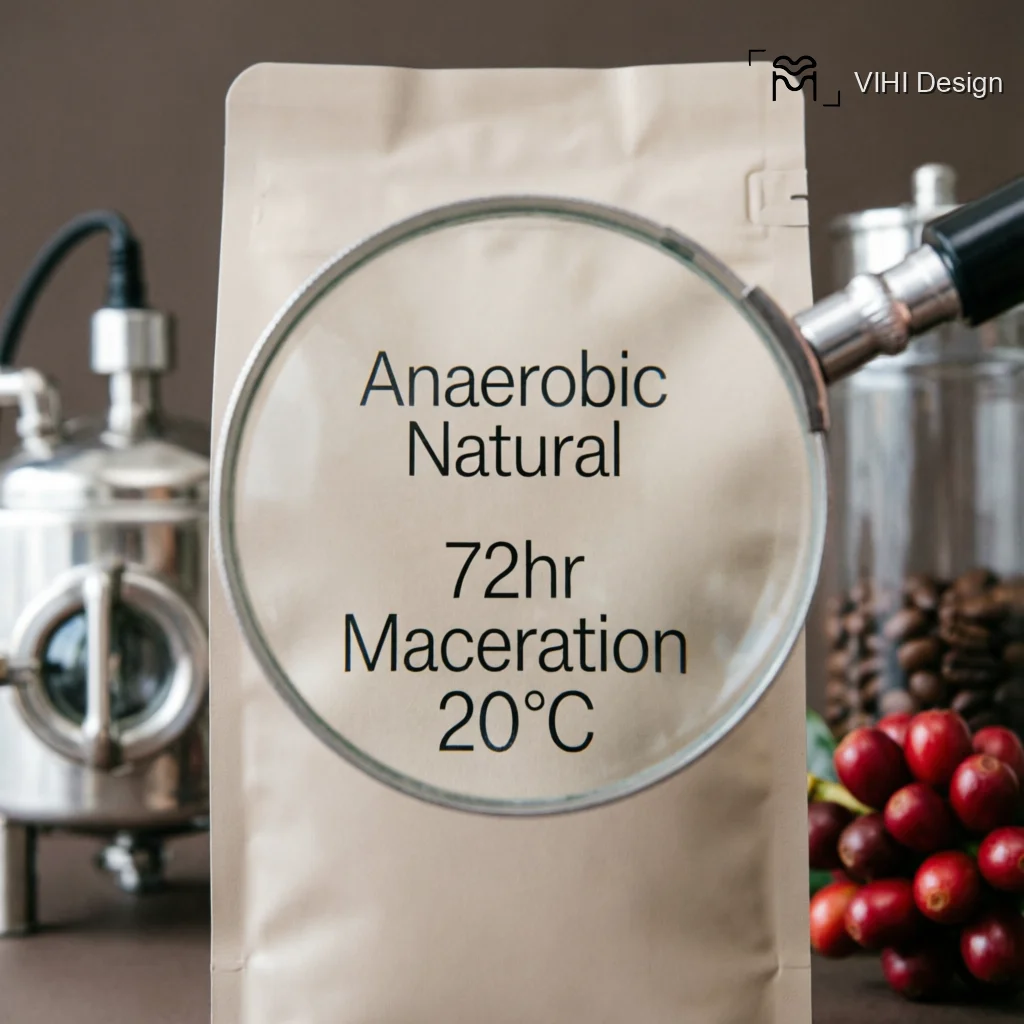
The Label Evolution: From ‘Natural’ to ’72hr Anaerobic Maceration in Cherry at 20°C’
The transformation of coffee labels is not merely a marketing trend but a reflection of advancements in post-harvest science and a changing market epistemology. The traditional labels (“Washed,” “Natural,” “Honey”) described an outcome based on visible, mechanical steps. The new recipe-based labels describe a controlled process. This evolution can be deconstructed into three interconnected drivers: scientific inquiry, producer agency, and consumer education.
The Role of Post-Harvest Biochemical Research
The adoption of specific processing recipes is underpinned by a growing body of research into the biochemistry of coffee fermentation. Scientists and progressive producers now treat the post-harvest period not as a simple stabilization step, but as a targeted fermentation process analogous to those in winemaking or cheesemaking. Key controlled variables include:
- Oxygen Availability (Aerobic vs. Anaerobic): Anaerobic environments, created by sealing coffee in tanks or bags, promote different microbial consortia and metabolic pathways (e.g., lactic acid fermentation) compared to aerobic conditions, directly influencing the production of volatile organic compounds and organic acids.
- Temperature Control: Precise temperature management (e.g., “at 20°C”) regulates microbial activity and enzymatic kinetics. Lower temperatures can slow fermentation, potentially leading to more complex acid profiles, while higher temperatures accelerate the process, risking off-flavors.
- Duration and Substrate: Specifying “72hr maceration in cherry” defines both time and the material being fermented. Maceration time influences the diffusion of sugars, acids, and phenolic compounds from the cherry flesh (mesocarp) into the seed (bean). The substrate—whole cherry, depulped beans, or mucilage—determines the nutrient availability for microbes.
- Microbial Inoculation: Some advanced recipes specify the use of selected yeast or bacterial strains (e.g., Saccharomyces cerevisiae var. boulardii, Lactobacillus spp.) to direct fermentation towards predictable sensory outcomes.
This scientific approach allows for the reproducible manipulation of flavor precursors (sugars, acids, amino acids) within the green coffee bean, making the processing recipe a direct tool for flavor design.
Producer Agency and Market Differentiation
For coffee producers, the detailed label represents an assertion of skill, intentionality, and intellectual property. Moving beyond the generic “Natural” allows a farm to distinguish its 96-hour anaerobic process from a competitor’s 48-hour aerobic one, even if both fall under the traditional umbrella of “Natural.” This specification:
- Commands price premiums by justifying unique quality and labor input.
- Facilitates direct communication with roasters and consumers about the craft involved.
- Encourages experimentation and innovation at origin, as successful “recipes” can be replicated and branded.
The label thus becomes a critical interface in the value chain, translating agricultural and microbiological work into a communicable and marketable asset.
The Informed Consumer and the Data-Driven Label
The modern specialty coffee consumer, particularly in third-wave markets, increasingly demands traceability and transparency. A recipe on a label serves as an educational tool and a quality signal. It allows the consumer to:
- Draw correlations between processing parameters (e.g., “extended anaerobic fermentation”) and experienced sensory attributes (e.g., “pronounced winey acidity, heavy body”).
- Make more informed purchasing decisions based on preferred processing styles.
- Understand coffee as a product of both agriculture and deliberate food science.
Consequently, the label evolves from a passive identifier to an active document containing key data points for sensory prediction. This shift necessitates a higher level of literacy from all actors in the supply chain, from producer to barista to end consumer, fundamentally changing how coffee quality is discussed and assessed.
Consequently, the label evolves from a passive identifier to an active document containing key data points for sensory prediction. This shift necessitates a higher level of literacy from all actors in the supply chain, from producer to barista to end consumer, fundamentally changing how coffee quality is discussed and assessed.
Decoding the Roaster’s Data: From Green Bean to Target Profile
A technically detailed label bridges the gap between farm processing and final brew. Roasters act as translators, interpreting agricultural inputs to engineer a specific sensory outcome. Key roast metrics, when shared, reveal their intent.
- Development Time Ratio (DTR): A percentage indicating the portion of total roast time spent after first crack. A lower DTR (18-22%) often highlights origin character and acidity; a higher DTR (23-28%) builds body and sweetness, mellowing sharp acids.
- Agtron/Color Values: Objective measurement of roast degree. Light roasts (Agtron 70-85) preserve volatile aromatics, while darker roasts (below 50) develop roast-driven bittersweetness.
- Roast Curve Annotations: Notes like “long drying phase” or “fast ramp” indicate how heat was applied to manipulate moisture content and bean structure, directly impacting extractability.
The Brewer’s Equation: Translating Label Data into the Cup
For the barista, the label provides the initial variables for the extraction equation. Understanding how processing and roast data influence solubility allows for precise recipe formulation.
- Total Dissolved Solids (TDS): Target range of 1.15% – 1.45%. Anaerobic or carbonic maceration coffees, with higher fermentative solubility, often excel at the lower end (1.15-1.25%) to prevent over-extraction of intense flavors. Washed coffees may target 1.30-1.40% for balanced clarity.
- Extraction Yield (EY): Target range of 18% – 22%. Dense, high-altitude washed beans often require finer grinds and higher extractions (20-22%) to fully dissolve sugars. Lower-density, experimentally processed beans can reach optimal flavor at 18-20% EY, as ferment-derived compounds extract early.
- Particle Size & Grind Setting: This is the primary control variable. Coffees labeled with “high solubility” (e.g., most thermal-shock processed) demand a coarser grind to slow extraction, while dense, slow-developing washed coffees need a finer grind to achieve target EY.
Barista’s Field Notes: Addressing Common Struggles
Facing a bag labeled “Double Anaerobic Thermal Shock Washed” can be paralyzing. The jargon feels exclusionary. Let’s reframe these pain points into actionable insight.
Pain Point: Buying coffee based on fancy processing names only to dislike the resulting flavor profile.
Action: Look past the processing *name* to the processing *effect*. A label stating “fermented in sealed tanks for 96 hours” tells you to expect pronounced fermented fruit (think brandy, rum). If you dislike boozy notes, this is your warning, regardless of the catchy name.
Pain Point: Confusion about whether detailed processing information is marketing hype or a genuine quality indicator.
Action: Cross-reference. Genuine technical labels provide cause-and-effect. “Raised-bed dried for 21 days” directly correlates to even moisture removal and reduced risk of mold—a tangible quality indicator. Vague terms like “masterfully processed” without data are hype.
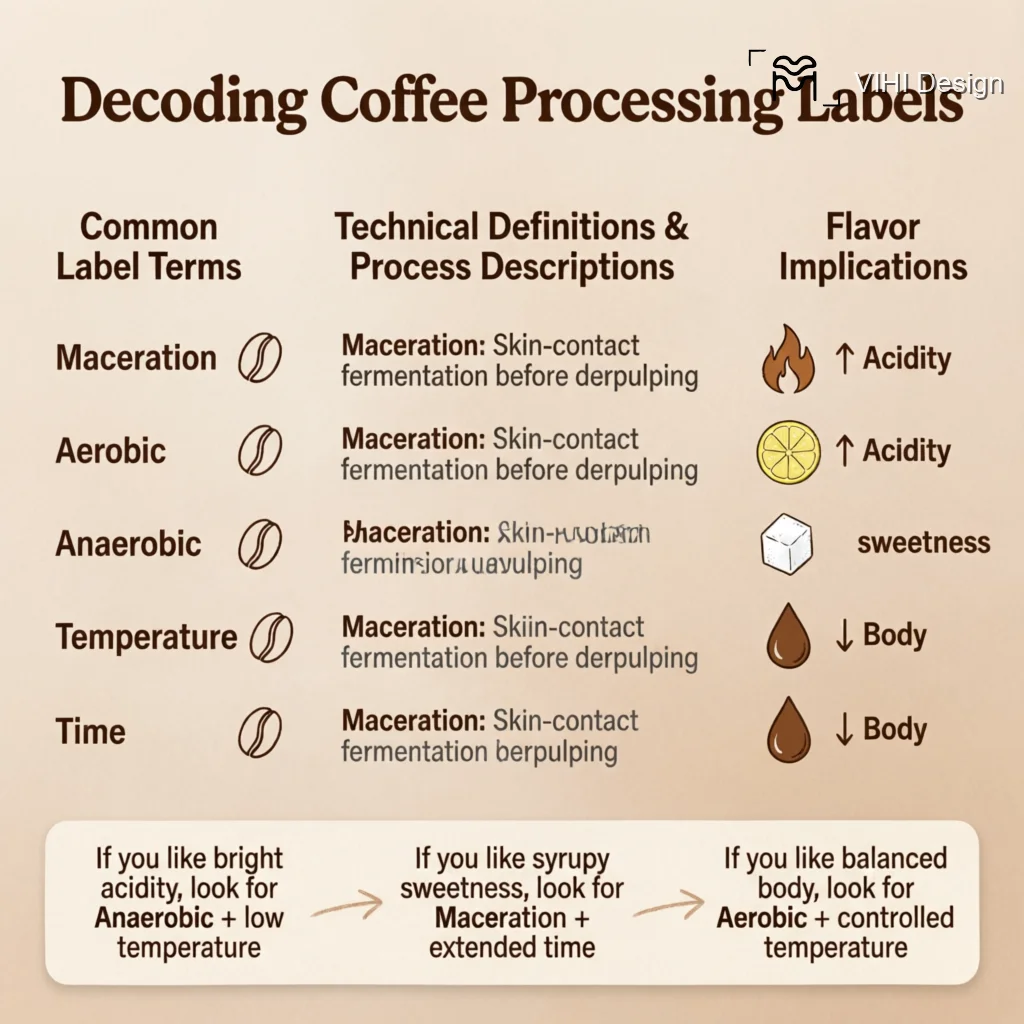
Pro-Tip: When you see temperature specifications on a label (like ‘fermented at 20°C’), note that lower temperatures (18-22°C) typically preserve brighter acidity and floral notes, while higher temperatures (24-28°C) develop more tropical fruit and fermented characteristics. This is the roaster’s secret to predicting acidity levels before you even brew.
Building a Sensory Library: Correlating Data to Flavor
True expertise links quantitative label data to qualitative taste experience. This builds a predictive sensory library.
- Label States: Washed, Ethiopian, 2100m, Agtron 78, DTR 19%.
Sensory Prediction: Expect high acidity (citrus, stone fruit), tea-like body, and floral aromatics. Target a higher EY (21-22%) with a slightly finer grind to unlock sugars. - Label States: Anaerobic Natural, Colombia, 48hr fermentation at 24°C, TDS target 1.20%.
Sensory Prediction: Anticipate heavy body, intense tropical fruit (pineapple, mango), and winey/fermented notes. Use a coarser grind, lower brew temperature (90-92°C), and aim for the lower end of the EY range to balance intensity.
Technical Summary
- Modern coffee labels are technical documents linking agricultural processing and roast science to brew parameters.
- Processing details (method, duration, temperature) predict solubility and primary flavor families (e.g., lower ferment temps preserve acidity).
- Roast metrics (DTR, Agtron) guide the barista on how to approach extraction for balance.
- Optimal brew targets are TDS: 1.15% – 1.45% and EY: 18% – 22%, with particle size as the key adjustment variable based on label-indicated solubility.
- Correlating specific label data points to tasted outcomes builds a predictive sensory library, transforming confusion into confident recipe creation.
“`html
“`
“`html
“`
Leave a Reply