
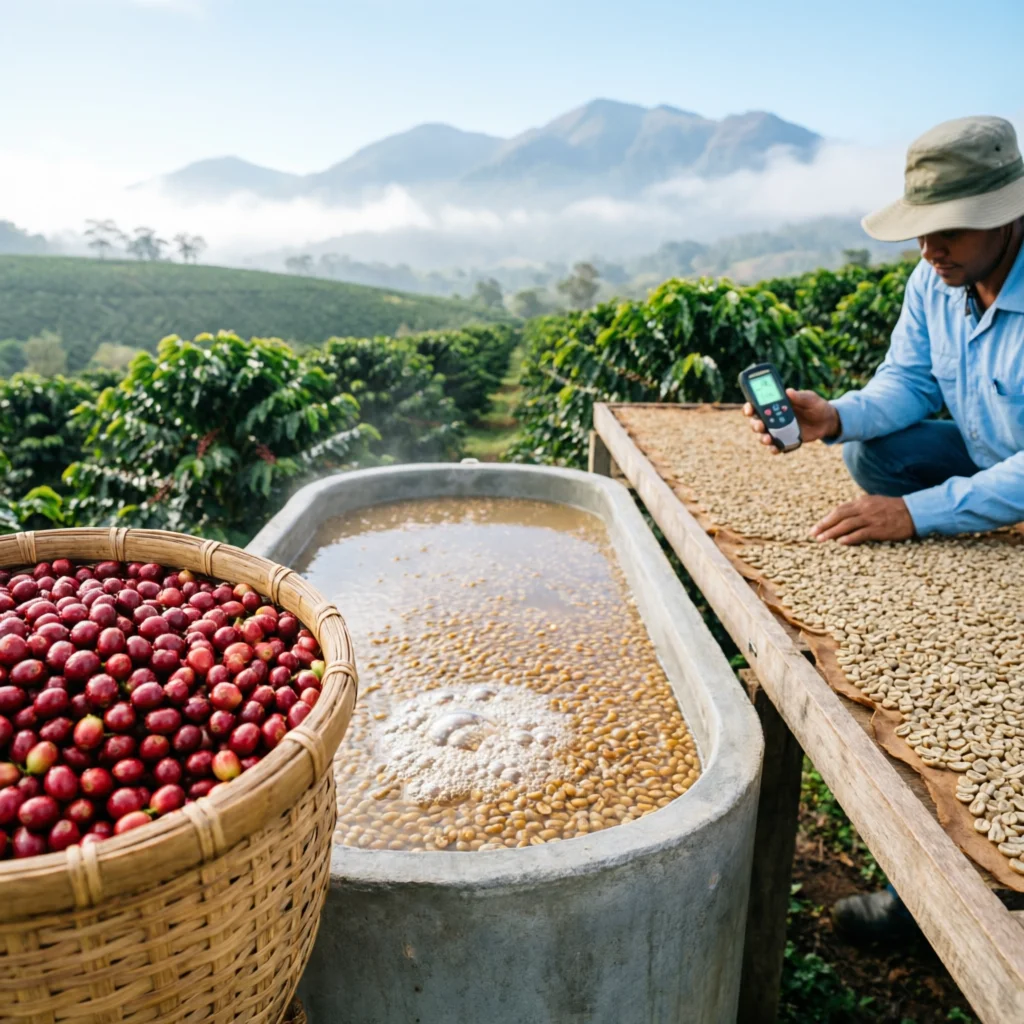
Introduction: Why Processing is the Second Most Important Factor in Coffee Flavor (After Genetics & Terroir)
The organoleptic profile of a roasted coffee beverage is a direct expression of its biochemical composition. This composition is determined by a primary trinity of factors: the genetic potential of the Coffea species and cultivar (genetics), the environmental and agronomic conditions of its cultivation (terroir), and the sequence of operations applied to the seed post-harvest (processing). While genetics and terroir establish the raw material’s potential, processing is the critical, controlled intervention that dictates which chemical precursors are preserved, transformed, or eliminated, thereby defining the final sensory outcome.
Processing refers to the complete set of methods used to remove the coffee seed from its surrounding fruit material—the exocarp (skin), mesocarp (mucilage/pulp), and endocarp (parchment)—and to stabilize it for storage and transport as a green bean. This is not a simple mechanical extraction but a series of biochemical and physical events. The process directly governs the degradation of fruit sugars, the initiation and management of microbial fermentation, the migration of compounds into the seed, and the kinetics of drying. Each decision point in this chain—from the time elapsed after picking to the final drying protocol—selectively influences the concentration of organic acids, sugars, volatile aromatic compounds, and phenolic substances within the endosperm.
Consequently, processing is not a neutral step but a flavor-determining craft. It can amplify inherent terroir characteristics, such as accentuating the malic acidity of a high-altitude coffee, or impart distinct process-driven flavors, such as the winey complexity of anaerobic fermentation or the clean, bright clarity of a fully washed coffee. Its position as the second most critical factor stems from its powerful role as the mediator between agricultural potential and the roaster’s raw material.
Post-Harvest Fundamentals: Moisture Content, Fermentation Basics, and Drying Principles
The theoretical foundation of all coffee processing rests on three interconnected pillars: moisture content management, controlled fermentation, and precise drying. These are not discrete stages but overlapping and interdependent processes that must be meticulously managed to ensure quality and prevent spoilage.
Moisture Content as the Central Metric
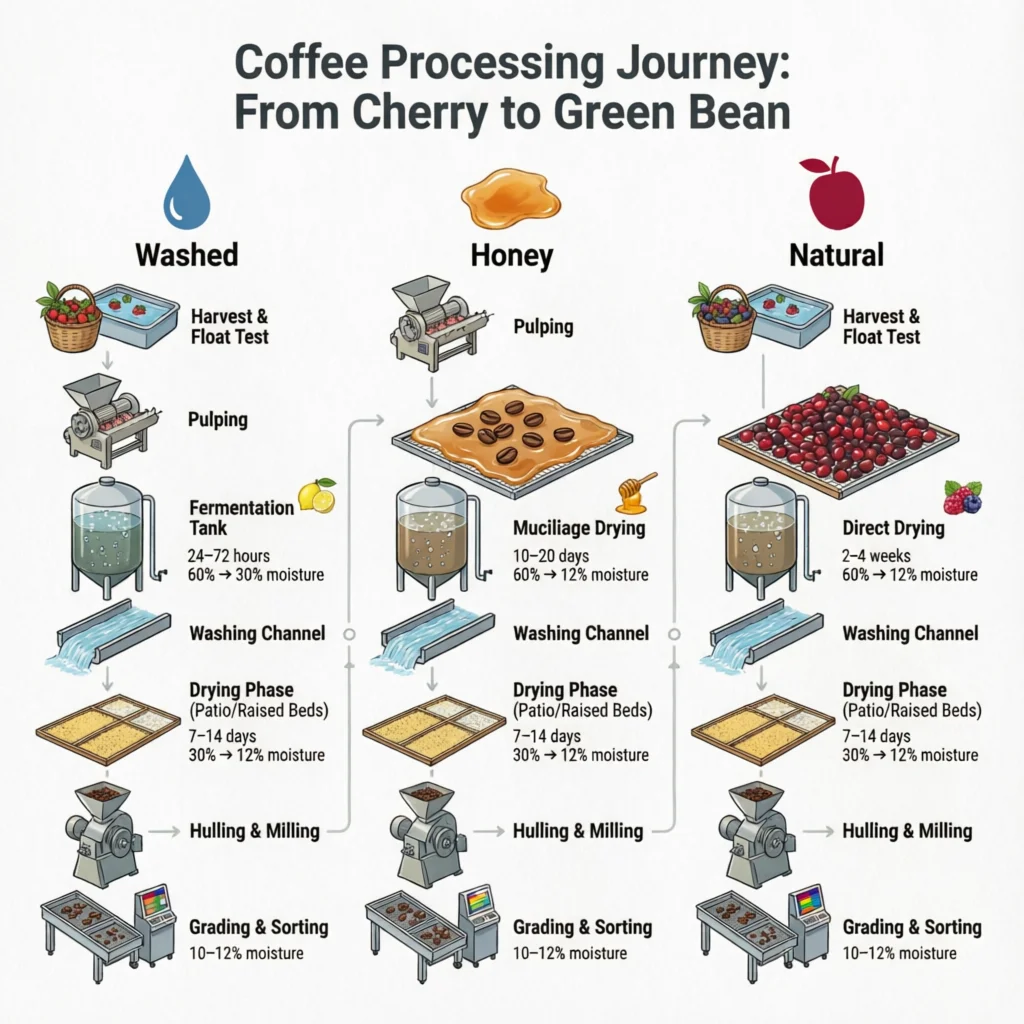
Moisture content (MC) is the principal quantitative variable in post-harvest processing. Fresh coffee cherries have an MC of approximately 60-70% (wet basis). The objective of processing and drying is to reduce the moisture within the parchment-covered bean to a stable 10-12% for safe storage and export. This reduction must be controlled:
- Too Rapid: Case-hardening can occur, where the outer layers of the bean desiccate and form a barrier, trapping moisture inside and leading to uneven drying, microbial growth, and musty flavors.
- Too Slow: Prolonged exposure in a high-moisture state promotes uncontrolled microbial activity, leading to over-fermentation, mold growth, and the development of off-flavors (e.g., acetic acid, butyric acid).
MC is the key indicator for every transition: the endpoint of fermentation, the progression of drying, and the final stabilization of the green bean.
Fermentation: A Controlled Biochemical Process
Fermentation in coffee processing is predominantly a microbial decomposition of the mucilage’s complex polysaccharides (pectins) by endogenous and environmental microorganisms. This process facilitates the mechanical removal of the mucilage but, more importantly, generates metabolites that can influence flavor.
- Agents: A succession of yeasts, bacteria (particularly lactic acid and acetic acid bacteria), and fungi metabolize the sugars and citric acid in the mucilage.
- Biochemistry: Primary products include organic acids (lactic, acetic), alcohols, esters, and carbon dioxide. The specific microbial profile and environmental conditions (pH, temperature, oxygen availability) determine the metabolic pathway dominance.
- Control Variables: Fermentation is managed by time, temperature, substrate concentration (amount of mucilage), and oxygen level (aerobic vs. anaerobic). The endpoint is determined empirically (textural change) or by measuring pH/total acidity, not by a fixed time, as ambient conditions vary.
The process must be halted via washing and the initiation of drying at the correct moment to prevent the migration of undesirable microbial metabolites into the seed.
Drying Principles and Kinetics
Drying is the phase of controlled water removal to achieve microbiological stability. It follows a non-linear kinetic curve, typically divided into phases:
- Constant Rate Period: Initial stage where free surface water and readily available moisture evaporate. The drying rate is limited by atmospheric conditions (air temperature, humidity, flow).
- Falling Rate Period: As MC decreases, moisture must migrate from the interior of the bean to the surface. The rate becomes limited by the bean’s internal diffusion properties and slows progressively.
Optimal drying requires uniform airflow, consistent temperatures (typically 35-40°C to avoid “baking” the bean), and protection from re-wetting. The final stabilization at 10-12% MC is critical; beans at higher MC are chemically active and prone to deterioration, while over-drying (<9%) can lead to brittle beans and loss of quality precursors.
From Drying to Degassing: The Final Chemical Lock-In
The stabilization of moisture content (MC) at 10-12% does not signify chemical stasis. It marks the transition from active drying to a period of controlled maturation and degassing. Residual enzymatic activity and the slow migration of organic acids continue to shape the bean’s internal structure. The porous matrix, now rigid, traps volatile aromatic compounds. This phase determines the bean’s shelf life and roast stability. Beans dried too quickly or at high temperatures develop a hard, impermeable structure that traps moisture and carbon dioxide, leading to “baked” flavors and uneven roasting.
Quantifying Quality: The Metrics of Extraction
Post-processing quality assessment transcends visual grading. Precise brewing metrics provide an objective lens into the bean’s soluble yield and structural integrity, which are direct results of processing efficacy.
- Total Dissolved Solids (TDS): Ranges from 1.15% to 1.45% for optimal sensory balance. Over-fermented beans often yield erratic, unusually high TDS readings with harsh flavors.
- Extraction Yield (EY): Targets 18% to 22%. Washed coffees typically extract more uniformly within this band. Naturals and honeys can show desirable flavors at the lower end (18-20%) due to higher concentration of non-sugar solutes.
- Particle Size Distribution: A uniform grind is paramount. Beans with inconsistent density from uneven drying create a bimodal particle distribution upon grinding, leading to simultaneous under- and over-extraction.
Barista’s Field Notes: Addressing Common Struggles
Translating processing theory into practice resolves daily frustrations behind the bar and in the roastery.
- Roasters & Uneven Naturals: The core issue is moisture gradient. The sticky fruit pulp creates a barrier, causing the bean’s exterior to dry faster than the interior. This differential leads to a dense, under-dried core and a brittle exterior. Solution: Extend the drying time at lower temperatures (max 35°C) and implement more frequent turning to break up clumps.
- Enthusiasts & Ethiopian Duality: Washed Ethiopians highlight terroir and intrinsic acidity (citrus, floral). Naturals from the same region showcase fruit-sugar transformation (berry, wine). They are fundamentally different beverages because processing alters the very substrate of flavor.
- Baristas & Misrepresentation: Never guess. If the processing method isn’t clear from provided info, describe the concrete flavors you taste (“a bright, tea-like body with lemon acidity” vs. “a syrupy body with strawberry jam notes”) rather than attributing an unconfirmed process.
- Buyers & Hidden Defects: Fermentation defects (phenolic, vinegar, onion) often bind to bean structures and volatilize only during roasting. Mandate sample roasting to a full city+ level and conduct rigorous cupping post-rest. Lighter roasts can mask these flaws.
Pro-Tip: When cupping, pay attention to the aftertaste length to identify processing method: Washed coffees typically have a cleaner, shorter finish; Naturals have a lingering, winey tail; Honey processes show pronounced sweetness that coats the palate. The ‘finish’ often reveals more about processing than the initial flavors.
The Roaster’s Role: Interpreting the Green Signature
A roaster acts as a translator for the processor’s work. Each processing method dictates a unique thermal strategy.
- Washed Beans: Dense, uniform structure. Require substantial initial energy to penetrate the compact cellulose. Expect a predictable, linear rate of rise.
- Natural Beans: Less dense, more porous, but often with internal moisture variation. Apply gentler initial heat to allow for internal moisture migration without scorching the sugar-rich exterior.
- Honey/Pulped Natural: High sucrose content on the parchment leads to rapid caramelization. Reduce heat application earlier in the Maillard phase to avoid ashy, bitter compounds from burnt sugars.
Technical Summary
- Final drying stabilizes bean moisture at 10-12%, transitioning chemical activity from transformation to preservation and setting roast behavior.
- Key brew metrics (TDS: 1.15-1.45%, EY: 18-22%) provide objective analysis of a bean’s soluble yield, directly impacted by processing uniformity.
- Particle size distribution post-grind exposes hidden density inconsistencies stemming from poor drying or fermentation.
- Processing method fundamentally alters the flavor substrate, making varietal or regional comparisons across methods misleading.
- Cupping the aftertaste length and quality offers the clearest sensory indicator of processing method.
- Roast profiles must adapt to the structural and chemical signatures imparted by washing, natural, or honey processing.
Leave a Reply