
Introduction
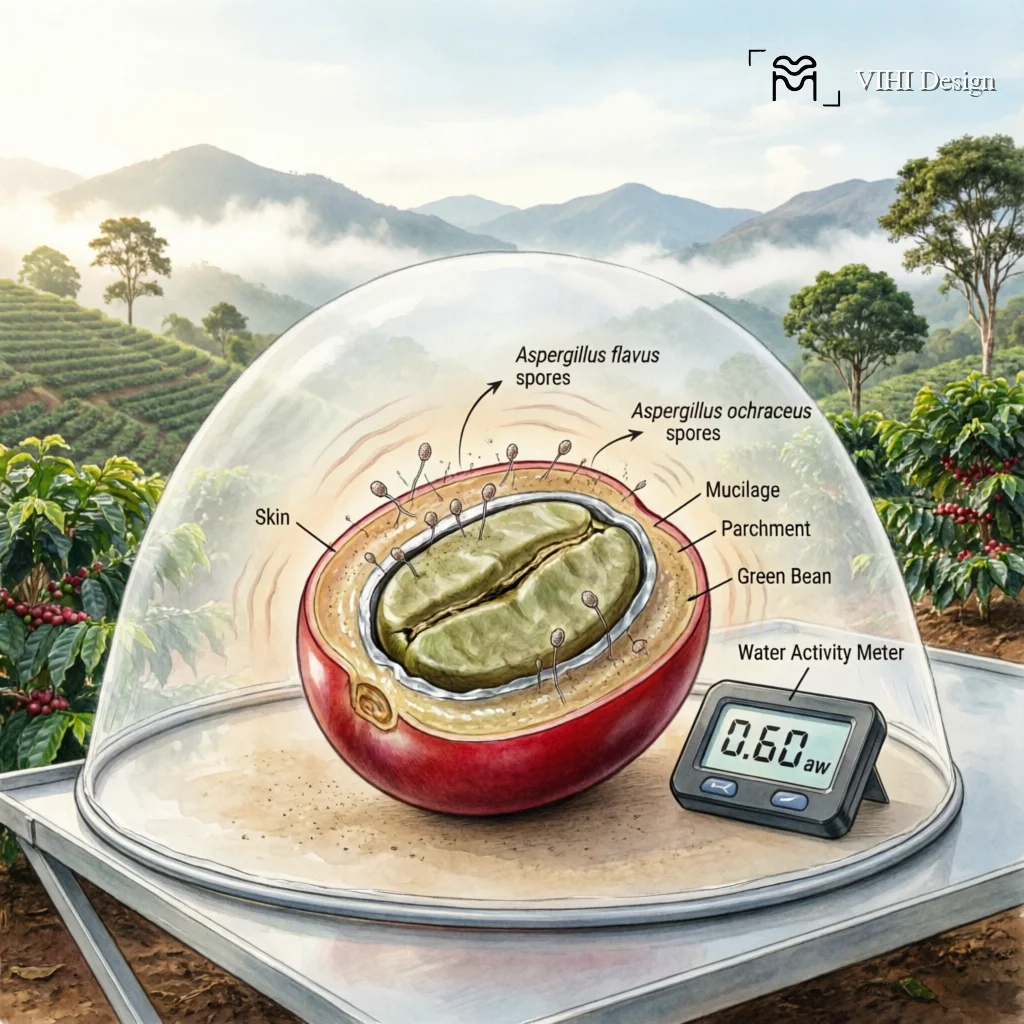
The journey of coffee from cherry to cup is a complex biochemical process where quality and safety are inextricably linked. Among the most significant and insidious threats to both is the proliferation of filamentous fungi (molds) and their subsequent production of toxic secondary metabolites known as mycotoxins. Contamination primarily occurs during the post-harvest processing (drying, storage) and transportation of green coffee beans under conditions of elevated moisture and temperature. The presence of mycotoxins, such as ochratoxin A (OTA) and aflatoxins, presents a documented public health concern due to their carcinogenic, nephrotoxic, and immunosuppressive properties. For the specialty coffee industry, where sensory excellence and provenance integrity are paramount, mold damage also directly correlates with severe cup defects, including musty, earthy, or phenolic off-flavors that render a coffee commercially worthless. Consequently, preventing mold growth is not merely a regulatory food safety imperative but a fundamental prerequisite for achieving and preserving specialty-grade quality. This article outlines a scientifically-grounded, prevention-focused framework for controlling mold and mycotoxin risk throughout the coffee supply chain.
Theoretical Background
Effective prevention requires an understanding of the biological and physicochemical principles governing fungal growth and mycotoxinogenesis. The central concept is water activity (aw), a dimensionless measure (0 to 1.0) of the free, unbound water in a substrate available for microbial growth. It is distinct from moisture content percentage, as it is influenced by the matrix’s composition and solute concentration. Each microorganism has a minimum aw threshold below which growth is halted. For the mycotoxigenic genera most relevant to coffee—primarily Aspergillus (especially sections Circumdati and Nigri) and Penicillium—growth is generally inhibited at aw ≤ 0.80, with optimal growth occurring above aw 0.90. Crucially, the production of mycotoxins has its own, often higher, aw threshold. For OTA production by Aspergillus ochraceus, the critical aw is approximately 0.85 at 25°C.
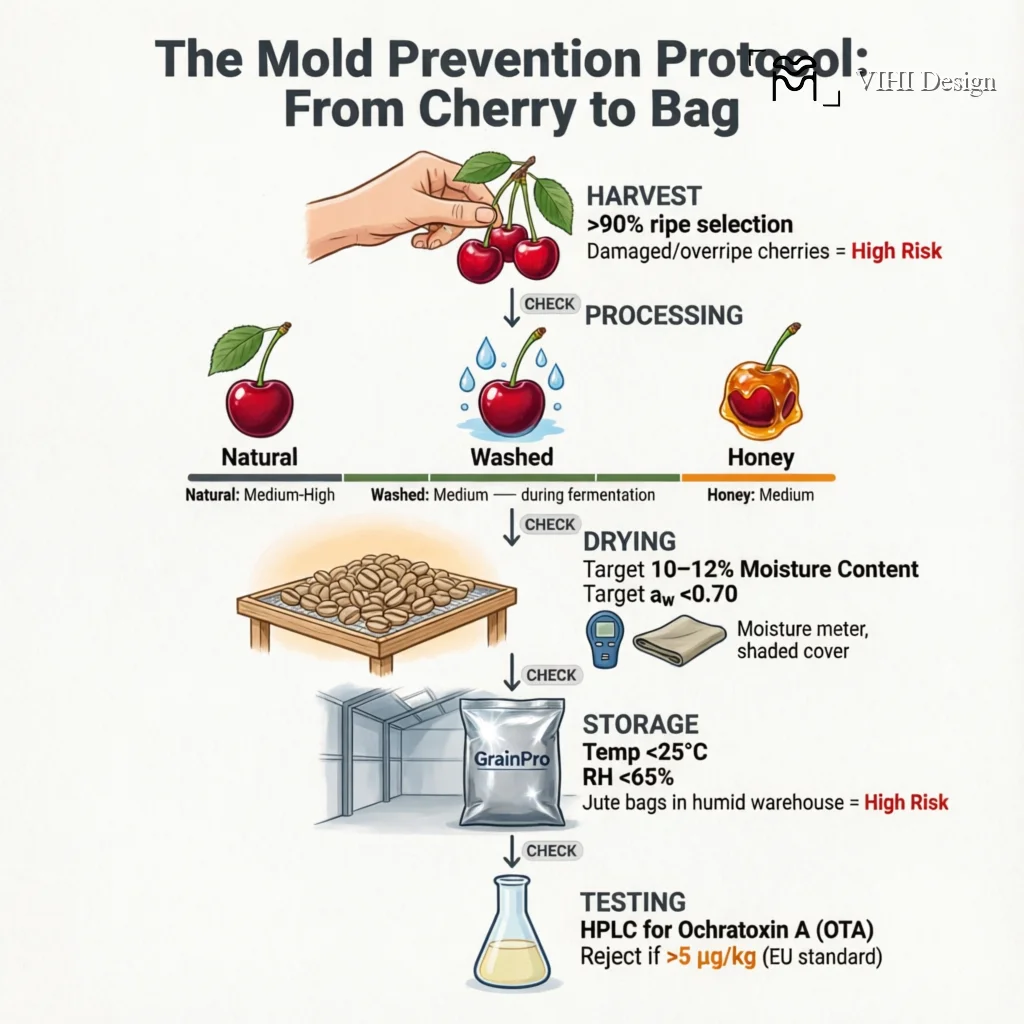
The paramount objective in green coffee stabilization is to achieve and maintain an aw level that prevents both fungal growth and mycotoxin production. Extensive research, codified in industry standards from the Specialty Coffee Association (SCA) and food safety bodies, identifies aw ≤ 0.70 as the critical control point for safe long-term storage of green coffee. At this level, the coffee is in equilibrium with air at approximately 70% relative humidity (RH) at 25°C, creating a hostile environment for all microbial proliferation. This aw typically corresponds to a moisture content in the range of 10-12% (wet basis), but this conversion is temperature-dependent. Therefore, aw provides a more reliable and direct metric for safety than moisture content alone.
Mycotoxins are stable compounds; once formed, they are not eliminated by standard roasting or brewing processes. While roasting can reduce OTA concentrations by 50-90% through thermal degradation, the reduction is inconsistent and depends on roast profile and initial contamination level. It is therefore universally accepted that roasting is not a control step for mycotoxins but a processing step that may partially reduce pre-existing contamination. The core strategy must be prevention at the green bean stage through rigorous management of water activity, temperature, and storage hygiene.
Preventing Mold and Mycotoxin Contamination: A Barista’s Guide to Quality Assurance
As established, roasting is not a reliable control step for mycotoxins. The specialty coffee industry’s first and best defense is sourcing clean, well-processed green coffee. But the responsibility doesn’t end at the roastery door. The barista, as the final quality gatekeeper, plays a crucial role in both identifying potential issues and ensuring the coffee’s inherent quality is expressed safely and deliciously.
Sensory Vigilance: The Barista’s First Line of Defense
Your senses are powerful tools for quality control. While mycotoxins themselves are odorless and tasteless, the conditions that produce them often leave clear sensory markers. During your pre-service routine and dial-in, be hyper-aware of the following off-flavors and aromas, which can indicate poor processing or storage:
- Musty/Earthy/Cellar-like: The most direct red flag. This is the classic sensory profile associated with mold growth.
- Sharp Acetic Acid (Vinegar) or Fermented Sourness: Can indicate uncontrolled fermentation or microbial activity beyond just yeast.
- Stale, Cardboard, or Damp Paper Notes: Often a sign of aging in high-humidity conditions, which favor mold.
Optimizing Extraction: Maximizing Flavor, Minimizing Risk
While proper extraction cannot “remove” contaminants, it is central to presenting a coffee’s true character. A poorly extracted coffee can mask or distort flavors, making it harder to identify subtle quality defects. Conversely, a balanced extraction within the specialty standards highlights clarity, allowing any off-notes to become more apparent for trained palates.
Adhere to the core specialty benchmarks:
- Total Dissolved Solids (TDS): Aim for a 1.15% – 1.45% concentration. This range typically yields a balanced body and intensity.
- Extraction Yield (EY): Target 18% – 22%. This ensures you are pulling the desirable sugars and acids without over-extracting bitter, astringent compounds.
Ultimately, preventing mold and mycotoxin contamination is a supply chain-wide effort. As a barista, your expertise in sensory analysis and precise brewing transforms you from a mere preparer of drinks into an essential quality assurance partner. By demanding transparency from green buyers and roasters, and by applying rigorous standards at the espresso machine, you uphold the integrity and safety of the specialty coffee experience for every customer.
Learn More: For a comprehensive understanding, explore our main guide on The Complete Guide to Coffee Processing Microbiology: Yeast, Bacteria, and Mold in Flavor Development.