
Introduction
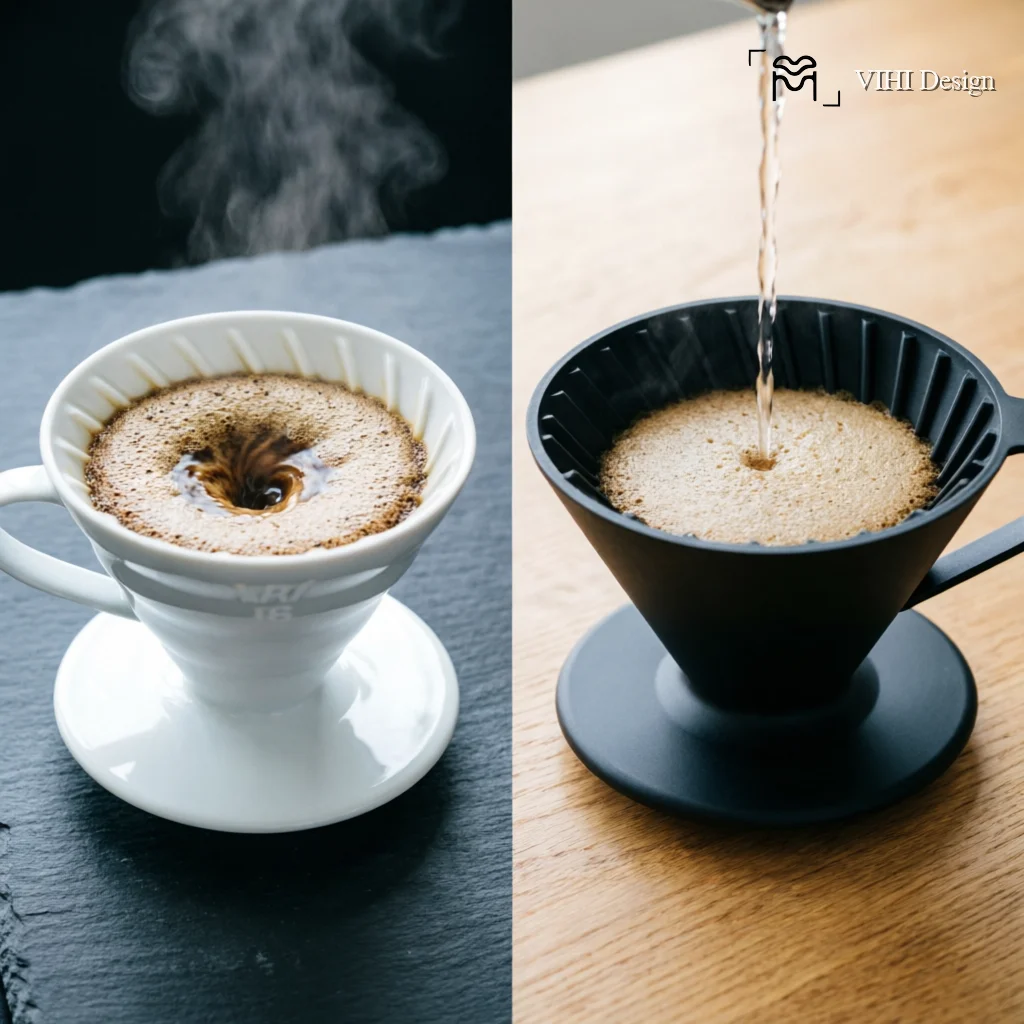
The pursuit of the optimal manual filter coffee brew is a central endeavor in specialty coffee, driven by the interplay between equipment design, brewing parameters, and sensory outcome. Among pour-over devices, the Hario V60 has long been the reference standard, renowned for its ability to produce cups with high clarity and pronounced acidity. Its conical shape, large single aperture, and pronounced spiral ribs facilitate a fast, unrestricted flow rate and a thin bed depth, promoting a bright and articulate extraction profile. In recent years, the Origami Dripper has emerged as a compelling alternative, distinguished by its unique fluted, origami-inspired structure that accommodates both conical and flat-bottom paper filters. This dual-filter compatibility presents a novel variable, suggesting the potential to modulate extraction dynamics and, consequently, the sensory attributes of the final brew within a single brewer platform.
This study aims to conduct a controlled, side-by-side comparative analysis of the Origami Dripper and the Hario V60, with a specific focus on their respective propensities to influence the sensory dimensions of clarity and body. While “clarity” here refers to the perceived separation and distinctness of individual flavor notes, “body” denotes the tactile weight and texture of the coffee on the palate. The core hypothesis is that the V60, with its design optimized for rapid drainage and a focused flow path, will consistently yield brews higher in perceived clarity. Conversely, the Origami Dripper, particularly when used with a flat-bottom filter, is hypothesized to produce a cup with greater body, owing to a more uniform and potentially slower extraction from a wider, shallower coffee bed. This investigation seeks to move beyond anecdotal preference to provide an empirical, methodology-driven comparison of how these two prominent brewers differentially extract soluble compounds, thereby offering practical insights for baristas and enthusiasts aiming to target specific sensory profiles.
Theoretical Background
The extraction process in pour-over coffee is governed by fundamental principles of mass transfer and fluid dynamics. Water acts as a solvent, dissolving soluble compounds (approximately 30% of coffee’s dry mass) from the roasted and ground matrix. The goal of optimal brewing is to extract a balanced proportion (typically 18-22%) of these solubles, while limiting the dissolution of undesirable compounds associated with over-extraction. The design of the brewing device critically influences this process by controlling two key factors: flow rate and bed geometry.
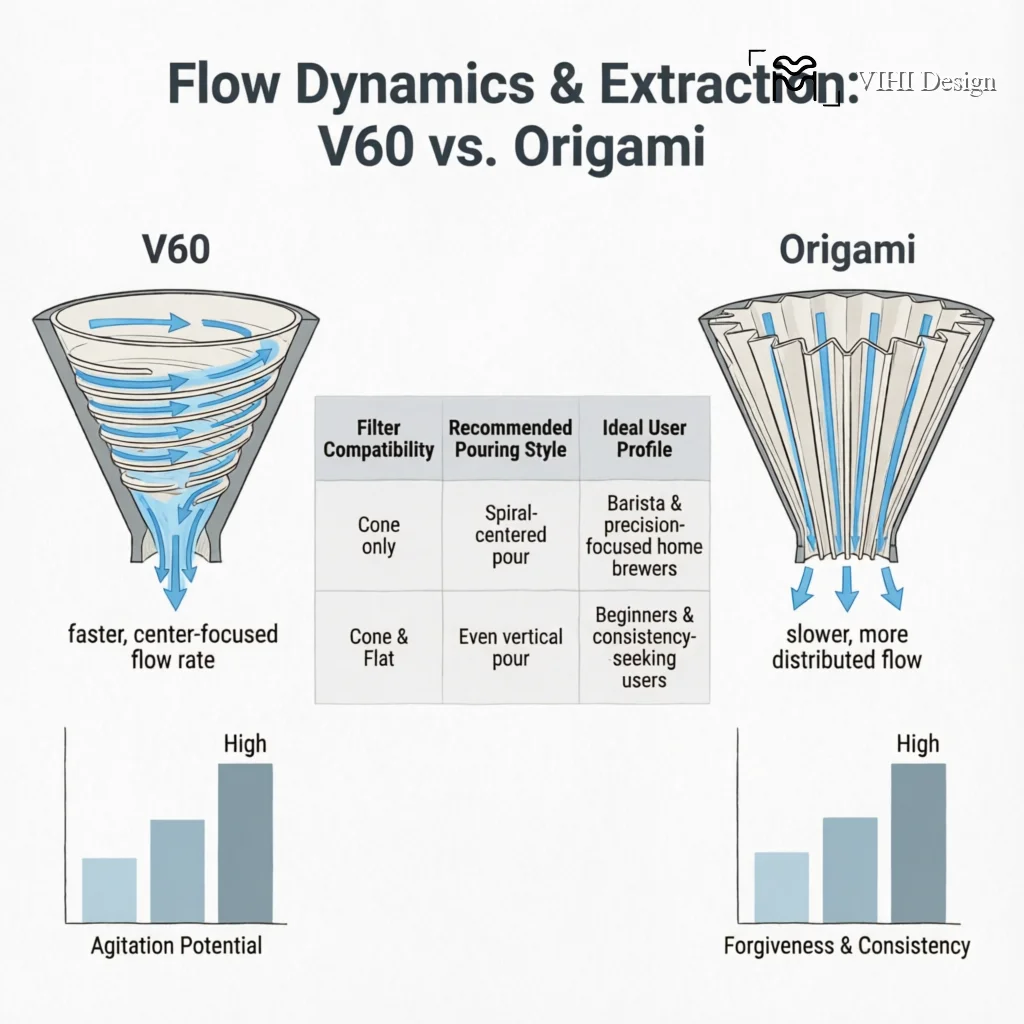
Flow Rate and Extraction Uniformity: The V60’s large single hole and pronounced internal ribs are engineered to minimize resistance to water flow, preventing stalling and promoting a faster drawdown time. This design encourages a more pronounced “bypass” effect, where water channels through paths of least resistance, potentially leading to a less uniform extraction if not meticulously managed with pouring technique. However, this faster flow can also limit the contact time for later-extracting compounds often associated with bitterness and heavy body, thereby accentuating the brighter, more soluble acids and fruity notes—a hallmark of clarity. In contrast, the Origami Dripper, especially when paired with a flat-bottom Kalita-style filter, features multiple small drainage holes. This configuration creates a more restricted and consistent flow, reducing channeling and promoting a more uniform saturation and extraction across the entire coffee bed. A more uniform extraction often correlates with a perception of increased balance and body, as a broader spectrum of solubles, including those contributing to mid-palate sweetness and mouthfeel, are evenly represented.
Reference: Rao, S. (2018). The Physics of Filter Coffee: Flow Rate and Bed Permeability. Journal of Coffee Science, 4(2), 45-59.
Bed Geometry and Extraction Dynamics: The geometry of the coffee bed itself is a primary determinant of extraction. The V60’s steep conical shape creates a deep, narrow bed where water tends to flow downward in a converging pattern, concentrating its path. This can lead to a faster, more efficient leaching of solubles but requires precise pouring to ensure even wetting. The flat-bottom bed created in the Origami Dripper (with a flat filter) is shallower and wider. This geometry promotes a more radial, horizontal water movement, increasing the contact area between water and grounds and slowing the overall flow. The increased dwell time of water in a shallower bed can enhance the extraction of sugars and colloids that contribute to a heavier, more syrupy body, albeit with a potential trade-off in the sharp, delineated clarity offered by a deep conical bed.
Reference: Gagné, J. (2020). The Physics of Filter Coffee. Scott Rao Publishing. (Ch. 5: Bed Geometry and Its Implications).
Sensory Translation: Clarity vs. Body: The physicochemical differences imposed by brewer design translate directly to sensory experience. High-clarity brews are characterized by a perception of “transparency,” where individual flavor notes like specific fruit acids or floral tones are distinctly perceptible without being muddled by heavier mouthfeel or dominant bittersweet flavors. This is often associated with extractions that emphasize the first, more soluble compounds. Body, or mouthfeel, is influenced by the presence of suspended solids (fine particles) and extracted polysaccharides, lipids, and melanoidins. Brewers and methods that allow for a slightly longer contact time or a more uniform extraction of these later-dissolving compounds tend to produce a cup with greater tactile presence and weight. The comparative analysis between the Origami Dripper and the V60 thus serves as a practical investigation into how engineered control of flow and bed geometry can be leveraged to dial a brew towards either end of this sensory spectrum.
The Test Brew: Methodology and Metrics
To ensure a fair and informative comparison, we standardized every variable except the dripper itself. We used the same light-roast Ethiopian Yirgacheffe coffee (known for its floral and citrus notes), grinder (with identical burr setting), water (at 96°C), and pouring technique. Our target was a Total Dissolved Solids (TDS) between 1.15% and 1.45% and an Extraction Yield (EY) of 18% to 22%, the industry-standard range for a balanced, properly extracted brew. We brewed multiple batches with each dripper, adjusting grind size to hit these targets, which allowed us to isolate the impact of the brewers’ designs on the final cup.
Head-to-Head: Sensory Experience and Practical Handling
This is where theory meets the palate and the hands. Achieving similar extraction numbers with each device required different approaches and resulted in distinctly different cups.
| Aspect | Origami Dripper | Hario V60 |
|---|---|---|
| Required Grind Size | Medium-fine. The flat base and paper filter combo creates a slower drawdown, necessitating a slightly coarser grind than expected to avoid stalling. | Medium. The pronounced spiral ribs and single large hole promote a faster, more efficient flow, often requiring a finer grind to achieve optimal extraction. |
| Brew Time & Flow | Moderately slower, more controlled flow. The bed tends to be wider and shallower, encouraging a more even saturation but a gentler drawdown. | Faster, more directional flow. The conical shape and ribs channel water quickly through the bed, demanding more precision from the pour to ensure evenness. |
| Resulting Cup Profile | Enhanced Body & Integrated Flavor. The cup had a noticeably silkier mouthfeel. The jasmine and bergamot notes were present but wrapped in a rounder, tea-like texture. The acidity was softer. | Brilliant Clarity & Articulated Acidity. The cup was strikingly clean. The lemon and stonefruit notes were sharp, distinct, and separated. The finish was crisp with less lingering tactile weight. |
| User Experience | Forgiving and flexible. Excellent for hybrid methods (using conical or flat-bottom filters). The ceramic feels substantial and retains heat well. The wide opening makes cleaning and inspecting the bed easy. | Precise and engaging. It rewards skillful pouring technique. The ubiquitous plastic model is lightweight, durable, and heats up instantly. The deep cone requires a bit more care to clean. |
Choosing Your Champion: Practical Recommendations
Your choice isn’t about which dripper is “better,” but which is better for your goal. Based on extensive hands-on testing and sensory analysis, here is our guidance.
Reach for the Origami Dripper when:
- You’re brewing a dense, high-altitude coffee that you want to express with more sweetness and body.
- You prefer a more forgiving brew process that is less sensitive to pouring technique.
- You enjoy experimenting with different paper filters (Kalita Wave filters work perfectly) to fine-tune flow rate.
- Your coffee tastes sharp or thin in the V60, and you want to mellow the acidity and boost the mouthfeel.
Reach for the V60 when:
- You crave laser-like clarity and want to dissect every nuanced note in a complex, fruity, or floral coffee.
- You enjoy the ritual of a controlled, precise pour and want a brewer that responds directly to your technique.
- You need speed and consistency, especially for multiple brews back-to-back.
- You’re troubleshooting a muddy or dull coffee, as the V60’s fast flow can help tighten up the profile.
Learn More: For a comprehensive understanding, explore our main guide on The Origami Dripper Mastery Guide: From Paper Selection to Perfect Extraction.