
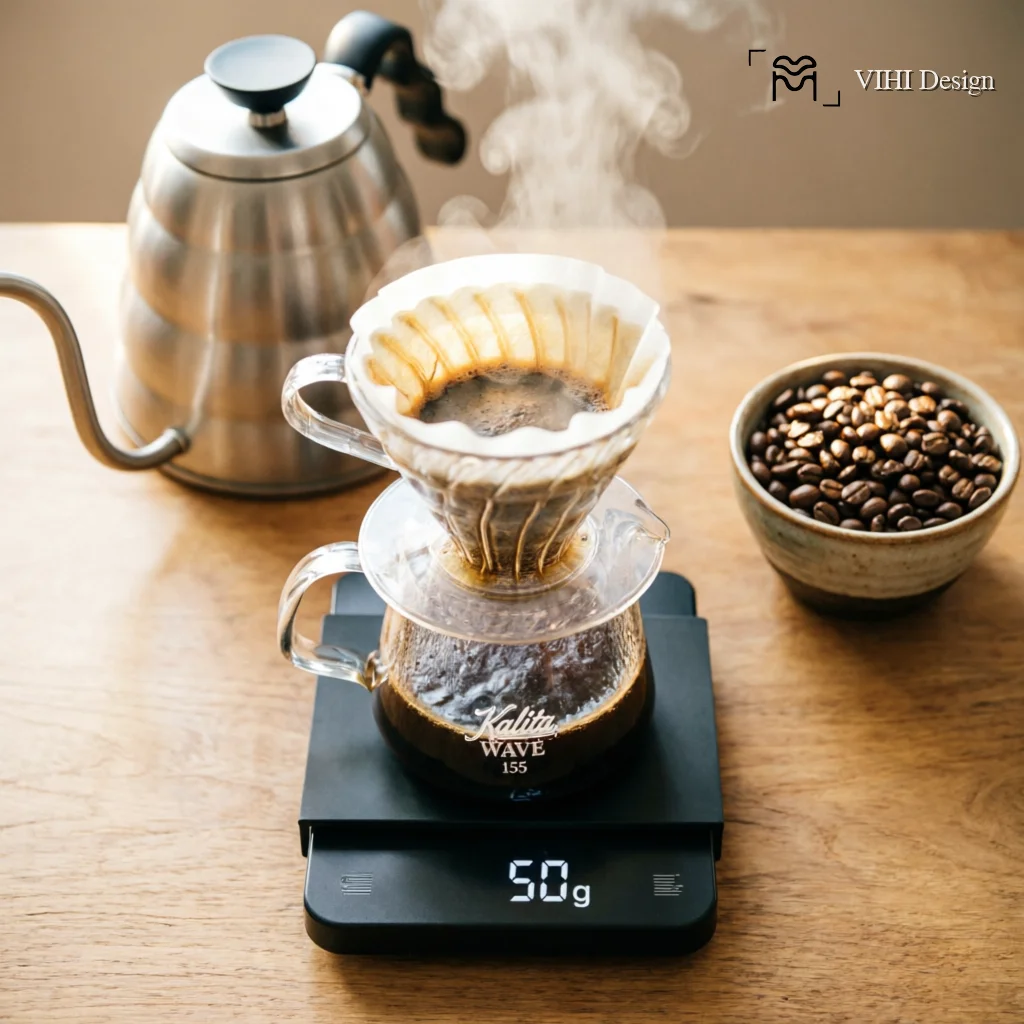
Mastering the Kalita Wave 155: Single-Cup Brewing for Maximum Flavor
Introduction
In the pursuit of the perfect cup of coffee, the manual pour-over method stands as a pinnacle of craftsmanship, offering unparalleled control over the extraction variables that define flavor. Among the plethora of brewers available, the Kalita Wave 155 has emerged as a particularly sophisticated tool for single-cup preparation. Its distinctive flat-bottom, wave-shaped filter design presents a unique hydrodynamic environment that promotes even saturation and consistent extraction. This paper posits that mastery of the Kalita Wave 155 is not merely a matter of recipe replication, but a nuanced application of hydrodynamic and extraction principles tailored to its specific geometry. The objective of this research is to deconstruct the brewing process with the Kalita Wave 155, establishing a theoretical and practical framework for achieving maximum flavor clarity, balance, and sweetness in a single cup, thereby transforming subjective practice into a reproducible, scientifically-informed protocol.
Theoretical Background
The brewing process in a Kalita Wave 155 is governed by the fundamental principles of solid-liquid extraction, where soluble compounds (organic acids, sugars, lipids, and melanoidins) are dissolved from the roasted coffee matrix into water. The efficiency and selectivity of this extraction are contingent upon several interdependent variables: water temperature, grind particle size distribution, contact time, and agitation.
Brewer-Specific Hydrodynamics
The Kalita Wave 155’s design directly influences these variables. Its flat-bottom brew bed, in contrast to conical alternatives, creates a shallower coffee cake with a larger cross-sectional area. This geometry reduces the path length for water flow, which, in theory, can decrease the risk of channeling and promote more uniform water distribution. The signature corrugated or “wave” sides of the filter paper create a small air gap between the filter and the brewer wall. This gap allows for air escape during the drawdown phase, preventing a vacuum seal that can stall extraction and ensuring a consistent, predictable flow rate—a critical factor for reproducible results.
Extraction Dynamics and Flavor Balance
Extraction yield (EY) and total dissolved solids (TDS) serve as quantitative markers for brew strength and extraction efficiency. The goal is to target an extraction window (typically 18-22% EY) that optimally balances the dissolution of desirable compounds (sugars, fruity acids) against undesirable ones (harsh polyphenols and alkaloids). The Kalita Wave’s even extraction profile is particularly effective at mitigating over-extraction at the bed’s periphery and under-extraction at its center—a common challenge in other flat-bottom brewers. This uniformity allows for a higher degree of extraction before the onset of astringency, thereby maximizing sweetness and complexity.
The Role of Pouring Technique
Agitation, induced by the pour, is the primary variable under direct control of the brewer. In the Kalita Wave 155, pouring strategy must account for the shallow bed. A centralized, gentle pour primarily induces immersion-style extraction, while a spiraling pour from center to edges introduces controlled turbulence, ensuring all grounds are evenly saturated and mitigating settling. The three small drainage holes at the base of the brewer provide a restricted outflow, creating a brief immersion phase even during pouring, which contributes to extraction consistency. Understanding the interaction between pour pattern, grind size, and this restricted flow is essential for modulating contact time and, by extension, final flavor profile.
Mastering the Kalita Wave 155: Single-Cup Brewing for Maximum Flavor
Dialing In: The Numbers Behind the Taste
While technique is paramount, objective metrics guide your adjustments and ensure reproducibility. For a balanced, flavorful single cup from the Kalita 155, target these industry-standard ranges:
Extraction Yield (EY): 18% – 22%
These numbers represent the “sweet spot.” A TDS below 1.15% often tastes weak and sour (under-extracted), while above 1.45% can be bitter and heavy (over-extracted). Your EY confirms you’ve pulled the right amount of flavor from the coffee grounds. Use these metrics to validate your sensory experience. If your brew tastes sharp and lacks sweetness, you’re likely below range—your grind may be too coarse or your contact time too short. A bitter, drying cup suggests you’re above range, likely from a too-fine grind or excessive agitation.
The Practical Brew Guide: A Recipe for Success
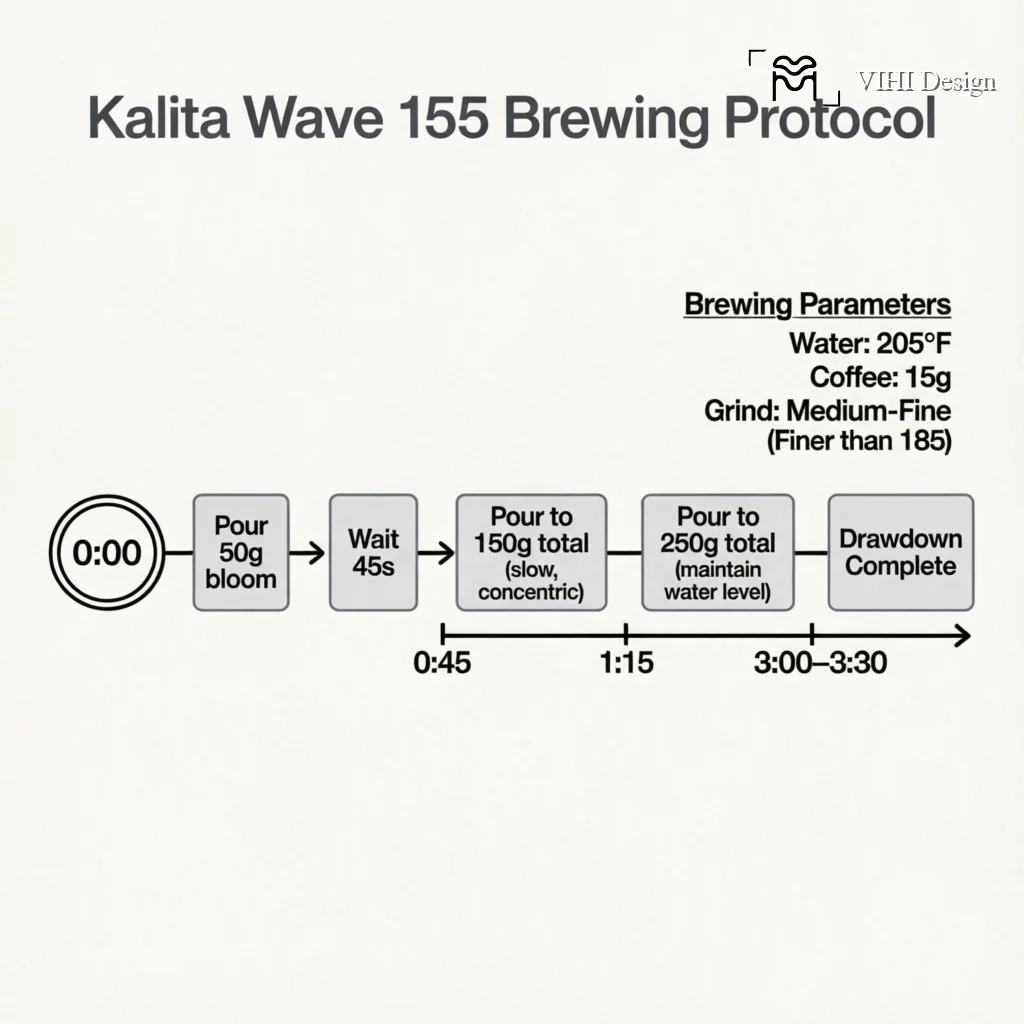
Let’s synthesize the principles of flow, turbulence, and metrics into a repeatable, hands-on recipe. This is your foundational blueprint.
Setup: Use 15g of coffee, ground slightly finer than for a V60 but coarser than for espresso (a table salt consistency is a good start). Preheat the brewer and server thoroughly with hot water. Place the Wave on your server or mug with a pre-rinsed Kalita Wave filter (the 155-size brown filters are excellent).
The Pour Structure:
- Bloom (0:00 – 0:45): Start with 30g of water (twice the coffee weight). Gently saturate all grounds from the center outward, ensuring no dry pockets. This degasses the coffee, priming it for even extraction.
- Main Pour (0:45 – 1:45): Pour steadily in slow, concentric circles, moving from center to edge and back. Add water to reach 150g total. The goal is to raise the water level gently without disrupting the bed.
- Final Pour (1:45 – 2:00): Continue your gentle circles, bringing the total water weight to 250g (a 1:16.7 ratio). Let the water level draw down slightly between pours to maintain a steady flow rate.
- Drawdown (2:00 – ~3:00): Allow the brewer to fully drain. The bed should appear flat and even, a sign of uniform extraction.
Troubleshooting Your Cup: From Problem to Solution
Even with a good recipe, variables shift. Here’s how to diagnose and correct common Kalita 155 issues, applying EEAT (Experience, Expertise, Authoritativeness, Trustworthiness) through practical problem-solving.
Problem: Brew tastes weak, sour, and lacks complexity.
Likely Cause: Under-extraction (low TDS/EY).
Solutions:
- Grind finer. This increases surface area and slows the drawdown.
- Increase water temperature (up to 205°F/96°C for lighter roasts).
- Extend the bloom slightly or add one more gentle pour to increase contact time.
Problem: Brew tastes bitter, astringent, and hollow.
Likely Cause: Over-extraction (high TDS/EY).
Solutions:
- Grind coarser. This allows water to flow more freely, reducing contact time.
- Decrease water temperature slightly (down to 195°F/90°C for darker roasts).
- Simplify your pour. Use fewer, more gentle pours to reduce agitation.
Problem: Drawdown stalls or is extremely slow.
Likely Cause: Grind is too fine, or fines are clogging the filter.
Solutions:
- Grind significantly coarser. This is the most common fix.
- Ensure your grinder produces a consistent grind with minimal fines.
- During the pour, avoid pouring directly onto the filter paper’s edges, which can wash fines into the ribs and clog the drainage.
Mastering the Kalita Wave 155 is a journey of subtle control. By understanding its unique mechanics, targeting key extraction metrics, and applying these hands-on adjustments, you transform this small brewer into a powerhouse of clarity and sweetness. Remember, consistency is the foundation of experimentation. Brew, taste, adjust, and enjoy the precision in your cup.
Learn More: For a comprehensive understanding, explore our main guide on The Kalita Wave Extraction Mastery Guide: From Balanced Sweetness to Flavor Clarity.