Controlled Atmosphere Fermentation: Beyond Anaerobic Sealing – A Technical Guide to Gas Mixtures, Pressure, and Precision Processing
1. Introduction: The Evolution from Anaerobic to Controlled Atmosphere Fermentation
The pursuit of flavor differentiation and quality enhancement in specialty coffee processing has driven significant innovation in post-harvest methodologies. A prominent development in this domain is the adoption of modified atmospheric conditions during the fermentation stage. Initially, the industry embraced the concept of “anaerobic fermentation,” characterized by the submersion of coffee cherries or mucilage in water or their placement in sealed, impermeable containers to create an oxygen-depleted environment. This technique, while a marked departure from traditional open-air fermentation, is fundamentally limited. Its primary control variable is the removal of atmospheric oxygen (O₂), relying on microbial respiration to naturally alter the internal gas composition, which becomes a dynamic and largely unmeasured byproduct of the process.
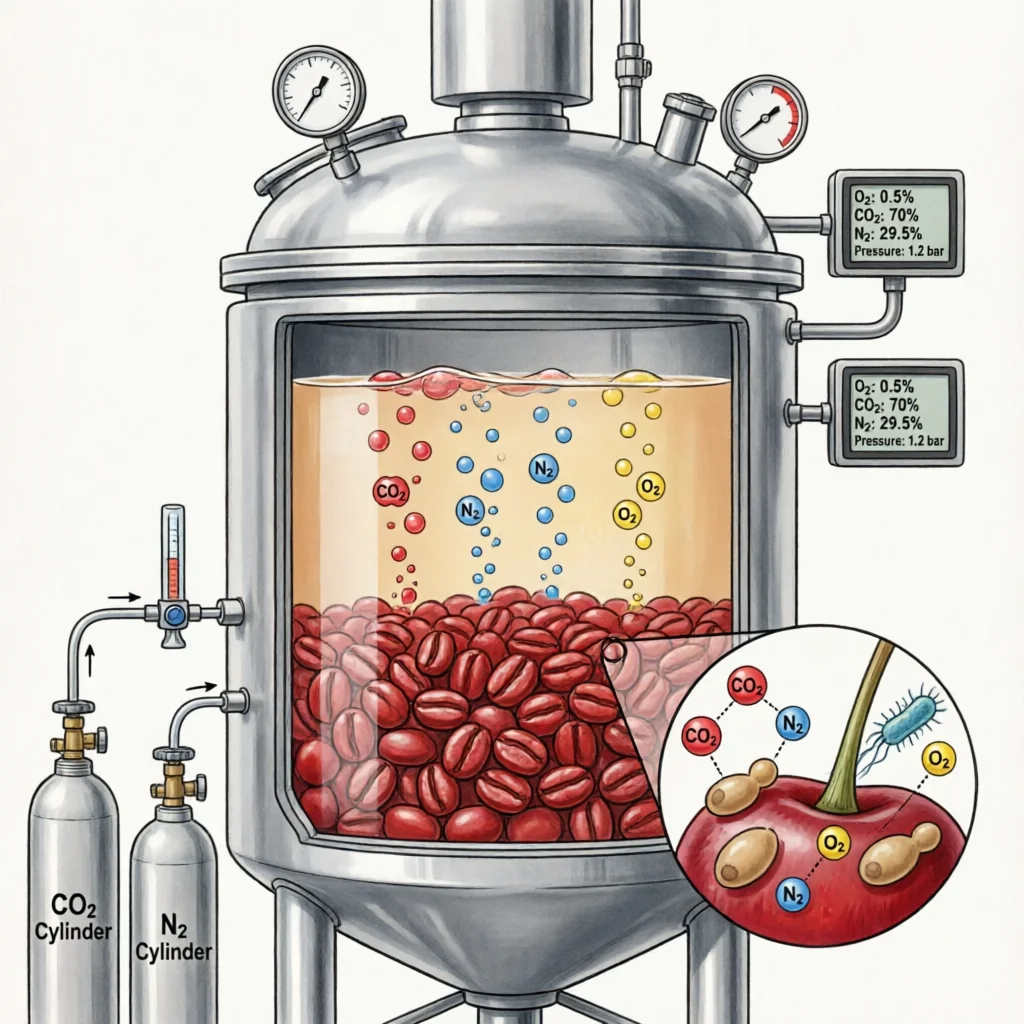
The logical and technologically advanced progression from this is Controlled Atmosphere (CA) Fermentation. This approach represents a paradigm shift from passive oxygen exclusion to active atmospheric engineering. CA Fermentation involves the precise regulation of multiple gas species—including carbon dioxide (CO₂), nitrogen (N₂), argon (Ar), and trace gases—within a sealed fermentation vessel. This is achieved through specialized equipment capable of gas injection, evacuation, and continuous monitoring. The core objective transitions from simply creating an anaerobic state to designing and maintaining a specific, reproducible gaseous matrix. This matrix directly influences the metabolic pathways of microbial consortia (yeasts, bacteria, and fungi) and the biochemical reactions within the coffee seed, thereby offering unprecedented command over flavor development, fermentation kinetics, and final cup profile.
2. Technical Distinction: Anaerobic Sealing vs. Controlled Atmosphere Regulation
The terms “anaerobic” and “controlled atmosphere” are often conflated but describe fundamentally different processes with distinct technical parameters and outcomes. The critical distinction lies in the intent and precision of gas composition management.
Core Conceptual Differences
Anaerobic sealing is a method focused on establishing a barrier to atmospheric oxygen. The resulting internal environment is a consequence of microbial activity: as microbes respire, they consume residual O₂ and produce CO₂. The final partial pressures of these gases are not predetermined but are emergent properties of microbial population dynamics, substrate availability, and temperature. In contrast, Controlled Atmosphere Regulation is an applied gas chemistry process. The initial headspace gas composition is actively established—often by vacuum evacuation followed by backfilling with a target gas mixture—and can be maintained or dynamically altered throughout fermentation. The atmosphere is an independent variable, not a dependent outcome.
Comparison of Technical Parameters
The following table delineates the key operational and outcome-based differences between the two methodologies.
- Primary Objective:
- Anaerobic Sealing: To create an oxygen-depleted environment via physical sealing.
- CA Regulation: To establish and maintain a precise, multi-gas atmospheric recipe.
- Control Variables:
- Anaerobic Sealing: Presence/absence of O₂ (indirectly), time, temperature.
- CA Regulation: Partial pressures of O₂, CO₂, N₂, Ar, etc.; total pressure; time; temperature.
- Gas Composition:
- Anaerobic Sealing: Dynamic and unknown; high CO₂, trace O₂, variable.
- CA Regulation: Static or programmed dynamic profile; precisely defined.
- Key Equipment:
- Anaerobic Sealing: Sealed tank, barrel, or plastic vessel with one-way valve.
- CA Regulation: Pressure-rated stainless steel tank, vacuum pump, gas cylinders, regulators, flow meters, pressure and gas sensors (e.g., O₂/CO₂ analyzers).
- Process Influence:
- Anaerobic Sealing: Influences microbial selection broadly via O₂ deprivation.
- CA Regulation: Directly modulates microbial metabolism and enzyme activity via specific gas partial pressures (e.g., high CO₂ can suppress certain bacteria, low O₂ promotes specific yeast pathways).
- Reproducibility & Precision:
- Anaerobic Sealing: Low to moderate; batch variation is common due to uncontrolled variables.
- CA Regulation: High; allows for precise replication of atmospheric conditions across batches.
Theoretical Implications for Fermentation Biochemistry
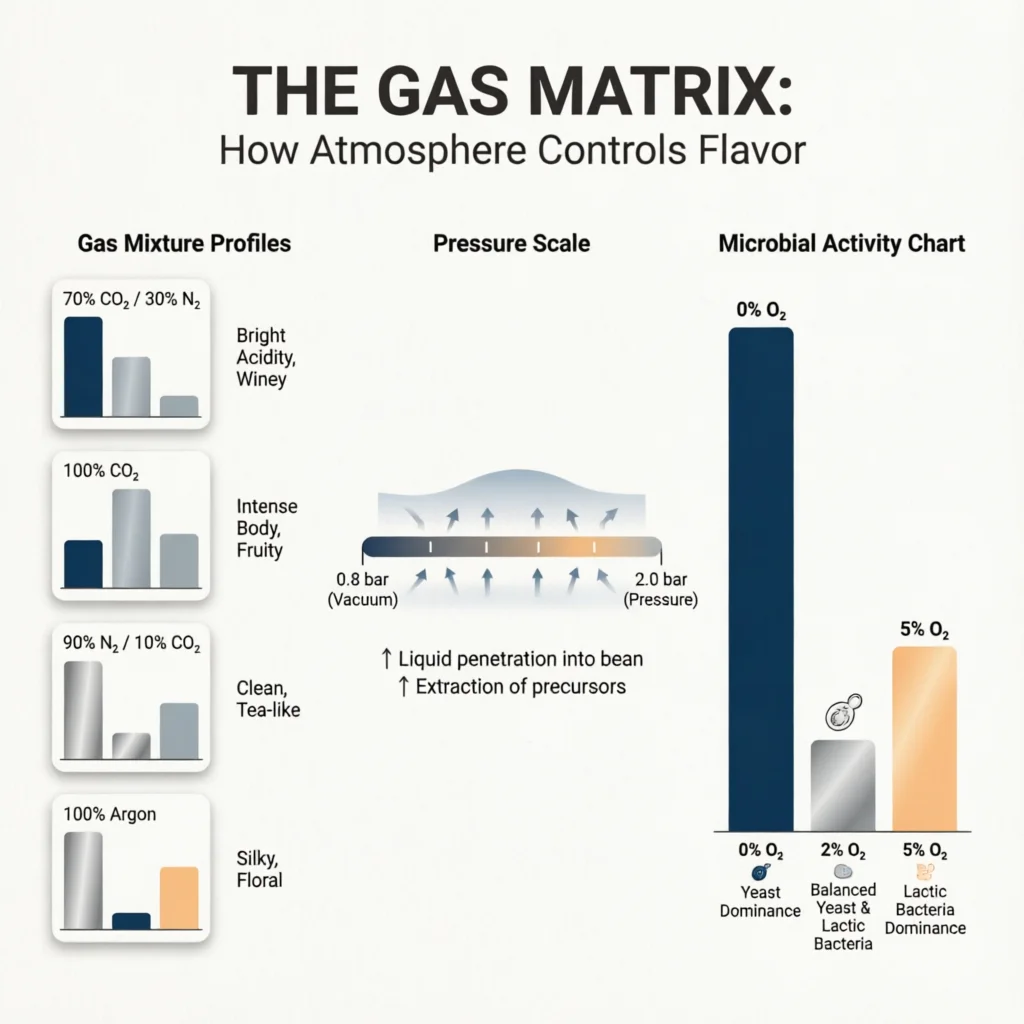
The shift to CA Fermentation introduces direct levers to influence biochemical pathways. For instance, elevated CO₂ partial pressure can lower intracellular pH in microbial cells, selectively inhibiting acid-sensitive bacteria while favoring yeasts tolerant of carbonic acid conditions. The use of inert gases like N₂ or Ar can create a truly inert background, allowing the study of specific gas effects in isolation. Furthermore, the ability to introduce micro-oxygenation (e.g., 1-5% O₂) enables the steering of metabolic flux between strictly fermentative and respiratory pathways in yeast, impacting the production of esters, higher alcohols, and organic acids. This level of control moves coffee processing from an empirical craft towards a applied biochemical engineering discipline.
Engineering the Atmosphere: From Flush to Feedback Control
Initial gas flushing merely sets the stage. The true engineering challenge lies in maintaining a specified atmospheric composition against the dynamic biochemical activity of fermentation. Yeast and bacteria actively metabolize substrates, consuming oxygen and producing carbon dioxide. This shifts the gas ratios, potentially pushing the process into an unintended metabolic state. Advanced systems address this with real-time monitoring and closed-loop control. In-line paramagnetic or zirconia oxygen sensors provide continuous data, triggering automated injections of pure gases or pre-mixed blends to maintain setpoints. This transforms a static “anaerobic” environment into a dynamically controlled bioreactor, where gas composition becomes a real-time variable as precise as temperature.
Quantifying the Impact: Analytical Correlations in the Cup
Precise atmospheric control directly translates to measurable and replicable quality markers in the final brew. By isolating variables, we establish clear cause-and-effect relationships between gas environment and sensory outcome.
- Esters & Fruit Complexity: Strictly anaerobic conditions (O₂ < 0.1%) favor fermentative pathways, promoting ester formation (ethyl acetate, isoamyl acetate) for intense fruity and floral notes. Introducing 2-4% O₂ can steer metabolism toward respiration, modulating ester production and encouraging cleaner, more structured acidity.
- Acidity & Malic Degradation: Controlled micro-oxygenation (1-3% O₂) can support microbial populations that metabolize malic acid, softening perceived acidity and increasing perceived sweetness without the risk of acetic acid (vinegar) production common in uncontrolled, oxygen-starved ferments.
- Body & Mouthfeel: Extended fermentation in inert nitrogen (N₂) atmospheres often correlates with higher polysaccharide retention, leading to a heavier, syrupy body. Argon (Ar), being denser, may further influence extraction dynamics during processing, potentially affecting the retention of heavier volatile compounds.
For roast and brew quality control, target these analytical ranges: Total Dissolved Solids (TDS): 1.15% – 1.45%; Extraction Yield (EY): 18% – 22%; with a consistent particle size (e.g., 800-900 microns for pour-over) to isolate flavor variables originating from processing.
Barista’s Field Notes: Addressing Common Struggles
Moving theory into practice reveals critical gaps between intention and execution in controlled fermentation.
- The “Sealed Tank” Myth: Achieving true oxygen-free conditions with just a sealed tank is nearly impossible. Residual O₂ in the headspace, dissolved in the pulp, or trapped in the coffee mucilage always affects fermentation unpredictably, making true replication a gamble.
- Terminology Confusion: Many producers do not understand that ‘anaerobic’ and ‘controlled atmosphere’ are different processes. Assuming any sealed fermentation is “controlled” leads to misapplied techniques and confused expectations.
- Inconsistency Drivers: Batch-to-batch inconsistency in simple anaerobic setups often stems from variable atmospheric conditions—daily changes in barometric pressure or temperature can alter gas solubility and microbial activity in a supposedly closed vessel.
- The Investment Hurdle: Small-scale producers rightly fear investing in gas equipment without clear ROI data or proven, scalable protocols. The jump from a sealed barrel to a system with gas cylinders, regulators, and sensors seems vast and financially unjustified.
Pro-Tip: The most critical control point isn’t the initial gas flush, but maintaining the atmosphere during fermentation. Top producers use in-line oxygen sensors with automated gas injection to maintain ±0.2% O₂ tolerance throughout the entire 72-120 hour process. For those without sensors, a simple water lock with colored indicator fluid that changes pH with CO₂ production (e.g., bromothymol blue) can provide visual feedback on fermentation activity and gas composition shifts, offering a low-tech proxy for metabolic rate.
Scalable Technology: Bridging the Gap from Lab to Lot
The future of accessible controlled-atmosphere processing lies in modular, scalable systems. Innovations include single-use, oxygen-barrier fermentation liners placed within standard tanks, purged with affordable food-grade CO₂ from fermentation lock kits. Smart sensor arrays using IoT technology can now log O₂, CO₂, and temperature data to a smartphone, providing smallholders with the analytics previously reserved for industrial labs. The key is developing robust protocols that map specific gas mixtures (e.g., 100% N₂ vs. 95% N₂ / 5% O₂) to desired sensory profiles for common varieties, turning abstract gas theory into a practical decision tree for farmers.
Technical Summary
- Controlled-atmosphere processing employs inert gases (N₂, Ar) or defined low-oxygen blends to dictate microbial metabolic pathways, moving beyond the binary of aerobic/anaerobic.
- Precise oxygen management between 0.1% and 5% O₂ directly steers the production of esters, acids, and alcohols, enabling targeted flavor development.
- Process control requires dynamic gas management to counter microbial gas consumption/production; optimal systems use real-time sensors and automated injection.
- Sensory outcomes manifest in measurable brew metrics; target a TDS of 1.15%-1.45% and an EY of 18%-22% with consistent grind size to evaluate processing effects.
- Scalable, low-cost tools like indicator-based airlocks and IoT sensors are democratizing access to reproducible controlled-fermentation techniques.