
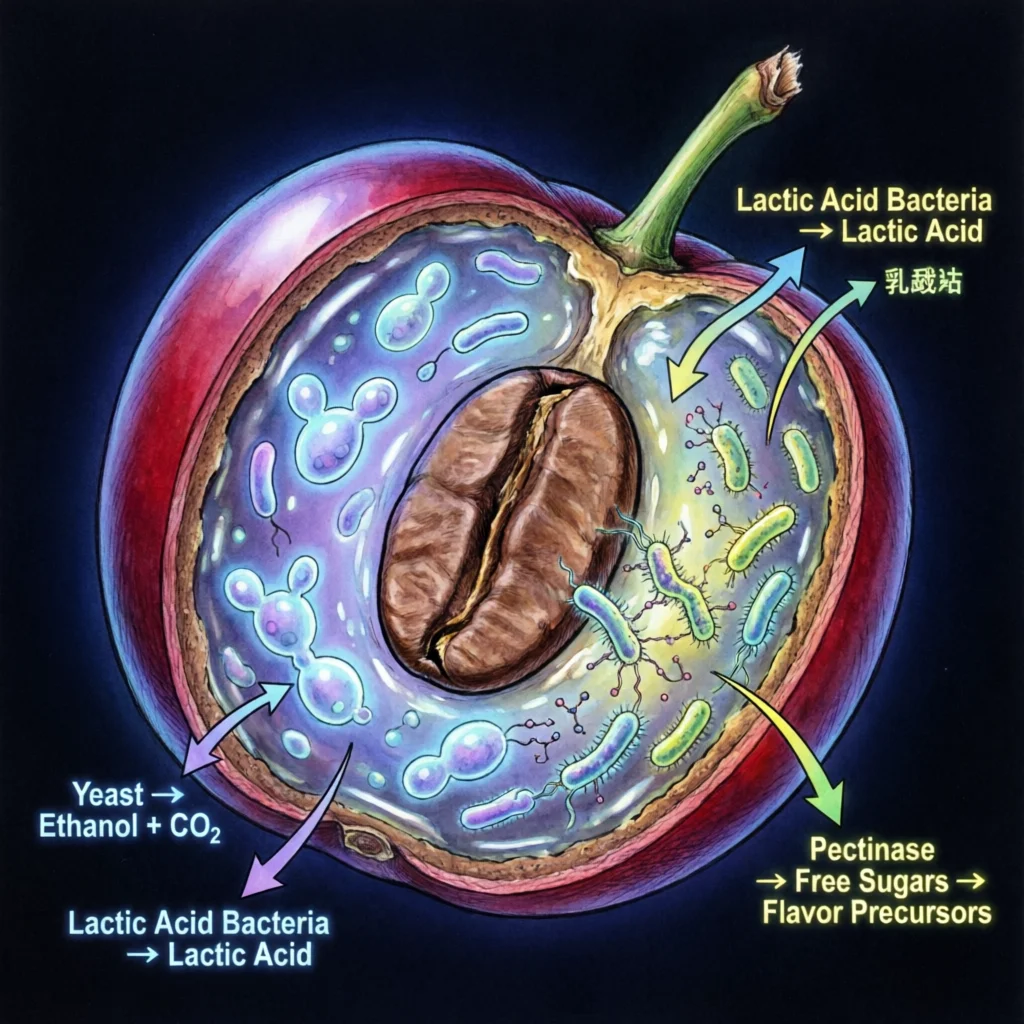
Introduction: The Hidden World in Your Coffee Cherry – Why Mucilage Matters
Coffee quality is a function of genetics, environment, and post-harvest processing. Among these, the controlled microbial fermentation of coffee mucilage has emerged as a critical, yet historically overlooked, determinant of final cup sensory profile. The coffee cherry is a complex biological structure consisting of the outer skin (exocarp), the sugary pulp (mesocarp), a viscous, pectin-rich layer known as mucilage (parenchyma), the parchment (endocarp), the silverskin (spermoderm), and the two seeds (endosperm). Following harvest, the primary objective of post-harvest processing is the removal of these outer layers to isolate the stable parchment coffee. The mucilage, a heterogeneous hydrogel adhering tenaciously to the parchment, is the central substrate for fermentation in washed and many hybrid processing methods.
The chemical composition of mucilage makes it a pivotal precursor for flavor development. It is approximately 85% water, with a dry matter composition dominated by pectin (30%), sugars (30% as sucrose, glucose, fructose), and smaller amounts of proteins, organic acids (e.g., citric, malic), and minerals. This nutrient-dense, aqueous environment presents an ideal ecological niche for diverse microbial communities. The fermentation process is, in essence, a targeted microbial degradation of this mucilage layer. The metabolic activities of indigenous or inoculated yeasts, bacteria, and fungi do not merely facilitate mucilage removal through pectinolysis; they generate a cascade of volatile and non-volatile compounds that diffuse into the seed. These compounds directly and indirectly influence the formation of key aroma and flavor precursors that are later expressed during roasting.
The Science of Breakdown: Pectin, Enzymes and Microbial Metabolism
The fundamental biochemical event in coffee mucilage fermentation is the depolymerization of pectin. Pectin is a complex heteropolysaccharide whose backbone consists primarily of α-(1-4)-linked D-galacturonic acid residues, often methyl-esterified. Its structural integrity is responsible for the mucilage’s adhesive and hydrogel properties. Efficient mucilage removal requires the breakdown of this pectin matrix, a process achieved through the synergistic action of microbial pectinolytic enzymes.
Key Enzymatic Activities
Microbial consortia produce a suite of enzymes that attack pectin through different mechanisms:
- Pectin Methylesterase (PME): Catalyzes the de-esterification of pectin, removing methoxyl groups to produce pectic acid and methanol. This demethylation is often a prerequisite for the efficient function of subsequent depolymerizing enzymes.
- Polygalacturonase (PG): Hydrolyzes the α-1,4 glycosidic linkages in the polygalacturonic acid chain (endo-PG acts randomly within the chain, exo-PG acts at the chain ends), producing oligogalacturonides and galacturonic acid monomers.
- Pectin Lyase (PL): Cleaves glycosidic linkages via a β-elimination mechanism without the requirement for prior de-esterification, generating unsaturated oligogalacturonates.
The activity of these enzymes, influenced by environmental factors such as temperature, pH, and oxygen availability, dictates the rate and completeness of mucilage degradation.
Microbial Metabolic Pathways and Flavor Precursor Formation
Concurrent with and following pectin breakdown, microbial metabolism of liberated sugars and other mucilage constituents drives chemical transformations central to flavor development. Three primary pathways are significant:
- Alcoholic Fermentation: Conducted primarily by yeasts (e.g., Saccharomyces, Pichia, Hanseniaspora), this pathway converts hexose sugars (glucose, fructose) into ethanol and carbon dioxide via glycolysis (Embden-Meyerhof-Parnas pathway). Secondary metabolites from this pathway, including higher alcohols (fusel oils), esters, and aldehydes, are key volatile aroma precursors.
- Lactic Acid Fermentation: Undertaken by lactic acid bacteria (LAB) such as Lactobacillus and Leuconostoc, this involves the homofermentative or heterofermentative conversion of sugars into lactic acid, acetic acid, ethanol, and CO₂. This activity acidifies the fermentation mass, influencing enzyme activity, microbial selection, and the final acidity profile of the coffee.
- Acetic Acid Fermentation: Often carried out by acetic acid bacteria (AAB) like Acetobacter in the presence of oxygen, which oxidize ethanol produced by yeasts into acetic acid. While controlled production can add complexity, excessive acetic acid is detrimental.
The metabolic byproducts of these pathways—acids, alcohols, esters, and other compounds—interact with the coffee seed. They may diffuse directly into the endosperm, act as substrates for further reactions, or alter the seed’s physiological state during fermentation (e.g., inducing germination-like metabolism). This biochemical influx directly shapes the pool of compounds that, upon roasting, undergo Maillard reactions, Strecker degradation, and caramelization to form the final volatile aromatic compounds defining coffee flavor.
The Roaster’s Crucible: Translating Biochemical Potential into Flavor
The compounds established during fermentation represent raw potential. Roasting provides the kinetic energy to actualize this potential through a precise sequence of thermal reactions. The Maillard reaction, a non-enzymatic browning between amino acids and reducing sugars, generates a vast array of flavor and color compounds. The specific amino acid profile, altered by fermentation, dictates the pathway of this reaction. A seed rich in valine, for instance, will produce more isobutyraldehyde upon Strecker degradation, leading to nutty, malty notes. Caramelization of sugars introduced or preserved during processing adds layers of sweetness and viscosity. Critically, the organic acids present—lactic, acetic, citric—modulate roast development. Higher levels of fermentation acids can accelerate bean structure breakdown, requiring a roaster to adjust charge temperature and rate of rise to avoid baking or scorching the seeds.
Quantifying the Impact: Extraction Metrics for Fermented Coffees
Fermentation-induced changes to bean density, porosity, and compound solubility directly influence brewing parameters. Coffees with intense fermentation profiles often exhibit distinct extraction behaviors that baristas must calibrate for.
- Total Dissolved Solids (TDS): Target a range of 1.15% – 1.45%. Highly processed coffees often achieve optimal flavor at the lower end of this spectrum (1.15%-1.25%) to avoid over-extracting dominant fermentation compounds.
- Extraction Yield (EY): Maintain the standard 18% – 22% range, but note that the “ideal” point shifts. A lactic-forward anaerobic coffee may taste balanced at 19% EY, while a washed process from the same origin might demand 20.5%.
- Grind Particle Size: Often requires a slightly coarser setting than traditional washed coffees. Increased bean brittleness from prolonged fermentation can create more fines, leading to channeling and astringency if not compensated for.
Barista’s Field Notes: Addressing Common Struggles
Practical application of this science is fraught with challenges. Here is how to navigate them.
Inconsistent Lots for Roasters: A “72-hour anaerobic” label is not a recipe. Variability in microbial populations, seed density, and ambient temperature between lots causes divergence. Roasters must cup each lot green and design a profile based on the seed’s current state, not its process name. Start with a lower charge temperature and extend the drying phase to probe bean stability.
Fermentation Timing for Producers: Weather variability is the greatest foe. In cold conditions, fermentation stalls; in heat, it races. Producers must monitor Brix and pH, not just hours. Targeting a specific pH drop (e.g., from 6.0 to 4.5) is more reliable than a fixed time. Using insulated tanks or temperature-controlled water can mitigate environmental swings.
Identifying Off-Flavors for Baristas: Distinguishing fermentation flaws from roast flaws is critical. Fermentation-derived off-flavors (acetic acid/vinegar, butyric acid/rancid cheese, ethyl acetate/nail polish remover) are often sharp and present from the first crack of the crust. Roast-derived off-flavors (scorched, baked, underdeveloped) often manifest as hollow mid-palates, grassy notes, or ashy bitterness. Cup the coffee at multiple grind settings; fermentation flaws persist, while roast flaws can shift with extraction.
Contradictory Terminology for Buyers: The industry lacks standardization. “Anaerobic” broadly means without oxygen, but vessel type (grain-pro, sealed tank) matters. “Carbonic maceration” specifically involves injecting CO2 to create an anaerobic environment, often with whole cherry. Buyers must ask producers for specifics: vessel material, headspace management, cherry state (whole/crushed), and temperature monitoring. The details, not the label, define the process.
Pro-Tip: When cupping, separate fermentation-derived acidity from origin acidity by focusing on the finish: fermentation acids (lactic, acetic) tend to leave a cleaner, quicker finish, while origin acids (malic, citric) linger longer on the palate. Use this to distinguish processing effects from terroir.
Future Frontiers: Precision Fermentation and Flavor Design
The next evolution moves from observation to design. Precision fermentation involves inoculating coffee with specific, cultured microbial strains (e.g., Saccharomyces cerevisiae var. boulardii for stone fruit, or Lactobacillus plantarum for creamy body) to produce target metabolite profiles. This approach reduces inconsistency and enables the creation of novel, traceable flavor experiences. Concurrently, real-time metabolite sensors allow producers to halt fermentation at an exact chemical milestone, guaranteeing a predefined sensory outcome. This transforms processing from an artisanal practice into a replicable, biochemical engineering discipline.
Technical Summary
- Fermentation compounds directly seed the Maillard reactions and Strecker degradation of roasting, defining the volatile aroma profile.
- Optimize extraction for fermented coffees by targeting the lower end of the TDS range (1.15%-1.25%) and adjusting grind size coarser to manage fines.
- Diagnose off-flavors by noting persistence across extraction variables; fermentation flaws are static, roast flaws are dynamic.
- Overcome terminology confusion by sourcing specific production details (vessel, pH management, cherry state) rather than relying on process labels.
- Leverage the finish of acidity on the palate to differentiate shorter, cleaner fermentation acids from lingering, complex origin acids.
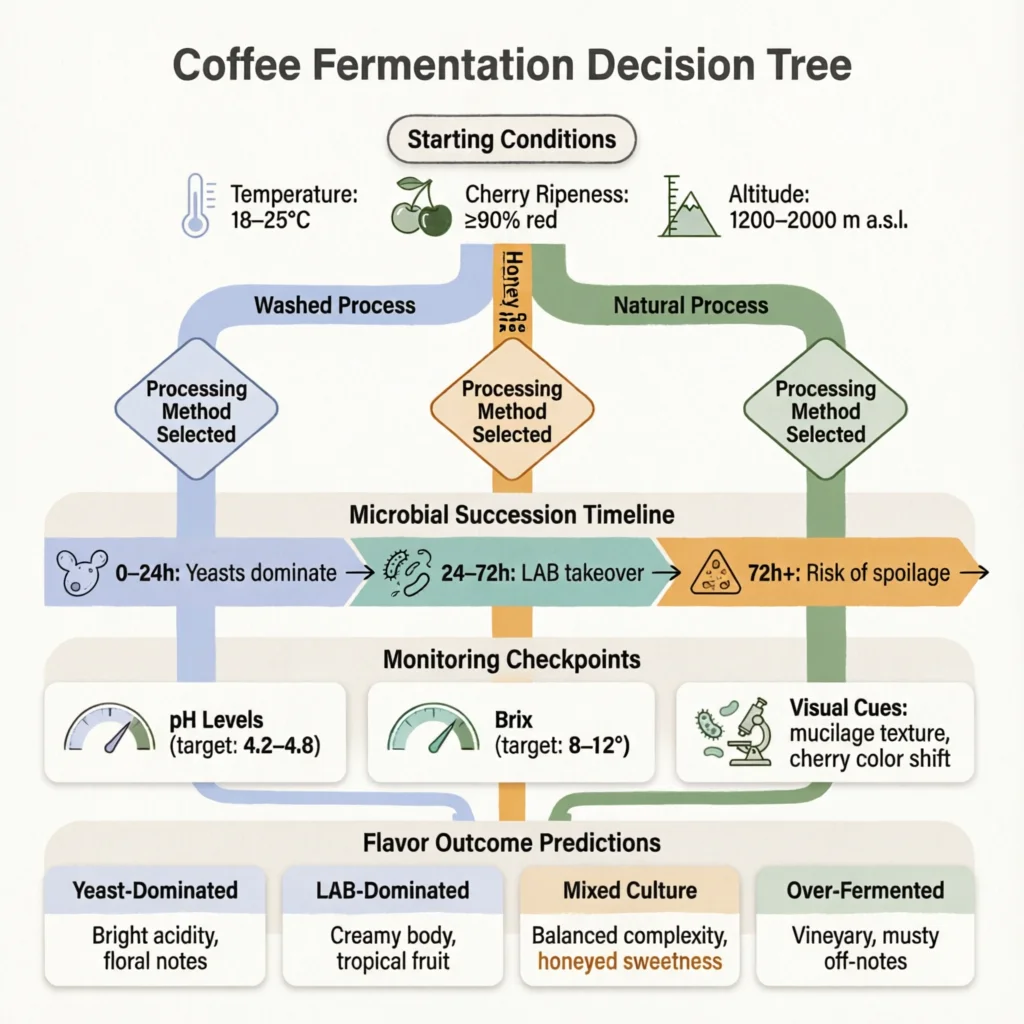
“`json
“`
“`html
“`
Learn More: For a comprehensive understanding, explore our main guide on The Complete Guide to Coffee Post-Harvest Processing: From Cherry to Green Bean.
Leave a Reply