
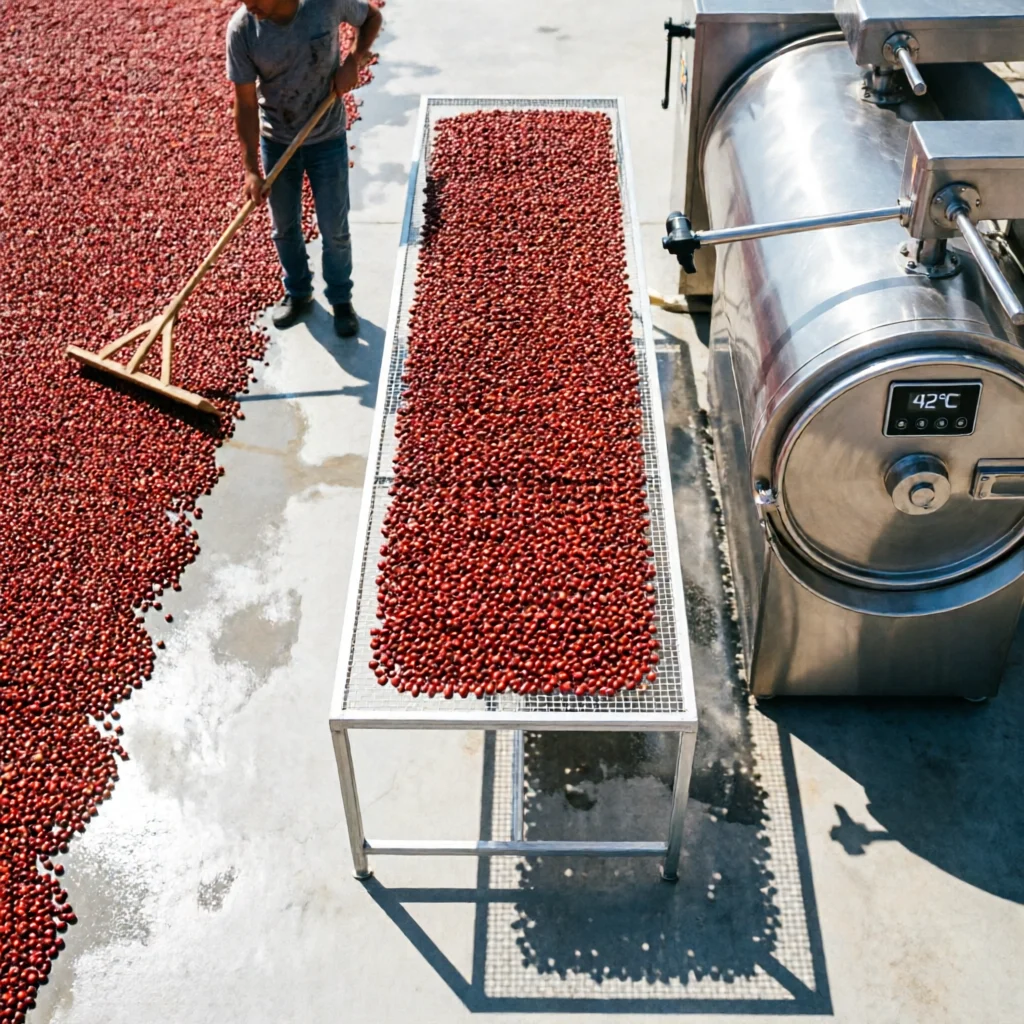
Coffee Drying Methods: Patios, Raised Beds, and Mechanical Dryers Compared – The Definitive Guide to Flavor Preservation
Executive Summary & Comparison Matrix
The selection of a post-harvest drying method is a primary determinant of final cup quality, operational efficiency, and economic viability for coffee producers. This analysis compares the three predominant methodologies: traditional concrete patios, elevated raised beds (African beds), and controlled mechanical dryers. The matrix below provides a foundational comparison across critical metrics.
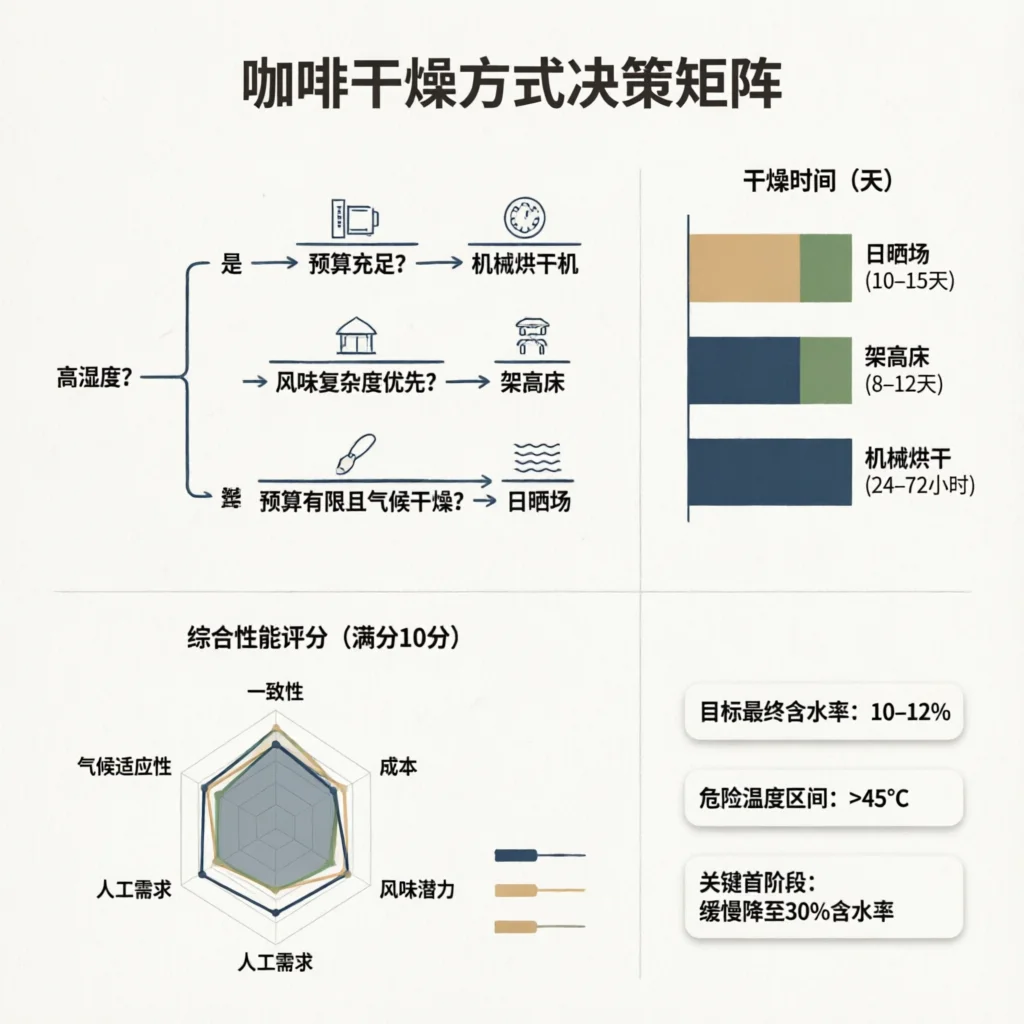
Comparative Analysis Matrix
- Method: Patio (Concrete) | Raised Bed (African) | Mechanical Dryer
- Capital Cost: Low | Moderate | High
- Drying Time (to 11% moisture): 8-15 days (weather-dependent) | 7-12 days (weather-dependent) | 24-72 hours (controlled)
- Labor Intensity: High (constant raking, weather vigilance) | High (regular turning, weather vigilance) | Low to Moderate (loading, monitoring)
- Climate Suitability: Requires consistent sun, low humidity; high risk in humid/rainy regions. | Better air circulation tolerates slightly higher humidity; still sun-dependent. | Independent of weather; suitable for all climates, especially humid regions.
- Process Consistency & Control: Low (subject to ambient fluctuations). | Moderate (improved airflow reduces risk). | High (precise control over temperature, airflow, humidity).
- Flavor Impact Profile: Risk of over-fermentation, mold, or mustiness if slow; can produce clean, balanced cups in ideal conditions. | Promotes even drying, reduces fermentation risk; often associated with enhanced clarity and complexity. | Enables precise profiles; risk of “baked” or flat flavors if overheated; can preserve origin character with correct protocol.
- Physical Bean Quality: Higher risk of cracking, uneven moisture content. | Lower physical damage, superior uniformity. | High uniformity; risk of brittleness if over-dried.
- Space Requirement: High. | High. | Low to Moderate.
- ROI Timeline: Short (low investment). | Medium. | Long (high initial investment).
The Science of Coffee Drying
Drying is not merely a dehydration process but a critical phase of biochemical stabilization and flavor development. Post-pulping, coffee parchment possesses a moisture content of approximately 55-60%. The objective is a systematic reduction to 10-12% moisture content, at which point biochemical activity and microbial growth are effectively halted.
Chemical Transformations During Drying
The primary chemical processes involve carbohydrate and acid metabolism. Residual mucilage, rich in sugars and pectins, is metabolized by endogenous enzymes and microbial activity. This process concentrates sucrose and reducing sugars within the bean. Concurrently, organic acids such as citric, malic, and quinic acids undergo degradation, directly influencing perceived acidity and flavor balance. The rate of moisture migration from the bean’s interior to its surface governs the kinetics of these reactions. An optimal, gradual rate allows for the development of favorable flavor precursors without the accumulation of undesirable metabolites like acetic acid or ethanol from uncontrolled fermentation.
The Drying Curve and the Critical First Phase
The drying process follows a non-linear curve, characterized by distinct phases. The initial 24-48 hours post-processing are the most critical for final quality. During this period, the bean is in a high-moisture state with high water activity, making it highly susceptible to rapid microbial proliferation and enzymatic fermentation.
- Phase 1 – High-Rate Drying: Free surface water and mucilage are removed. Rapid removal of excess moisture in this phase is essential to prevent spoilage. Raised beds facilitate this through superior drainage and airflow compared to patios.
- Phase 2 – Falling-Rate Drying: Moisture from within the bean’s cellular structure migrates to the surface. This phase must be gradual and even to prevent case-hardening (where a hard, dry shell forms, trapping moisture inside) and to allow for proper chemical maturation.
Mechanical dryers manipulate temperature and airflow to navigate this curve predictably. However, excessive heat (>40°C) can denature proteins, scorch sugars, and volatilize delicate aromatic compounds, leading to a baked flavor defect. Natural and honey process coffees, with their greater mucilage load, require even more careful management during the first phase to balance drying speed with controlled biochemical development.
Optimizing the Drying Curve: A Technical Framework
Mastering the drying curve demands precise control over two variables: temperature and airflow. The ideal protocol is not linear but a responsive curve. We initiate drying at a lower temperature (35-40°C) with high airflow to safely remove surface moisture without creating a hardened exterior shell that traps internal moisture—a condition known as case hardening. As moisture content drops below 30%, we can gradually increase the temperature, but must vigilantly monitor bean temperature, not just ambient air. The final phase, bringing beans from 11% down to the target 10-12% moisture content, requires gentler, consistent heat to stabilize the bean without introducing thermal stress. This staged approach preserves the volatile aromatic compounds and complex sugars developed during processing.
Instrumentation and Measurement: Moving Beyond Guesswork
Consistent quality requires moving from sensory estimation to quantifiable data. Key tools transform drying from an art to a repeatable science.
- Moisture Meters: Use a calibrated dielectric meter for spot checks, but validate with the oven method (ISO 6673) for absolute accuracy. Track moisture migration from core to shell.
- Data Loggers: Place sensors within the bean mass, not just in free air, to record temperature and relative humidity profiles throughout the entire drying cycle.
- Water Activity (Aw) Meters: The critical metric for storage stability. Target an Aw below 0.70 to inhibit microbial growth and ensure chemical stability during resting.
Barista’s Field Notes: Addressing Common Struggles
Practical application often reveals gaps between theory and reality. Here are solutions to frequent challenges.
- “I invested in a mechanical dryer but my coffee tastes flat and baked.” This classic defect points to excessive heat application during the initial drying phase. Proteins denature and sugars caramelize before moisture can properly migrate, locking in a hollow flavor. Protocol: Never exceed 40°C bean temperature in the first 24-48 hours. Prioritize high airflow over high heat to pull moisture away.
- “My patio-dried coffee has a musty off-note every few batches.” This indicates inconsistent drying and likely nighttime condensation, creating micro-environments for mold. Protocol: Rake frequently and mound beans at night to retain heat. Ensure patios are fully cured and dry before use. Pro-Tip: The ‘Nail Test’ for Patios: Experienced farmers drive a common nail into the patio surface in the morning. If moisture condenses on the nail by midday, the patio is still releasing ground humidity and is not ready for a new batch—this prevents ground moisture from re-wetting the beans.
- “As a buyer, how can I tell if uneven drying caused this harsh acidity?” Inspect the green bean. Uneven drying often manifests as a mix of bluish-green (over-dried) and pale white (under-dried) beans in the same lot. In the cup, it creates a sharp, sour acidity that lacks sweetness or balance, as sugars failed to develop uniformly.
From Green Bean to Cup: Validating Drying Quality Through Extraction
The ultimate test of drying efficacy is in the brewer. Properly dried beans exhibit predictable, optimal extraction parameters. Use these benchmarks to diagnose drying-related defects.
- Total Dissolved Solids (TDS): Target 1.15% – 1.45%. Coffees with a “baked” flavor from over-heating often max out below 1.20%, tasting thin and hollow despite correct grind.
- Extraction Yield (EY): Target 18% – 22%. Unevenly dried beans frequently yield extractions below 18%, even with fine adjustment, presenting as sour and underdeveloped.
- Particle Size Distribution: Analyze your grinds. Beans that are too brittle (over-dried) or too soft (under-dried) create excessive fines or boulders, leading to channeling and uneven extraction that masks true flavor.
Technical Summary
- Execute drying along a responsive curve: start with high airflow & low heat (<40°C), gradually increasing temperature as moisture drops below 30%.
- Measure bean temperature internally, not ambient air, and use water activity (Aw < 0.70) as the key metric for storage stability.
- Prevent “baked” flavors in mechanical dryers by strictly managing initial phase temperature and prioritizing airflow.
- Eliminate musty notes in patio drying with frequent raking, nighttime mounding, and using the “Nail Test” to ensure patio readiness.
- Correlate green bean color variation (blue-green to pale white) with harsh, uneven acidity in the cup as a sign of inconsistent drying.
- Validate drying quality through brew metrics: target a TDS of 1.15-1.45% and an EY of 18-22% for optimal expression.
Leave a Reply