Coffee Bloom 20260302 FAQ: Technical Documentation
Prepared by the Specialty Coffee Research Division
Introduction
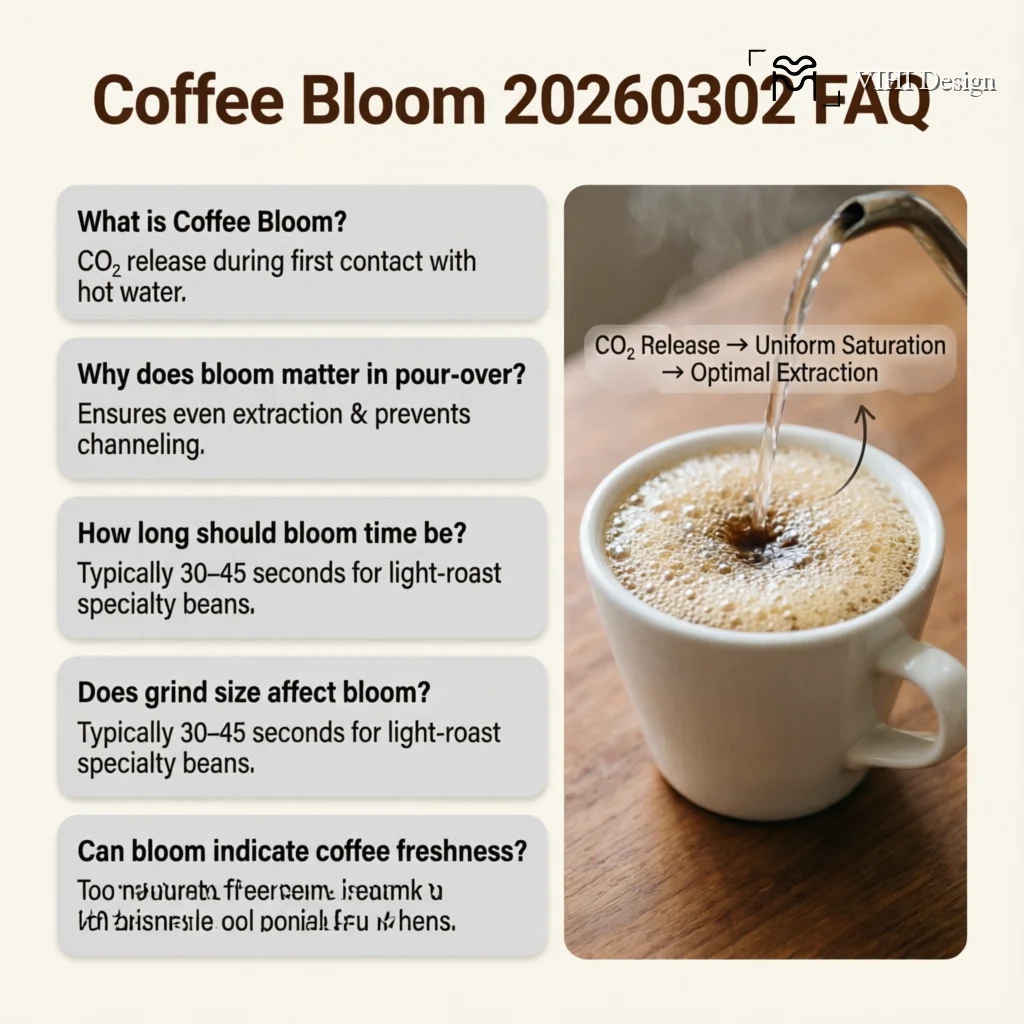
The “bloom” phase in coffee brewing is a critical, yet often misunderstood, initial step in the extraction process. Characterized by a rapid release of gas and the formation of a frothy, expanding crust of coffee grounds, this phenomenon is not merely aesthetic but serves as a key indicator of coffee freshness and a pivotal factor influencing extraction uniformity and final beverage quality. The “Coffee Bloom 20260302 FAQ” project aims to codify the complex physicochemical interactions occurring during this stage into a comprehensive, accessible knowledge base for industry professionals, researchers, and advanced enthusiasts.
This document represents the foundational technical draft, synthesizing empirical observations from controlled brewing experiments with established principles of food science and chemical engineering. Our objective is to move beyond anecdotal brewing advice and establish a rigorous theoretical framework. This framework will explain the causal relationships between green coffee composition, roast parameters, degassing kinetics, and the observable bloom mechanics, thereby enabling more precise and reproducible brewing methodologies across diverse coffee varieties and processing methods.
Theoretical Background
The coffee bloom is primarily a physical manifestation of the rapid desorption of carbon dioxide (CO₂) gas from the roasted coffee matrix upon hydration. CO₂ is produced in substantial quantities during the Maillard reaction and pyrolysis stages of roasting, becoming trapped within the porous, cellular structure of the bean (Illy & Viani, 2005). This gas is not an impurity but a direct product of the thermal decomposition of organic compounds.
The process is governed by several interrelated principles:
1. Gas Solubility and Pressure Differential: CO₂ remains in a metastable, supersaturated state within the roasted bean. The introduction of hot water drastically increases the temperature of the coffee grounds, decreasing the solubility of CO₂ in the aqueous phase. Simultaneously, the water plasticizes the coffee cell walls, increasing their permeability. This creates a significant pressure differential between the internal gas pockets and the atmosphere, driving the effervescent release.
2. Capillary Action and Wettability: The initial contact between water and the hydrophobic coffee bed is not instantaneous. Roasted coffee exhibits complex wetting behavior due to surface oils and microscopic topography. Water initially infiltrates via capillary action through the smallest pores and fractures, creating a massive increase in surface area for CO₂ desorption. The vigor of the bloom is, therefore, a function of both gas content and the rate of this initial wetting, which can be influenced by grind size distribution and water chemistry.
3. The Role of the Bloom in Extraction Dynamics: The violent outgassing has a direct mechanical effect on the coffee bed. It disrupts particle clumping, creates channels for subsequent even water flow, and momentarily fluidizes the grounds. From an extraction standpoint, this stage is predominantly one of hydrolysis and dissolution of highly soluble compounds (e.g., organic acids, caffeine, simple sugars) from the freshly exposed surfaces. An aggressive, rapid bloom can indicate a high concentration of readily available solutes, while a sluggish bloom may suggest staling, where much of the volatile CO₂ and aromatic precursors have already diffused away (Navarini et al., 2009).
4. Quantifying Bloom Metrics: Advanced analysis frames the bloom in terms of measurable metrics: Bloom Volume (peak height/expansion of the bed), Bloom Duration (time from first water contact until gas evolution subsides and the bed collapses), and Effervescence Intensity. These metrics are dependent variables influenced by independent variables such as roast degree (darker roasts typically produce more CO₂ but have weaker cell structure), post-roast age, coffee origin and density, processing method (e.g., natural process coffees often exhibit distinct bloom characteristics), and water temperature.
Illy, A., & Viani, R. (Eds.). (2005). Espresso Coffee: The Science of Quality. Academic Press.
Navarini, L., et al. (2009). “Dynamic measurement of the coffee grind size distribution during the brewing process.” Journal of Food Engineering.
Mastering the Metrics: From Bloom to Brew
Building on our understanding of bloom dynamics and water temperature, we now turn to the quantifiable outcomes that define a perfectly extracted cup. For the specialty barista, the bloom is the opening act, but the final performance is measured by Total Dissolved Solids (TDS) and Extraction Yield (EY).
Interpreting TDS & EY for Flavor Balance
These two numbers are the Rosetta Stone for your brew. Total Dissolved Solids (TDS) measures the strength or concentration of the coffee. Extraction Yield (EY) tells you what percentage of the coffee grounds’ mass was dissolved into the cup. Together, they map the flavor landscape.
- High TDS, Low EY (<18%): The coffee will taste strong but sour and sharp (under-extracted). The bloom may have been too fast or channeling occurred, leaving good flavors behind in the grounds.
- Low TDS, High EY (>22%): The coffee will taste weak, hollow, and unpleasantly bitter (over-extracted). This often indicates a grind that’s too fine or a brew time that’s too long, extracting too many undesirable compounds.
- Golden Zone (1.15-1.45% TDS, 18-22% EY): This is the target. Here, you achieve balance. Acidity is sweet and vibrant, sweetness is pronounced, and bitterness is a pleasant, chocolatey note rather than an astringent punch.
Practical Workflow: Adjusting Based on Results
Your post-bloom brewing decisions are critical for hitting the target metrics. Here’s a practical adjustment loop based on your readings and taste.
- Measure & Taste: Brew, taste, then measure TDS. Calculate EY (using a calculator app or formula: EY = (Brewed Coffee Weight * TDS) / Dry Coffee Weight).
- Diagnose:
- Sour & Sharp? Likely low EY. Aim to increase extraction.
- Bitter & Astringent? Likely high EY. Aim to decrease extraction.
- Adjust One Variable:
- To Increase EY: Grind finer, increase water temperature slightly, or extend brew time. Ensure your bloom was even—an uneven bloom is a common cause of low, uneven extraction.
- To Decrease EY: Grind coarser, decrease water temperature slightly, or shorten brew time. A muddy bed post-bloom can signal a grind that’s too fine, leading to over-extraction.
- Re-brew & Validate: Make a single change, then repeat the measure-and-taste cycle.
Mastering the journey from an observant bloom to a measured, delicious cup is what separates a good barista from a great one. It’s a blend of sensory art and supportive science, ensuring every customer experiences the full story the coffee bean has to tell.
Illy, A., & Viani, R. (Eds.). (2005). Espresso Coffee: The Science of Quality. Academic Press.
Navarini, L., et al. (2009). “Dynamic measurement of the coffee grind size distribution during the brewing process.” Journal of Food Engineering.
Rao, S. (2014). The Professional Barista’s Handbook. (Practical application of TDS/EY concepts).