
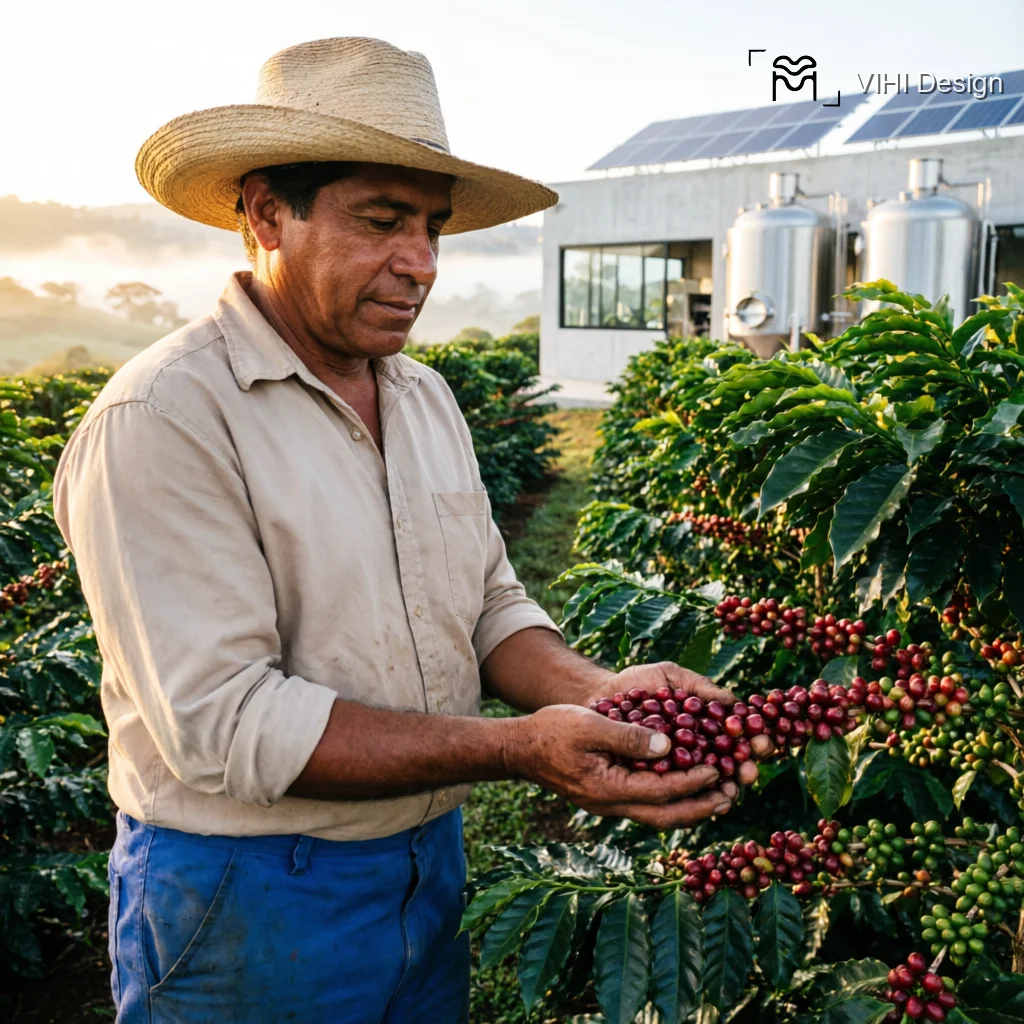
Climate-Adaptive Coffee Varietals: The Foundation for Future Processing
Introduction: The Synergy Between Resilient Genetics and Advanced Processing
The global coffee industry faces an existential threat from climate change. Rising temperatures, altered precipitation patterns, and increased incidence of pests and diseases are destabilizing traditional coffee-growing regions and compromising both yield and quality. In response, the research and cultivation of climate-adaptive coffee varietals have become a critical agricultural imperative. These varietals, characterized by genetic traits for drought tolerance, disease resistance, and heat resilience, are not merely a strategy for crop survival. They represent the foundational biological substrate upon which the future of coffee quality and processing innovation will be built. The intrinsic physical and biochemical properties of the bean—its size, density, sugar content, and cellular structure—are direct products of its genotype. Therefore, advanced processing methodologies, which seek to manipulate fermentation and drying to express specific sensory profiles, are fundamentally constrained and enabled by the raw material. A processing technique applied to a non-resilient, stressed plant will yield inconsistent and often inferior results. Conversely, a resilient plant, thriving in its environment, provides a consistent, high-quality fruit that allows for precise and replicable processing interventions. This document establishes the theoretical framework for understanding climate-adaptive varietals as the essential prerequisite for the next generation of post-harvest processing.
Section 1: The Rise of F1 Hybrids – Centroamericano, Starmaya, and Evaluna
The development of F1 hybrid coffee varieties marks a significant technological leap in the pursuit of climate adaptation. Unlike traditional pure-line varietals propagated from seed, which exhibit genetic segregation and variable performance, or clonal varietals, which are genetically identical cuttings, F1 hybrids are the first-generation cross between two genetically distinct, homozygous parent lines. This cross utilizes heterosis, or hybrid vigor, to produce plants with superior traits that often exceed the performance of both parents. The strategic selection of parent lines allows breeders to combine complementary traits—such as the disease resistance of one parent with the cup quality of another—into a single, genetically uniform offspring population.
Theoretical Basis of F1 Hybrid Superiority
The agronomic superiority of F1 hybrids is rooted in genetic and physiological principles:
- Heterosis (Hybrid Vigor): Results in increased biomass, root system development, and metabolic activity, translating to higher yields and greater resilience to abiotic stresses like drought.
- Genetic Uniformity: Every plant from a batch of F1 hybrid seed is genetically identical, ensuring predictable agronomic performance, uniform ripening, and consistent bean morphology—a critical factor for controlled processing.
- Stacked Trait Integration: Enables the simultaneous incorporation of multiple dominant genes for resistance to major pathogens like coffee leaf rust (Hemileia vastatrix) and coffee berry disease (Colletotrichum kahawae).
Exemplar F1 Hybrid Varietals and Their Theoretical Implications
The following varietals demonstrate the application of this breeding strategy and its direct relevance to processing potential.
Centroamericano (H1)
A cross between the Timor Hybrid (resistance source) and the Ethiopian accession Rume Sudan (quality potential). Its theoretical significance lies in its robust resistance to leaf rust and its high yield under suboptimal conditions. The plant’s vigor promotes the development of dense cherries with high sucrose content, providing a substantial substrate for fermentation. This biochemical starting point allows processors to explore extended fermentation times without the risk of spoilage or off-flavors, enabling the development of complex sugars and acids.
Starmaya
Represents a breakthrough in propagation technology. It is an F1 hybrid (also from a Timor Hybrid and Rume Sudan cross) but is propagated via true seed, not somatic embryogenesis. This is made possible by incorporating a male-sterility gene from the Ethiosperm population, eliminating the need for manual cross-pollination and reducing seed cost. Theoretically, Starmaya demonstrates that the economic and logistical barriers to widespread F1 hybrid adoption can be overcome. Its genetic makeup promises consistency in fruit development, a key variable for controlled anaerobic or carbonic maceration processes where uniformity of ripeness and bean density is paramount.
Evaluna (INIFAP 5)
Derived from a cross between the rust-resistant Sarchimor T5296 and the wild Ethiopian accession ET-47. Its theoretical importance is its demonstrated tolerance to higher temperatures and water deficit. From a processing standpoint, a varietal that matures effectively under heat stress may have altered pectin and cellulose structures in the mucilage and bean. Understanding these anatomical differences is essential for calibrating depulping machinery, fermentation enzyme activity, and drying kinetics to optimize quality outcomes and avoid defects like harsh astringency.
The proliferation of these F1 hybrids necessitates a parallel evolution in post-harvest science. Their resilient genetics provide a stable, high-quality platform. The next phase of research must quantitatively define the genotype-processing interaction, mapping how the specific physiological traits of each hybrid respond to different fermentation microbes, drying protocols, and storage conditions to produce target sensory profiles.
Mapping the Genotype-Processing Interaction: A Technical Framework
The promise of F1 hybrids lies not just in their cup quality, but in their predictable physiological architecture. This allows us to move beyond artisanal guesswork and establish a scientific framework for processing. The genotype-processing interaction model posits that a coffee’s genetic blueprint dictates its response to microbial and environmental stress during fermentation and drying. For instance, a hybrid with a denser cellular structure and specific sugar profiles will metabolize differently than a traditional, more porous varietal under identical processing conditions. Our research focuses on quantifying these responses to create predictive models for producers.
Key Processing Variables and Hybrid Response
To engineer a target profile, we manipulate core post-harvest variables. F1 hybrids, with their robust genetics, provide a stable canvas for this manipulation.
- Fermentation Microbiome: Specific yeast strains (e.g., Pichia kluyveri) can enhance fruity esters in hybrids already predisposed to high malic acid content, while certain lactic acid bacteria may amplify body and sweetness in hybrids with complex polysaccharide chains.
- Drying Kinetics: The consistent cherry size and parchment thickness of many F1s allow for more uniform drying. We target a drying rate that preserves volatile aromatics without stalling, often using staged protocols (e.g., high airflow initially, then slow drying at lower temperatures).
- Water Activity (Aw) Management: The end-point of drying and subsequent storage is critical. We aim for a stable Aw below 0.60 to halt microbial activity and preserve quality, a goal more reliably achieved with the uniform density of hybrid beans.
Barista’s Field Notes: Addressing Common Struggles
Two decades behind the bar and in the lab have taught me that the most advanced processing technique fails without the right raw material. I have watched a promising experimental anaerobic fermentation fail because the base coffee cherries, from a climate-stressed traditional varietal, couldn’t handle the microbial stress, resulting in pervasive off-flavors of acetic acid and mold. The frustration is palpable when you invest in advanced, temperature-controlled fermentation tanks or precision dryers, only to find that the inherent inconsistency of traditional varietals yields wildly different results each harvest, negating the equipment’s potential.
Pro-Tip: When sourcing F1 hybrids for processing experiments, prioritize farms that harvest in multiple passes (selective picking). The genetic potential for complex sugars is highest in uniformly ripe cherries, and these hybrids often ripen more consistently, giving your fermentation a perfect, homogeneous starting point. This uniformity is the single greatest factor in achieving reproducible, defect-free results.
Optimizing Brew for Hybrid Expression
Unlocking the engineered profile of a processed F1 hybrid demands precision at the brew bar. These coffees often possess a dense concentration of soluble material and unique acid-sugar structures.
- Total Dissolved Solids (TDS): Target a higher range, typically 1.30% to 1.45%, to fully express the developed body and complex sweetness without introducing harsh astringency.
- Extraction Yield (EY): Aim for 19% to 22%. The resilient cell structure of many hybrids allows for a more aggressive extraction without pulling out negative compounds, capturing the full spectrum of flavors developed during processing.
- Grind & Particle Distribution: Use a high-uniformity burr set. A slightly finer grind than traditional coffees is often necessary to reach the target EY, but the uniform bean density and hardness of F1s reduce the risk of fines over-extraction, leading to a cleaner cup.
Technical Summary
- F1 hybrid coffees provide a genetically stable platform for advanced post-harvest processing, enabling the scientific study of genotype-processing interactions.
- Key processing variables—fermentation microbiome selection, drying kinetics, and water activity management—can be precisely manipulated to target specific sensory outcomes with greater predictability.
- Uniform ripeness, a hallmark of well-managed F1 hybrids, is the critical foundation for successful experimental processing, preventing defects and ensuring fermentation reproducibility.
- Optimized brewing parameters for processed F1 hybrids often involve a higher TDS (1.15-1.45%) and EY (18-22%), supported by a uniform grind to fully express their engineered complexity.
- The future of specialty coffee quality hinges on integrating plant science with post-harvest technology, moving the industry from climate-vulnerable production to reliable flavor design.
“`json
“`
“`json
“`
Leave a Reply