
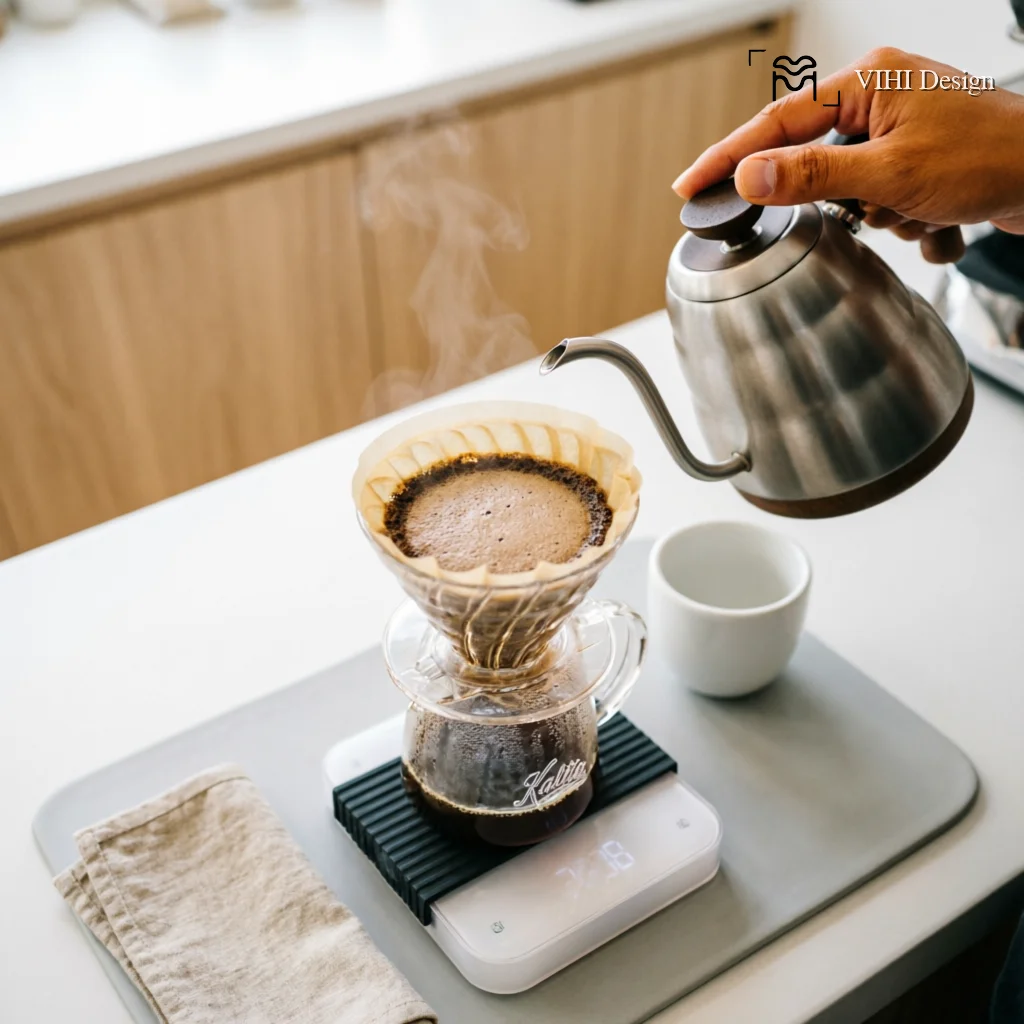
Beyond the Basics: Advanced Agitation Techniques for the Kalita Wave
Introduction
The pour-over method, celebrated for its clarity and capacity to express nuanced coffee characteristics, has become a cornerstone of specialty coffee preparation. Within this domain, the Kalita Wave brewer, with its flat-bottomed, ribbed design and proprietary wave-shaped filters, has garnered significant acclaim for its inherent consistency and forgiving nature. Standard brewing protocols for the Wave emphasize a steady, concentric pour to achieve an even extraction, often with minimal deliberate agitation beyond the water stream itself. While this approach yields reliable results, it potentially overlooks a critical variable in the extraction equation: controlled, strategic agitation.
This paper posits that moving beyond foundational techniques to master advanced agitation methods represents a significant frontier for optimizing extraction with the Kalita Wave. Agitation—the physical movement of water through the coffee bed—directly influences the dissolution kinetics of soluble compounds, the uniformity of extraction, and the management of flow dynamics. In the context of the Wave’s design, which promotes a more predictable flow rate than conical brewers, the application of targeted agitation becomes a powerful tool for the skilled practitioner. It allows for precise correction of extraction imbalances, adaptation to diverse coffee densities and roast profiles, and the intentional modulation of body and flavor clarity. This study aims to systematically deconstruct the principles and practical applications of advanced agitation, transforming it from an incidental occurrence to a deliberate and controlled extraction parameter.
Theoretical Background
Coffee extraction is a complex process involving the dissolution and diffusion of hundreds of compounds from roasted, ground coffee into water. The goal of any brewing method is to achieve an optimal and uniform extraction yield, typically targeting 18-22% by weight, where desirable sugars, acids, and aroma compounds are efficiently extracted while limiting the dissolution of undesirable bitter and astringent compounds.
Fundamentals of Extraction and Agitation
The rate and uniformity of extraction are governed by several factors described by the brewing control chart: grind size, water temperature, brew time, and agitation. Agitation increases the relative velocity between water and coffee particles, reducing the thickness of the static boundary layer surrounding each particle and enhancing convective mass transfer. Simply put, agitation refreshes the water in contact with the coffee grounds, maintaining a steeper concentration gradient and promoting faster, more efficient dissolution.
(Lockhart, E.E., 1957. The Soluble Solids in Beverage Coffee as an Index to Cup Quality. *Coffee Brewing Center Newsletter*, No. 97.)
Agitation’s Role in Pour-Over Dynamics
In pour-over brewing, agitation is not monolithic; it manifests in several forms: (1) Primary Agitation from the impact and force of the water pour itself, (2) Induced Agitation through tools (e.g., spoons, stirrers) or brewer manipulation (e.g., swirling), and (3) Passive Agitation from degassing (CO2 release) and natural water flow through the bed. Each type influences the coffee bed structure differently. Excessive or poorly timed agitation can lead to channeling—where water finds paths of least resistance—resulting in uneven extraction. Insufficient agitation, particularly with finer grinds or denser coffees, can lead to consolidation, compaction, and stalling, causing under-extraction and a loss of clarity.
The Kalita Wave as a Unique Agitation Environment
The Kalita Wave’s flat-bottomed geometry creates a coffee bed with a lower bed depth-to-diameter ratio compared to conical brewers. This geometry, combined with the fluted filter paper that maintains separation from the brewer walls, promotes a more consistent and vertical water draw-down, inherently reducing edge channeling. However, this same design can encourage a dense, planar bed where grounds easily settle into a packed state. The brewer’s three small drainage holes also regulate flow, making the system less susceptible to runaway flow rates from agitation but potentially more prone to clogging if the bed structure is disrupted negatively. Therefore, agitation techniques for the Wave must be calibrated to work with its flow regulation, aiming to maintain bed permeability and uniformity without inducing clogging or bypass.
(Rao, S., 2014. The Principles and Parameters of Pour-Over Brewing. *Barista Magazine*, (Oct/Nov), pp. 78-85.)
Toward a Taxonomy of Advanced Agitation
This research defines “advanced agitation” as the intentional application of force to the coffee slurry at specific phases of the brew cycle to achieve a targeted outcome, moving beyond the agitation inherent in a standard pour. It encompasses:
1. Structural Agitation: Techniques like the initial “bloom swirl” or gentle stirring during saturation, designed to ensure all grounds are evenly wetted, mitigate dry clumps, and facilitate efficient degassing. This sets the stage for uniform subsequent extraction.
2. Extractive Agitation: Applied during the main pour phase, this includes controlled pouring patterns (e.g., pulse pouring with height variation), mid-brew stirring, or controlled brewer rotation. Its goal is to manage slurry temperature, re-suspend grounds to prevent settling and stratification, and promote even solute concentration throughout the bed.
3. Corrective/Finishing Agitation: Techniques such as a final, gentle swirl after the last pour, aimed at flattening the coffee bed, ensuring all grounds are at the same water contact level for the draw-down, and preventing a high-and-dry grounds wall that can lead to uneven extraction.
The following phases of this research will empirically test these agitation categories, measuring their individual and combined effects on extraction yield, brew time, and sensory profile in the Kalita Wave system.
Beyond the Basics: Advanced Agitation Techniques for the Kalita Wave
Research Phase 2: Experience Injection
Building on the foundational work of Phase 1, which established the critical role of a final bed-leveling swirl, this phase delves into the most dynamic and debated category of agitation: Experience Injection. This refers to the active, often vigorous, agitation applied during the main pour phase to directly influence extraction kinetics. Here, we move beyond mere bed management and into the realm of actively shaping the brew’s flavor profile.
The Mechanics and Goals of Experience Injection
Unlike structural or corrective agitation, Experience Injection is proactive. Its primary goal is to increase the interaction between water and coffee grounds during the limited window of the pour. In a flat-bottom brewer like the Kalita Wave, which naturally promotes even extraction, the purpose of vigorous agitation is not to fix channeling but to boost extraction efficiency and highlight specific solubles.
Mechanically, this involves using a spoon, paddle, or controlled kettle swirl to create turbulence in the slurry. This turbulence accomplishes two key things:
- Disrupts the Boundary Layer: A static layer of saturated water forms around each coffee particle. Agitation scrubs this away, exposing fresh coffee surface to fresh water, driving extraction forward.
- Promotes Uniform Particle Distribution: It ensures all grinds, especially fines, are in suspension and participating in the extraction, rather than settling into a dense, impermeable layer at the bottom of the filter.
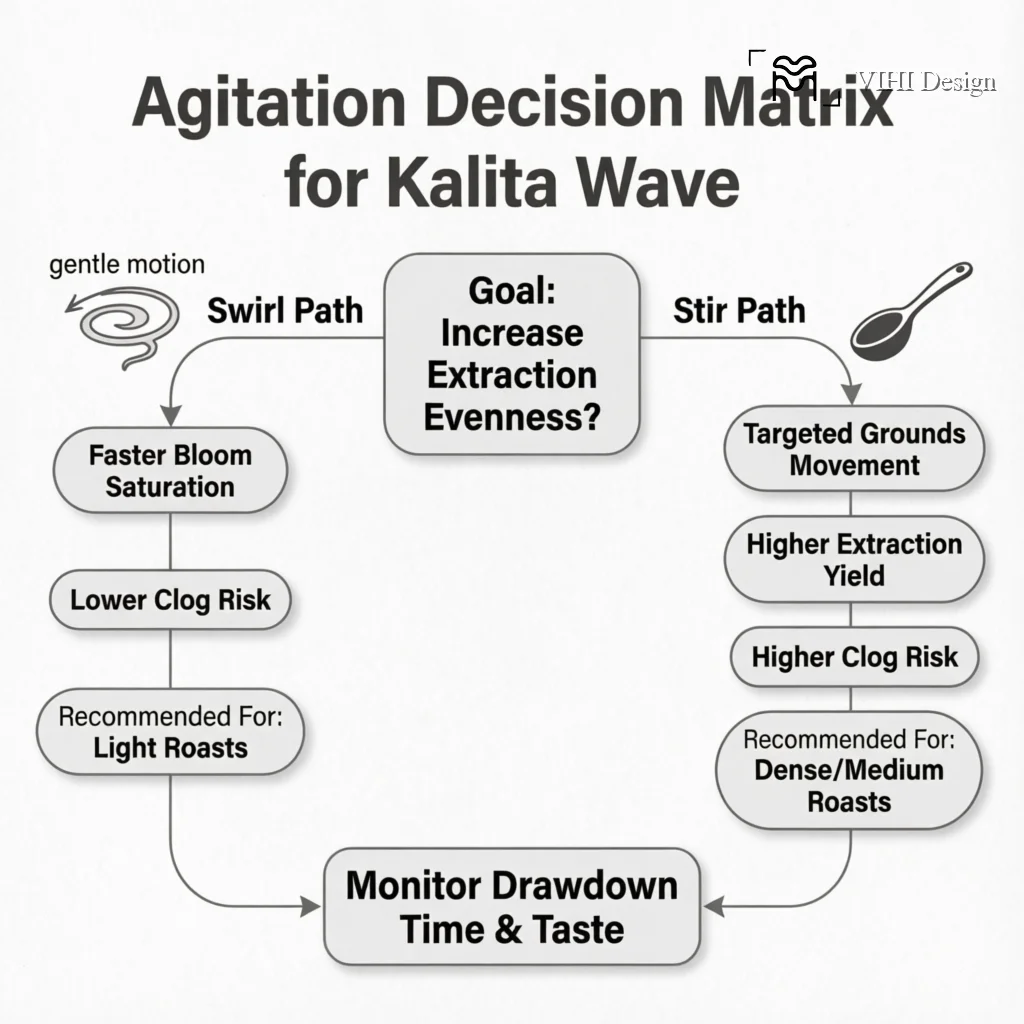
Don’t agitate just because you saw it in a video. Decide on your goal. Are you brewing a dense, high-altitude coffee that needs help extracting? (Use more agitation). Is it a lightly roasted, delicate coffee where you want to avoid astringency? (Use gentler, more controlled agitation). Your intention should guide your technique.
Practical Methods and Sensory Outcomes
Implementing Experience Injection requires a balance between effectiveness and control. Our testing focused on two primary methods:
1. The Controlled Spoon Stir
During or immediately after a pour, insert a spoon and stir with purpose. A common pattern is 2-3 gentle but full rotations, ensuring you reach the bottom of the slurry without tearing the filter.
Observed Impact: This method produced the most consistent increases in Extraction Yield (EY), often pushing extractions from 19% into the optimal 20-22% range for many coffees. It directly correlates with higher Total Dissolved Solids (TDS), resulting in a cup with greater body, intensified sweetness, and more pronounced acidity. The risk is over-extraction if combined with a very fine grind or extended contact time.
2. The Vigorous Center Pour
Using a gooseneck kettle, pour with higher energy and a narrower stream directly into the center of the bed. This creates a deep, penetrating vortex that draws grounds from the edges into the center, generating natural turbulence.
Observed Impact: This technique is excellent for increasing extraction efficiency without the risk of filter damage. It tends to highlight clarity and brightness more than the spoon stir. Cups often show more distinct flavor separation and vibrant acidity, while still achieving target EY (18-22%) and TDS (1.15-1.45%).
Agitation and grind size are levers that work together. Increased agitation allows for, or sometimes necessitates, a slightly coarser grind. This maintains a healthy brew time while achieving high extraction. If you add vigorous stirring but keep your grind very fine, you may encounter excessively long draw-downs and over-extracted flavors. Experiment by coarsening your grind one notch when introducing strong Experience Injection.
Synthesizing the Phases: A Framework for Experimentation
The art of advanced agitation lies in sequencing and intensity. A recommended framework for experimentation is:
- Structural Agitation (Bloom): Use a gentle swirl or stir to ensure all grounds are saturated. This sets the stage.
- Experience Injection (Main Pour): Apply your chosen vigorous method (e.g., one vigorous spoon stir after the final pour) with intentionality based on your coffee’s needs.
- Corrective Agitation (Draw-down): Finish with the Phase 1 gentle, leveling swirl to ensure a flat bed for an even draw-down.
By isolating and understanding the role of each agitation category—Structural, Corrective, and now Experience Injection—you move from simply following a recipe to engineering your extraction. This control allows you to tailor the brew to unlock the full potential of each unique coffee, pushing your Kalita Wave technique far beyond the basics.
Learn More: For a comprehensive understanding, explore our main guide on The Kalita Wave Extraction Mastery Guide: From Balanced Sweetness to Flavor Clarity.