
Introduction
The Kalita Wave 155 and 185 drippers have secured a prominent position within the specialty coffee brewing landscape, celebrated for their consistent extraction and user-friendly design. The flat-bottomed brew bed and unique wave-patterned filters promote even water dispersion and a predictable, controlled flow rate. However, this perceived consistency can be deceptive for the practitioner. Despite its design advantages, the Kalita Wave is not immune to the most common sensory defects in brewed coffee: excessive bitterness and pronounced sourness. These off-flavors often lead to frustration, as the brewer is confronted with a suboptimal cup despite using high-quality, freshly roasted beans and seemingly correct technique.
This troubleshooting guide addresses a critical gap between equipment ownership and brewing mastery. It moves beyond generic brewing advice to provide a diagnostic, scientifically-grounded framework specifically for the Kalita Wave system. The core premise is that bitterness and sourness are not random failures but diagnostic signals of specific imbalances in the extraction process. By understanding the interplay between the Kalita Wave’s unique geometry, coffee grind physics, and the principles of soluble compound extraction, the home barista can systematically identify and correct the underlying causes. The objective is to transform these undesirable sensory experiences from endpoints into actionable data, enabling precise adjustments that yield a balanced, sweet, and complex cup reflective of the coffee’s intrinsic quality.
Theoretical Background
The foundation of effective troubleshooting lies in the principle of Extraction Yield and its sensory manifestation, often visualized on the “Coffee Brewing Control Chart.” Extraction yield refers to the percentage of total coffee mass dissolved into the water. Under-extraction (typically below 18%) results in a predominance of acidic, fruity, and sometimes salty compounds, perceived as sourness, sharpness, or a thin body. Over-extraction (typically above 22%) sees the later-dissolving, larger molecular weight compounds—primarily bitter alkaloids and certain phenolic compounds—dominate the brew, leading to bitterness, astringency, and a dry mouthfeel. The target “ideal” range of 18-22% represents a balance of sweet, acidic, and bitter flavors.
Kalita Wave-Specific Extraction Dynamics
The Kalita Wave’s design directly influences this extraction process in several key ways. First, its flat-bottomed geometry creates a shallower, wider coffee bed compared to conical brewers. This reduces the hydraulic pressure exerted by the water column, leading to a slower flow rate and increased contact time if grind size is not adjusted accordingly. Second, the three small holes at the base of the brewer provide a restrictive outflow, offering resistance to channeling but also making the system sensitive to grind size distribution and pour agitation. Third, the wave-patterned filters have a thicker structure and sit away from the brewer walls, which minimizes bypass (water flowing between the filter and brewer) and ensures most water interacts with the coffee grounds, but can also lead to clogging if fines are prevalent.
The Role of Key Brew Variables
Within this physical system, four primary variables interact to determine extraction outcome:
1. Grind Size: The most critical and responsive variable. Finer grinds increase surface area, accelerating extraction and increasing resistance to flow, which extends contact time. Coarser grinds do the opposite. An inappropriate grind size for the chosen dose and pour structure is the most frequent primary cause of bitterness (too fine) or sourness (too coarse).
2. Water Temperature: Higher temperatures (e.g., 92-96°C) increase the kinetic energy of water molecules, facilitating the dissolution of soluble compounds more rapidly, including both desirable sugars and acids and undesirable bitter compounds. Lower temperatures (e.g., 85-90°C) slow extraction, which can highlight acidity but risk under-extraction.
3. Contact Time: The total duration water is in contact with the coffee grounds. In the Kalita Wave, this is controlled by grind size, pour rate, and pour structure (e.g., pulse pouring vs. continuous). Extended contact time increases extraction, potentially into the bitter zone; insufficient contact time limits extraction, locking in sourness.
4. Agitation: Introduced through pouring technique (height, force, direction), agitation disrupts the coffee bed, renews the water-coffee interface, and promotes even extraction. Excessive agitation, however, can cause migration of fine particles to the filter, increasing resistance and the risk of over-extraction in localized channels.
Therefore, a bitter cup from a Kalita Wave is not simply “over-extracted” but is the product of a specific combination of factors—likely a grind that is too fine for the chosen water temperature and pour method, leading to high resistance, long contact time, and excessive dissolution of bitter compounds. Conversely, a sour cup points to an opposing combination—likely a grind that is too coarse, resulting in fast flow, short contact time, and insufficient dissolution of sweetness-balancing compounds. The following diagnostic protocol is built upon this theoretical model.
The Barista’s Diagnostic Protocol: From Palate to Parameter
Now that we understand the core principles, let’s translate that taste into action. This diagnostic flow is designed for the home barista to systematically isolate and correct the issue. Your palate is the most important tool.
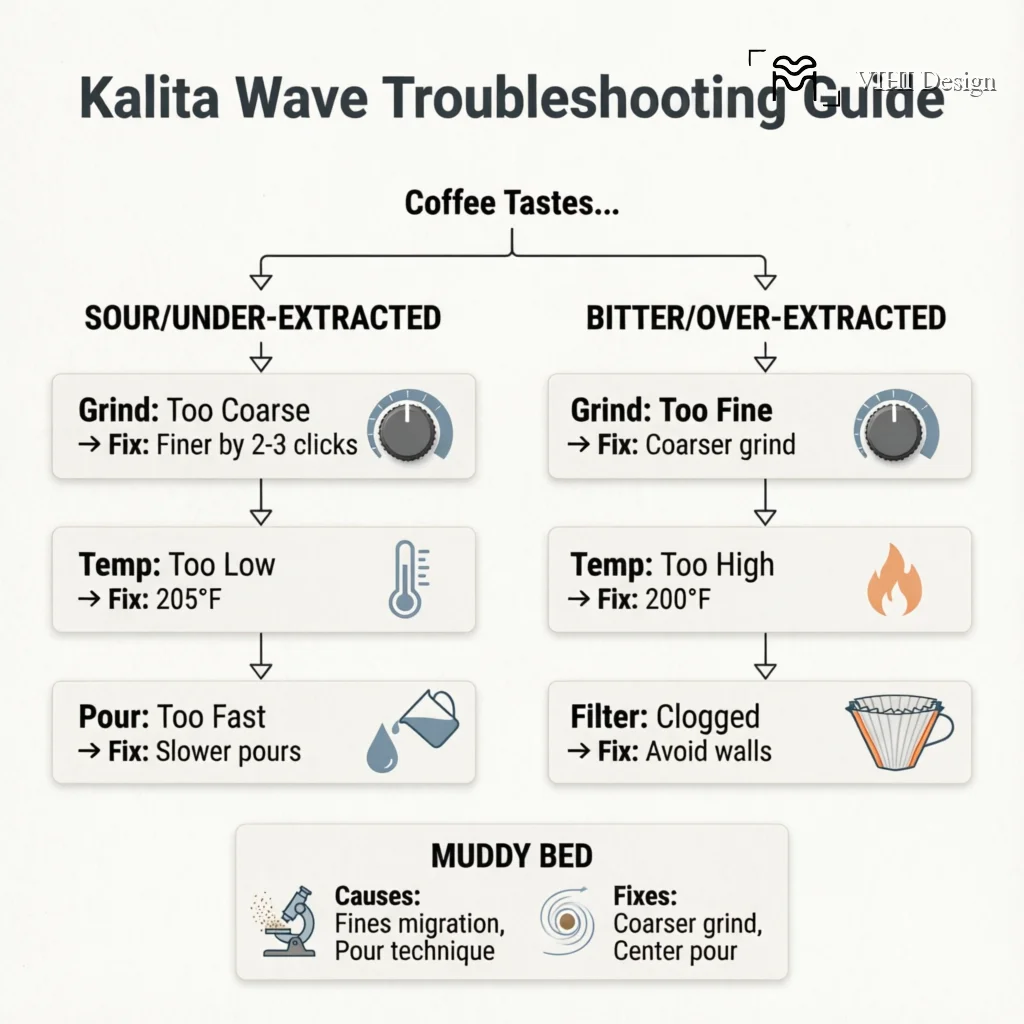
Step 1: The Taste Diagnosis. Is it predominantly bitter (drying, harsh, dark chocolate) or sour (sharp, tangy, citrus-pith)? Don’t overthink the first impression. Trust your gut reaction.
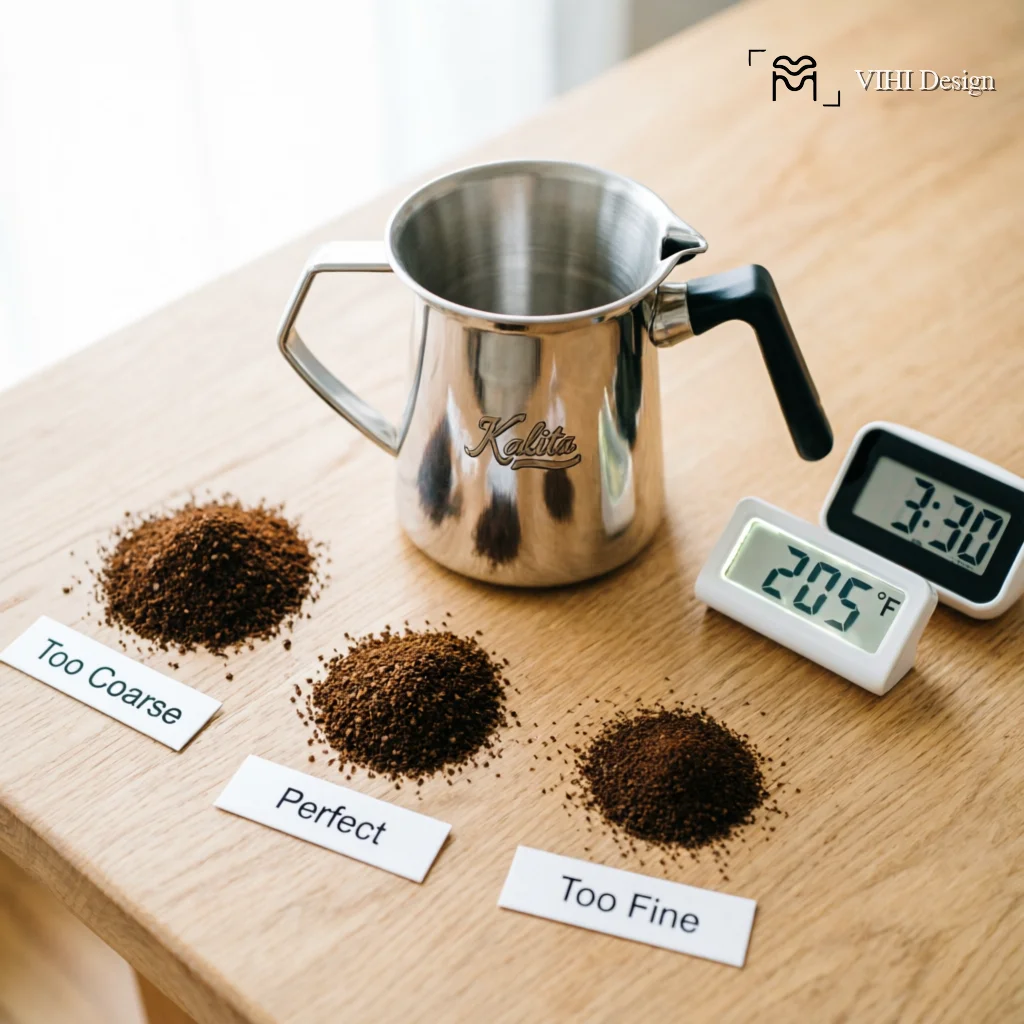
Step 2: The Visual & Temporal Check. Observe your brew. Did it drain very slowly (often >3:30 total time for 15g/250g), suggesting high resistance? Or did it rush through in under 2:30, suggesting low resistance? This is your primary clue to grind size.
Step 3: The Parameter Adjustment. This is where we apply the theory:
- For BITTER (Slow Drain): Your first and most effective adjustment is to coarsen your grind significantly. Aim for a texture like coarse sea salt. This reduces resistance, shortens contact time, and limits over-extraction of bitter compounds. If bitterness persists after coarsening, consider a slight reduction in water temperature (e.g., from 96°C to 93°C).
- For SOUR (Fast Drain): Your primary move is to fineness your grind. Aim for a texture between table salt and fine sand. This increases resistance, extends contact time, and promotes further extraction of sugars and balancing compounds. If sourness remains, a slight increase in temperature can help.
Beyond Grind: Advanced Calibration with Numbers & Technique
If you’ve dialed in your grind and are still chasing perfection, these advanced considerations will help you fine-tune. This is where the principles of Extraction Yield (EY) and Total Dissolved Solids (TDS) provide a deeper framework.
A well-extracted, balanced Kalita Wave brew typically falls within a TDS range of 1.15% – 1.45% and an EY range of 18% – 22%. While you may not have a refractometer, understanding these targets informs your technique:
1. The Pouring Technique’s Role: Your pour controls agitation, which directly affects extraction. A constant, gentle pour from a low height minimizes agitation, leading to a cleaner, more tea-like cup. Aggressive, high pours increase agitation and can boost extraction, which can help correct sourness but risk introducing bitterness if the grind is already fine.
2. The Water Quality Foundation: Water is 98% of your beverage. If your water is too hard (high mineral content), it can inhibit extraction, leading to flat or sour cups. If it’s too pure, it can extract unpredictably and taste sharp. Using a balanced third-wave water formula or a good quality filter can be a game-changer for consistency.
3. The Freshness Factor: Coffee is a fresh agricultural product. Beans more than 4-5 weeks post-roast will have degassed significantly, leading to faster, more channel-prone flow rates. This can manifest as sourness or unevenness. For older beans, you may need a slightly finer grind than usual to compensate.
Mastering the Kalita Wave is a journey of subtle feedback. Listen to your coffee—its taste, its drain time, its aroma. By methodically applying this guide, you transform troubleshooting from frustration into a rewarding craft. Remember, the goal is not just to eliminate bitterness or sourness, but to find the sweet, vibrant, and complex balance that makes specialty coffee so captivating.
Learn More: For a comprehensive understanding, explore our main guide on The Kalita Wave Extraction Mastery Guide: From Balanced Sweetness to Flavor Clarity.