
Kalita Wave vs. V60: A Barista’s Guide to Choosing Your Dripper
Phase 1: Introduction and Theoretical Background
Introduction
The pursuit of the ideal cup of filter coffee is a central tenet of specialty coffee, driven by a desire to achieve clarity, balance, and a faithful expression of a coffee’s intrinsic origin characteristics. This pursuit is mediated by the brewing apparatus, where the design of the dripper is not a passive vessel but an active participant in the extraction process. Among the plethora of manual pour-over devices available, the Hario V60 and the Kalita Wave have emerged as two preeminent tools, each championed by baristas and enthusiasts for their distinct approaches to coffee extraction. Despite their shared goal of producing excellent coffee, their divergent designs—encompassing geometry, flow rate, and filter paper interaction—engender fundamentally different hydrodynamic and extraction environments.
☕ Ready to brew like a pro? The V Fold 155 combines precision engineering with beautiful design for the perfect pour-over.
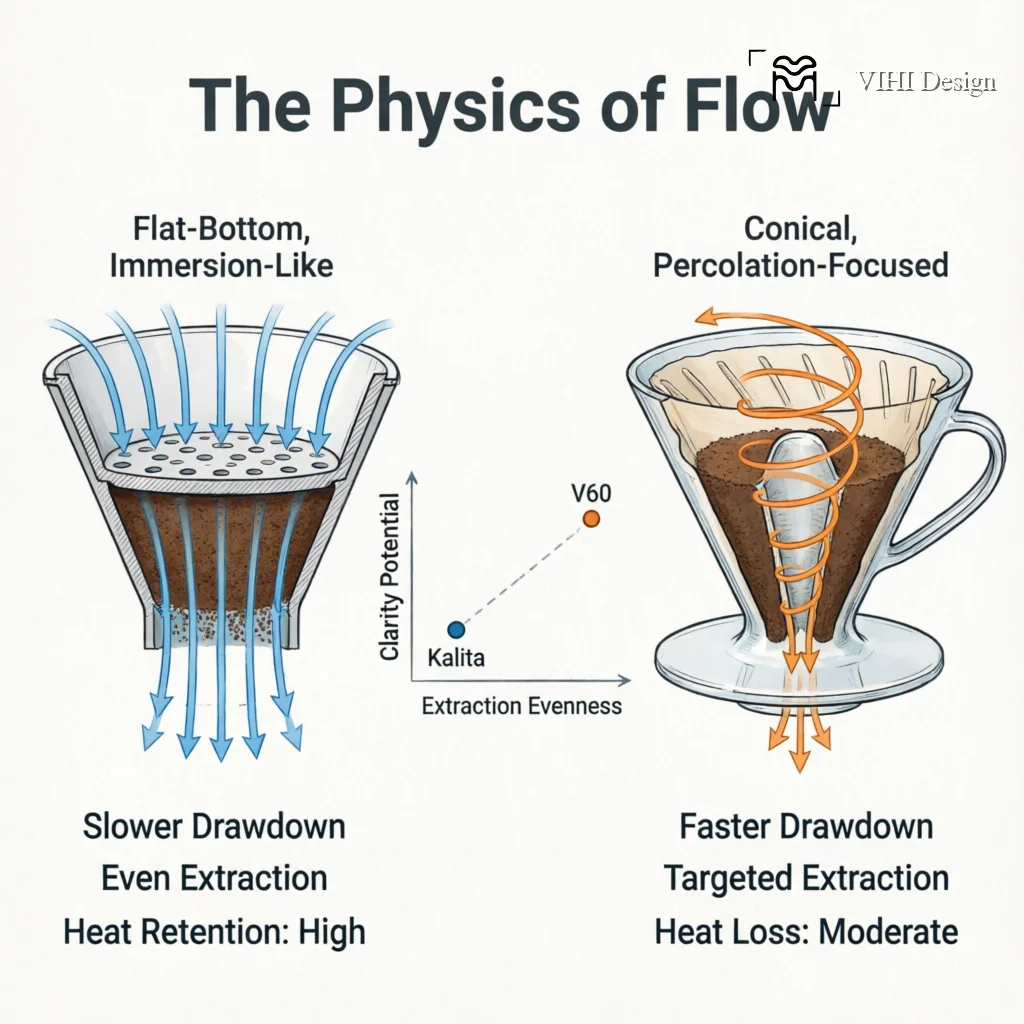
This guide posits that the choice between the Kalita Wave and the V60 is not a matter of identifying a universally superior device, but rather of matching the dripper’s extraction signature to the specific sensory profile of a coffee bean, the desired cup attributes, and the skill level of the brewer. The V60, with its single large aperture and spiral ribs, promotes a faster, more turbulent flow, often associated with higher clarity and accentuated acidity. Conversely, the Kalita Wave, featuring a flat bed and three small drainage holes, encourages a slower, more consistent, and immersion-like extraction, typically yielding a cup with greater body and pronounced sweetness. This document will provide a barista with a scientifically-grounded framework for this decision, moving beyond anecdotal preference to examine the underlying principles of percolation brewing that govern each device’s performance.
Theoretical Background
The manual pour-over is a dynamic percolation system where hot water is manually dispensed over a bed of ground coffee contained within a filter. The resulting beverage is a function of a complex interplay of variables, which can be conceptually organized into the Coffee Extraction Control Triangle: Grind Size, Water Application (pour technique), and Dripper Design. While grind size and pour technique are adjustable parameters, the dripper design is a fixed variable that establishes the boundary conditions for the entire extraction.
Fundamentals of Percolation Extraction
Extraction in a pour-over system is governed by the dissolution of soluble compounds from the coffee matrix into water. The efficiency and uniformity of this process are critical to cup quality. Key theoretical concepts include:
Extraction Yield (EY) & Total Dissolved Solids (TDS): EY represents the percentage of the coffee’s mass dissolved into the beverage, while TDS measures the concentration of those solids. An optimal balance (typically 18-22% EY) is required to avoid under-extraction (sour, sharp) or over-extraction (bitter, astringent).
Flow Dynamics & Contact Time: The rate at which water passes through the coffee bed directly influences contact time. Darcy’s Law, which describes fluid flow through a porous medium, is a foundational principle here. Flow rate is proportional to the pressure head (water height) and the permeability of the bed, and inversely proportional to the bed’s depth and the fluid’s viscosity. Dripper geometry directly impacts the pressure head and the effective bed permeability.
Extraction Uniformity: A primary challenge in percolation is achieving even extraction across the entire coffee bed. Channeling—where water finds paths of least resistance—leads to simultaneous under- and over-extraction, producing a muddled, often astringent cup. Dripper design aims to mitigate channeling by controlling how water is introduced and distributed.
Dripper Design as an Extraction Variable
The physical architecture of a dripper influences extraction through several mechanisms:
1. Bed Geometry: The shape of the coffee bed (conical vs. flat-bottomed) determines the hydrostatic pressure gradient. A conical bed (V60) has a deep center and shallow edges, creating a variable flow path length and a pressure differential that can draw water toward the apex. A flat bed (Kalita Wave) provides a more uniform bed depth, promoting even water distribution and consistent flow paths.
2. Drainage Architecture: The size, number, and placement of drainage holes are the primary regulators of flow rate. A single, large aperture (V60) offers minimal restriction, making flow rate highly dependent on grind size and pour technique. Multiple, smaller apertures (Kalita Wave) act as a flow restrictor, providing a more self-regulating, consistent drawdown time that is less sensitive to minor variations in grind or pour.
3. Filter Interaction & Bypass: The fit of the filter paper to the dripper walls and the presence of structural ribs control the potential for bypass—where water flows between the filter and the dripper wall, bypassing the coffee bed entirely. Ribs (as on the V60) create intentional air channels, preventing a vacuum seal and ensuring all water is forced through the coffee bed, albeit with a specific flow pattern.
4. Thermal Mass & Stability: The material (ceramic, glass, metal) and mass of the dripper affect heat retention. A significant thermal mass can help maintain a stable brew temperature, a critical factor given the temperature dependence of extraction kinetics.
Academic Context: This analysis synthesizes principles from chemical engineering (mass transfer, fluid dynamics) and materials science, applied within the empirical framework of modern coffee research (e.g., work referenced by the Specialty Coffee Association, Barista Guild, and publications in the Journal of Agricultural and Food Chemistry). The comparison is framed not as a subjective taste test, but as a controlled experiment in manipulating extraction environment through hardware selection.
body { font-family: ‘Georgia’, serif; line-height: 1.6; color: #333; max-width: 900px; margin: 0 auto; padding: 20px; }
h1, h2 { color: #2c3e50; }
h2 { border-bottom: 2px solid #ecf0f1; padding-bottom: 5px; margin-top: 40px; }
.tip-box { background-color: #f8f9fa; border-left: 4px solid #3498db; padding: 15px; margin: 20px 0; }
.data-point { font-family: ‘Courier New’, monospace; background-color: #eee; padding: 2px 5px; border-radius: 3px; }
Phase 2: The User Experience – Practical Workflow and Control
Moving from theory to practice, the choice between the Kalita Wave and V60 significantly impacts the barista’s workflow and the level of manual control required. This is where the principles of fluid dynamics and thermal mass meet the human element of brewing.
The Kalita Wave, with its flat bed and restricted flow, creates a forgiving, hands-off experience. The brewer manages the fluid dynamics for you, promoting a consistent, immersion-like environment. This is ideal for high-volume settings, beginners, or anyone seeking repeatability without constant attention. The thermal mass of the stainless steel or ceramic models also aids in heat retention throughout the brew cycle.
Conversely, the Hario V60 is a manual control instrument. Its wide-open flow path makes the brewer’s pour technique the primary variable governing extraction. You directly manipulate the slurry’s agitation, temperature, and water distribution—key factors in mass transfer. This offers unparalleled flexibility to highlight specific coffee attributes but demands skill and consistency from the user.
Phase 3: Dialing In – Empirical Strategies for Target Extraction
Your target is an extraction yield (EY) of 18% – 22% and a total dissolved solids (TDS) reading of 1.15% – 1.45%. How you reach this “ideal” window differs dramatically between brewers.
For the Kalita Wave: Focus on grind size and recipe. Since flow is restricted, your main lever for increasing or decreasing extraction is adjusting grind fineness. A too-slow drawdown (over ~4:30 for 500g) indicates a need to coarsen the grind to avoid over-extraction and astringency. The flat bed naturally promotes even extraction, so pour technique is less critical. Your goal is to saturate the bed fully and then maintain a steady water level.
For the Hario V60: Focus on pour structure and agitation. Grind size is crucial, but your pouring pattern—whether a single central pour, multiple pulses, or a continuous spiral—directly controls agitation and bed temperature. More agitation increases extraction; less promotes clarity. Use a gooseneck kettle to master water distribution. A common strategy is the “single pour” for brightness or “pulse pouring” for greater body and complexity.
Wave (Under-extracted, Sour): Grind finer, ensure full initial saturation, or increase water temperature.
Wave (Over-extracted, Bitter): Grind coarser.
V60 (Under-extracted): Increase agitation with more vigorous pours, use a finer grind, or add a pour pulse.
V60 (Over-extracted): Reduce agitation (gentler pours), coarsen grind, or try a single-pour method to reduce total contact time.
Ultimately, the Kalita Wave is a tool for consistency and balanced extraction, leveraging its design to minimize user-driven variance. The Hario V60 is a tool for precision and customization, converting skilled input into specific sensory outcomes. Your choice isn’t about which is objectively better, but which engineered system best aligns with your coffee, your skill, and the experience you wish to create.
]
}
Choose Your Dripper, Perfect Your Brew
Whether you pick Kalita Wave or V60, the right tools make all the difference.
Related: Explore our complete pour-over collection including filters, kettles, and accessories.