The Kalita Wave Extraction Mastery Guide: From Balanced Sweetness to Flavor Clarity
Introduction: The Pursuit of Reproducible Excellence
In the specialty coffee landscape, manual pour-over brewing stands as a pinnacle of craftsmanship, demanding precision, understanding, and control. Among the constellation of brewers, the Kalita Wave 185 has emerged as a paragon of consistency and flavor clarity. Its distinctive flat-bottom, three-hole design is not merely an aesthetic choice but a deliberate engineering solution to the challenges of uneven extraction. This guide posits that mastery of the Kalita Wave transcends simple recipe following; it requires a foundational comprehension of the hydrodynamic and chemical principles governing extraction. By synthesizing empirical barista knowledge with established scientific theory, we establish a framework for achieving reproducible excellence—specifically targeting the harmonious balance of sweetness, acidity, and body that defines a truly exceptional cup.
Theoretical Background: Foundations of Soluble Yield
Brewing coffee is fundamentally an exercise in controlled solubilization. Approximately 30% of a roasted coffee bean is soluble in water, yet the ideal target for specialty coffee extraction lies between 18-22% of the bean’s total mass. This “Goldilocks Zone,” known as the Total Dissolved Solids (TDS) range, is where desirable compounds—such as fruity acids, sugars, and certain aroma precursors—are optimally dissolved, while undesirable bitter and astringent compounds remain largely intact within the coffee bed. The Kalita Wave’s design directly influences the key variables—time, temperature, agitation, and grind size—that determine the rate and totality of this extraction process.
Hydrodynamics of the Flat-Bed Brewer
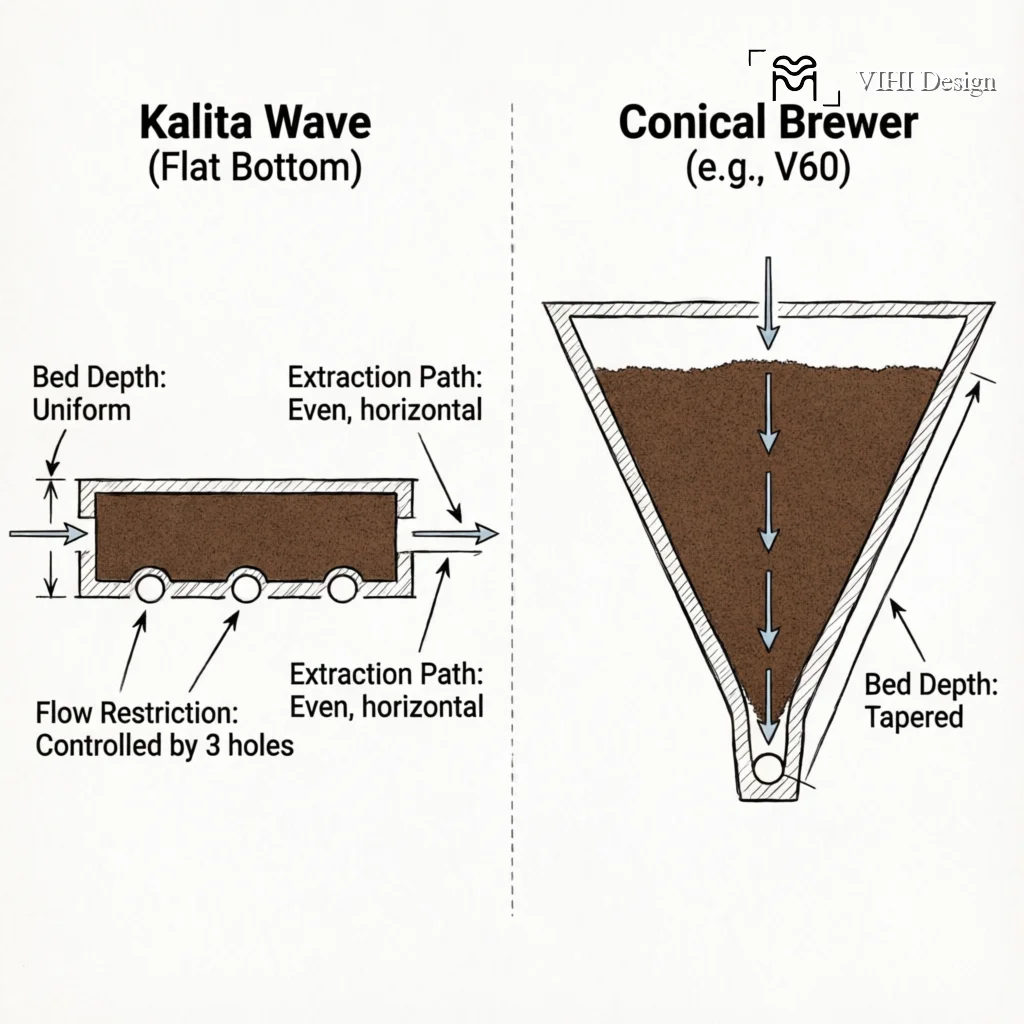
The geometry of the brew chamber is a primary determinant of water flow dynamics. Unlike conical brewers that channel water toward a single apex, the Kalita Wave’s flat bed promotes a more uniform, vertical water path. This geometry minimizes preferential channeling, where water finds the path of least resistance, leading to uneven extraction. The three small-diameter drainage holes provide a consistent, restricted outflow, creating a gentle “percolation pool” that increases contact time and promotes even saturation. This hydrodynamic profile allows for a more predictable and linear extraction timeline, making the brewer exceptionally forgiving and consistent compared to its conical counterparts.
The Role of the Wave Filter in Extraction
The proprietary waved, pleated paper filter is an integral, active component of the system, not a passive barrier. Its design serves multiple critical functions. First, the pleats increase surface area and create consistent gaps between the filter and the brewer wall, ensuring water drains evenly from the entire perimeter of the coffee bed, not just the center. Second, the filter’s thickness and material quality play a significant role in oil and fine particulate retention, resulting in a cup with pronounced clarity and a lighter body compared to metal or cloth filters. This filtration characteristic directly emphasizes the solubilized compounds’ sensory attributes, allowing nuanced acidity and sweetness to shine without being obscured by textural weight.
Thermodynamics and Mass Transfer in Pour-Over
Extraction is a temperature-dependent mass transfer process. Water acts as a solvent, with its efficacy peaking between 92°C and 96°C (197°F-205°F) for most coffee varieties. At these temperatures, kinetic energy is sufficient to efficiently dissolve soluble solids. The Kalita Wave’s ceramic or stainless steel construction provides significant thermal mass, helping to maintain a stable slurry temperature throughout the brew cycle. Each pour reintroduces hot water, reheating the system. Understanding this thermal decay curve is essential; a significant drop in slurry temperature can stall extraction, leading to a flat, underdeveloped cup, while excessive heat retention can promote over-extraction of bitter compounds.
Grind Particle Distribution and Extraction Uniformity
The coffee grind is the most critical variable for controlling extraction surface area. A uniform particle distribution is paramount for the Kalita Wave. Excessive fines (very small particles) can migrate and clog the filter pores or create compact, impermeable zones in the bed, increasing resistance and leading to localized over-extraction. Conversely, excessive boulders (large particles) under-extract, contributing sour and salty notes. The flat bed geometry is less effective at correcting for poor grind quality than a conical vortex. Therefore, achieving a consistent grind profile through a high-quality burr grinder is a non-negotiable prerequisite for leveraging the Kalita Wave’s inherent advantages in extraction uniformity.
Integrating Variables: The Extraction Control Framework
True mastery requires viewing the brewing process as an interactive system, not a series of independent steps. The Kalita Wave provides a stable platform upon which the “Barista’s Control Variables”—grind size, water temperature, pour rate/agitation, and brew ratio—interact. This guide’s methodology is built on a control framework where one variable is intentionally manipulated at a time while others are held constant, allowing the brewer to diagnose and correct flavor imbalances systematically. For instance, a sour, sharp cup indicates under-extraction, which can be addressed by finer grinding, increased agitation, or a higher water temperature—each adjustment changing the extraction dynamic in a subtly different way. The following sections will apply this theoretical foundation to practical, phase-by-phase brewing protocols.
The Kalita Wave Extraction Mastery Guide: From Balanced Sweetness to Flavor Clarity
Phase 2: The Foundational Brew – Establishing Your Baseline
Before chasing complex flavors, you must master a repeatable, balanced baseline. This protocol prioritizes sweetness and clarity, providing a stable platform from which all future experiments will launch. Consistency in your method is the first step toward mastery.
The Baseline Recipe:
Coffee: 22g light to medium roast
Grind: Medium-fine (similar to table salt)
Water: 360g at 94°C (201°F)
Total Brew Time: 3:00 – 3:30 minutes
The Technique:
- Rinse & Pre-heat: Rinse the paper filter thoroughly with hot water. This eliminates paper taste and pre-heats the brewer and server, ensuring an even extraction temperature from the start.
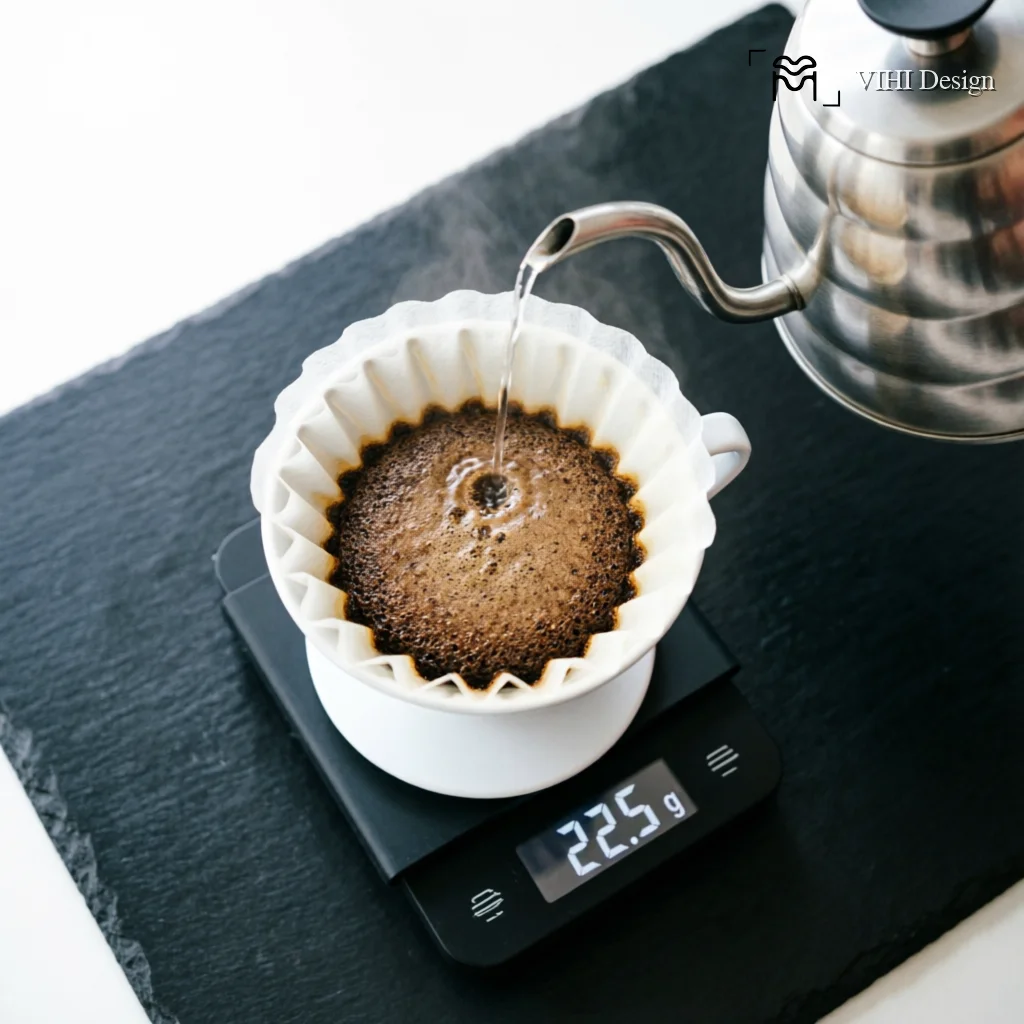
- Bloom with Intention: Add your grounds, level the bed, and start your timer. Pour 50g of water, ensuring all grounds are saturated. Gently swirl the brewer to wet all coffee evenly. Let bloom for 45 seconds. This degassing phase is critical for even water penetration later.
- The Main Pour – Gentle and Centralized: At 0:45, begin a slow, steady pour, aiming for the center of the bed. Maintain a low flow rate, raising the water level to about 1cm from the top of the brewer. Your goal is to reach 360g total weight by 1:30 on the timer. Avoid pouring directly onto the filter walls.
- The Controlled Drawdown: Allow the brew to draw down completely. The flat bed design of the Kalita will facilitate an even, predictable flow. Your total contact time should land between 3:00 and 3:30.
After your final pour, at around 1:45, give the brewer one final, gentle horizontal swirl. This levels the coffee bed and washes any high-and-dry grounds into the slurry, promoting uniform extraction and a cleaner cup. Avoid swirling during the final 30 seconds of drawdown to prevent fines migration.
Target & Diagnosis: This recipe aims for a Total Dissolved Solids (TDS) of 1.25-1.35% and an Extraction Yield (EY) of 19-21%—the heart of the “sweet spot.” Taste your baseline. Is it balanced with pleasant acidity, sweetness, and a clean finish? If so, you have your control. If it’s sour, consider a slightly finer grind or higher temperature next time. If it’s bitter/hollow, consider a slightly coarser grind. Document your observations.
Phase 3: Strategic Adjustments for Flavor Modulation
With a reliable baseline, you can now intentionally manipulate variables to highlight specific attributes in your coffee. Remember the principle: change only one key variable at a time to understand its isolated impact.
Adjustment 1: Enhancing Sweetness & Body
Goal: To increase solubility and extract more sugars, bumping EY toward the 22% upper limit for a richer, rounder cup.
Action: From your baseline, grind one step finer. Keep everything else identical.
The Science: Finer particles increase surface area, raising extraction potential. The Kalita’s flat bottom resists clogging, making it forgiving for fine grinds if your pour is gentle.
Expect: A slightly longer drawdown (add ~15 seconds). Cup should have increased body, muted acidity, and amplified caramel/chocolate notes. Monitor for bitterness, a sign you’ve gone too fine.
Adjustment 2: Boosting Brightness & Flavor Clarity
Goal:
Action: From your baseline, use a slightly coarser grind and increase water temperature to 96°C (205°F).
The Science: The coarser grind speeds flow and limits later-stage extraction of bitters. Higher temperature efficiently extracts bright, acidic compounds early in the brew.
Expect: A faster drawdown (subtract ~15 seconds). The cup will be lighter, with vibrant acidity and pronounced origin character. Ensure it doesn’t taste sour or thin.
While taste is ultimate, a refractometer (measuring TDS/EY) transforms guesswork into knowledge. If your balanced-tasting brew measures at 1.2% TDS and 18.5% EY, you have a quantitative reference for “balance” with your gear. This data allows you to replicate results and communicate precisely with other brewers, building deep, practical expertise.
By cycling between these phases—returning to your baseline, then testing a single adjustment—you build an intuitive understanding of the Kalita Wave. Your hands learn the pour, your palate learns the outcomes, and you gain the true mastery to sculpt the perfect cup from any bean.