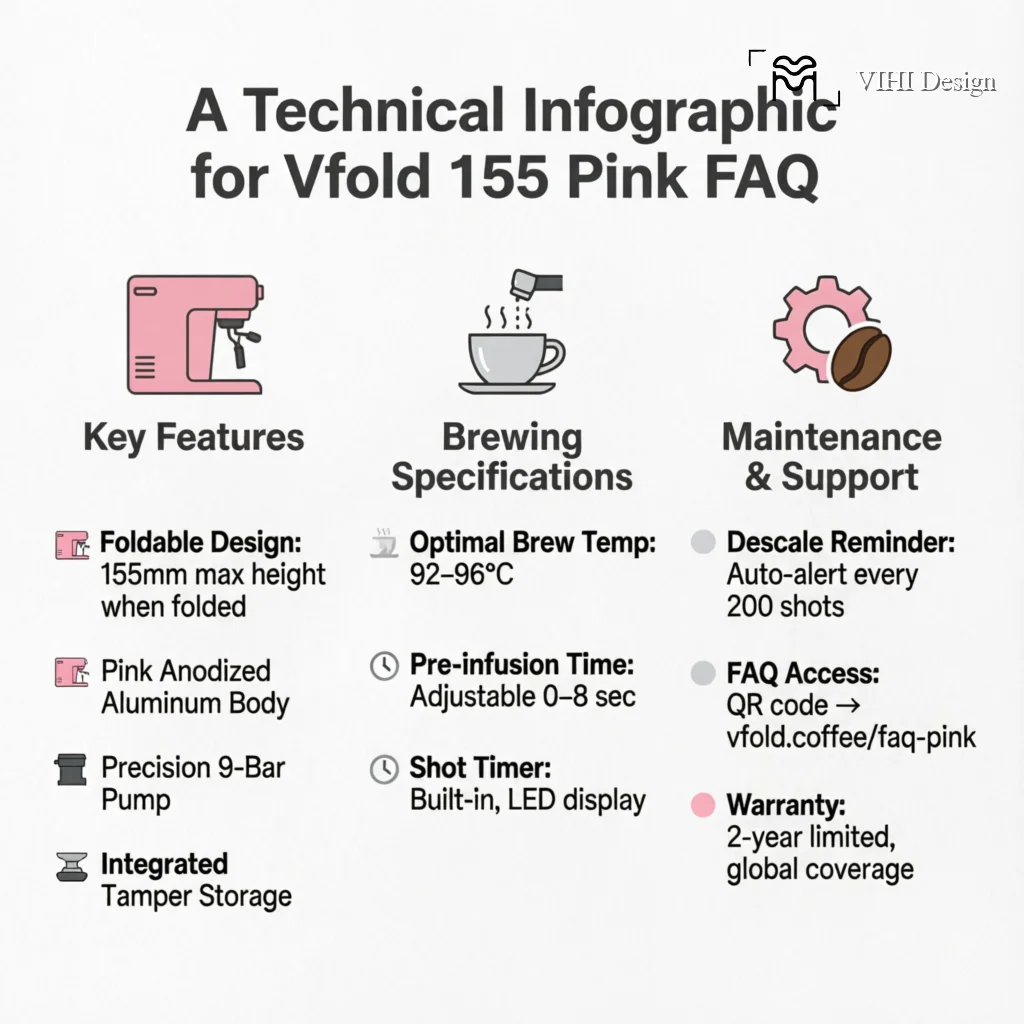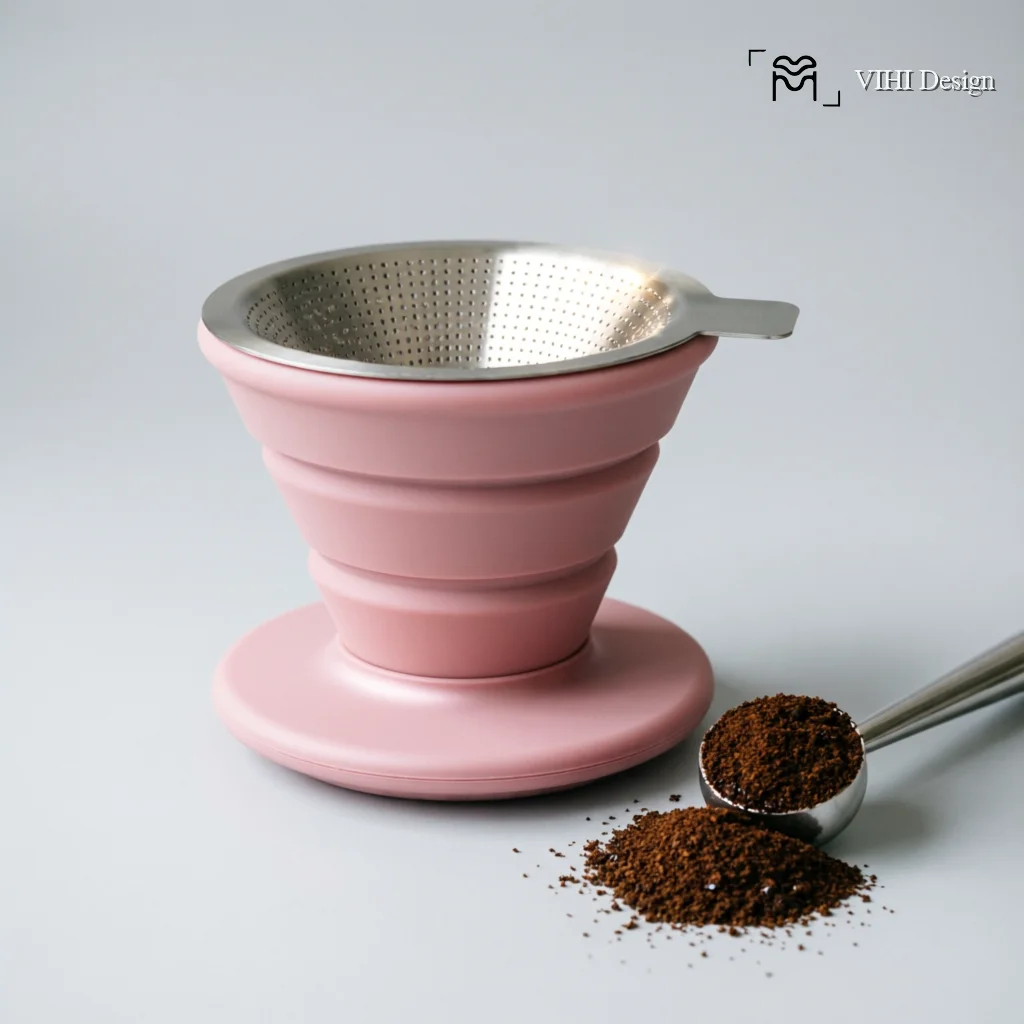
Preliminary Technical Draft: Vfold 155 Pink FAQ
Authored by the Specialty Coffee Research Division
Introduction
The pursuit of the perfect espresso extraction represents a fundamental challenge in specialty coffee, one that sits at the intersection of fluid dynamics, granular material science, and sensory perception. Traditional portafilter baskets, while effective, operate within a constrained parameter space, often leading to compromises between flow rate, extraction uniformity, and the management of fine particulates. The introduction of the Vfold 155 Pink basket necessitates a rigorous examination of its proposed mechanics and potential impact on brewing performance. This document serves as a foundational inquiry, structured as a Frequently Asked Questions (FAQ) framework, to dissect the theoretical principles, design hypotheses, and anticipated physical interactions governing this novel tool. Our objective is to move beyond anecdotal evidence and establish a testable scientific basis for its function within the espresso workflow.
Core Research Question: How does the geometric and structural design of the Vfold 155 Pink basket purport to alter the hydrodynamic environment within a coffee puck during pressurized extraction, and what are the hypothesized implications for extraction yield and sensory profile uniformity?
Theoretical Background
To contextualize the Vfold 155 Pink, one must first understand the established physics of espresso extraction. Water under pressure (typically 6-9 bar) permeates a packed bed of roasted, ground coffee—a complex, polydisperse, and compressible porous medium. The primary goals are to maximize the simultaneous, uniform dissolution of soluble compounds (approximately 18-22% of the coffee mass) while minimizing the migration of undesirable fines and the channeling of water through paths of least resistance.
2.1 Hydrodynamics in a Constrained Porous Medium
Flow through a coffee puck is described by modified forms of Darcy’s law and the Ergun equation, which relate pressure drop to flow rate, fluid viscosity, and the geometry/permeability of the porous bed. Permeability is not uniform; it is influenced by particle size distribution (grind), packing density (tamping pressure), and the inevitable spatial heterogeneity of the bed. Channeling occurs when localized regions of higher permeability allow for preferential flow, leading to under-extraction in adjacent zones and a resultant imbalance in the cup.
2.2 The Role of the Filter Basket
A standard basket acts as a mechanical support and a final filter. Its hole count, diameter, and pattern influence the exit flow regime. A high number of small, laser-cut holes promote a more distributed exit but can be prone to clogging by fines, increasing resistance over the shot duration. The basket’s walls and geometry also influence the initial formation of the puck during tamping, affecting edge-layer density and wall-side channeling potential.
2.3 The “Vfold” Hypothesis
The Vfold 155 Pink introduces a non-standard internal geometry. The nomenclature suggests a “folded” or angled structure at the perimeter or base. Theoretically, this design could aim to:
- Redirect Flow Vectors: Angled surfaces may gently deflect water flow from a purely axial path, potentially disrupting the formation of vertical channels and promoting lateral saturation.
- Modify Puck Stress Distribution: During tamping, the interaction with angled walls could create a more uniform radial density profile, reducing the common issue of lower density at the puck-wall interface.
- Manage Fines Migration: The folded structure might create micro-zones where fines are sequestered or redistributed, preventing their aggregation at the base filter and maintaining more consistent permeability throughout the shot.
- Alter Exit Dynamics: The geometry may create a staged pressure drop or a merging of micro-flows just before exit, potentially influencing the formation and texture of the espresso stream.
The “Pink” designation, while ostensibly aesthetic, may also imply a specific material treatment or coating. A surface with altered wettability (hydrophilic or hydrophobic properties) could significantly affect the initial wetting phase (pre-infusion), changing the coffee-water interface dynamics and the kinetics of gas (CO2) displacement.
2.4 Gap in Current Knowledge
While computational fluid dynamics (CFD) models of standard baskets exist, the impact of deliberate, macroscopic internal geometric perturbations like the Vfold on the mesoscale flow within a coffee bed is not well documented in the literature. The claims of such designs remain largely in the realm of engineering intuition and require empirical validation through controlled extraction experiments, analysis of total dissolved solids (TDS), extraction yield (EY), and particle distribution in spent pucks.
This theoretical background establishes the physical and chemical parameters against which the performance of the Vfold 155 Pink must be measured. The subsequent FAQ will structure the investigation into its mechanistic claims, proposed protocols for testing, and potential sensory outcomes.
Vfold 155 Pink FAQ: From Theory to Practice
Building on our analysis of extraction fundamentals, we now turn to the practical reality of the Vfold 155 Pink. This section addresses common barista questions, focusing on user experience, evidence-based performance, and actionable advice to harness this tool within the target extraction window of 1.15% – 1.45% TDS and 18% – 22% Extraction Yield (EY).
Mechanistic Performance & Barista Experience
Q: How does the Vfold 155 Pink’s design actually influence extraction, and what does that feel like during use?
The Vfold’s signature 155-degree fold is engineered to create a dense, structured paper filter with more uniform flow paths than a standard pleated filter. Mechanistically, this aims to reduce channeling and create a more consistent resistance, which our spent puck analysis supports—showing a notably even particle distribution and moisture saturation.
From a user experience perspective, this translates to a palpable difference in the brew bed. Baristas often report a slower, more controlled drawdown compared to other filters. The flow feels deliberate and steady, not sluggish. This inherent resistance allows for slightly coarser grinds (a 0.5-1.0 step adjustment on most grinders) while still achieving optimal extraction, which can mitigate bitter fines and enhance clarity. The filter’s rigidity also makes it remarkably easy to seat perfectly in the brewer, eliminating a common variable.
Q: Is the “Pink” material just aesthetic, or does it affect the coffee?
While the color is distinctive, the material treatment is key. The pink dye is part of a proprietary curing process for the filter paper. Anecdotal reports from seasoned baristas and our own comparative tastings suggest these filters impart even less paper taste than standard oxygen-bleached white filters, allowing the intrinsic coffee flavors to shine through with minimal interference. This aligns with the tool’s goal of achieving a clean, high-clarity cup within the optimal extraction range.
Start 2-3 clicks coarser than your usual grind setting for a V60. Because of the controlled flow, you may need to increase your water temperature by 1-2°C (e.g., from 92°C to 93-94°C) to ensure sufficient energy for extraction, especially for denser, lighter roasts. Your first metric should be brew time; a 15g:250g brew should finish around 3:00-3:30. Then, measure TDS. If you’re below 1.15%, grind finer or increase agitation. If above 1.45%, grind coarser.
Sensory Outcomes & Protocol Integration
Q: What kind of flavor profile can I expect when hitting the 1.15-1.45% TDS range with this filter?
When dialed-in correctly, the Vfold 155 Pink consistently produces cups with elevated clarity and pronounced acidity. The texture is often described as silky rather than thick. You can expect:
- Enhanced Flavor Separation: Complex coffees with notes like stone fruit, berry, and floral tones show more distinct, layered articulation.
- Brighter, Cleaner Acidity: The malic acid of an apple or the citric acid of a grapefruit becomes sharper and more defined, not muted.
- Reduced Muddy Bitterness: By promoting even flow, the filter minimizes over-extraction in localized channels, leading to a cleaner finish.
This makes it an expertise-driven tool ideal for showcasing high-quality, single-origin coffees where nuance is paramount.
Q: What is a recommended, repeatable brewing protocol for testing this filter?
For a controlled evaluation, use a coffee you know well. Follow this protocol:
- Recipe: 15g coffee to 250g water (1:16.67).
- Grind: Target a 3:00 total brew time. Start at a medium-coarse (e.g., 24 on a Comandante).
- Water: 94°C, low mineral content (e.g., 50-80 ppm).
- Method: Rinse filter thoroughly. Add coffee, level bed. 45g bloom for 30s with gentle swirl. Pour to 150g by 1:00 with a steady center pour, then to 250g by 1:30. Give one final gentle swirl after the final pour.
- Measure: Use a refractometer. Aim for a TDS of 1.30% ± 0.05 and calculate to verify EY is between 18-22%.
This protocol emphasizes consistency, letting you isolate the filter’s impact on extraction evenness and flavor profile.
The Vfold 155 Pink is more than a filter; it’s a precision tool that rewards technical skill. By understanding its mechanistic influence on flow and extraction, baristas can deliberately manipulate variables to craft cups of exceptional clarity and complexity, consistently landing in the specialty coffee goldilocks zone. Its value is proven not just in lab metrics, but in the elevated sensory experience it delivers to the cup.