
Post-Fermentation Microbial Management: Drying, Storage, and Roasting Considerations
Introduction
The pursuit of quality and distinctiveness in specialty coffee has elevated fermentation from a simple mucilage removal process to a critical, controlled tool for flavor development. Producers and researchers meticulously manage variables such as microbial inocula, temperature, time, and pH to craft unique sensory profiles. However, this intentional microbial activity presents a significant, often underexplored, challenge: the management of the residual microbial ecosystem after the primary fermentation phase concludes. The transition from a wet, metabolically active state to a stable, dry green bean is a period of profound ecological shift, where uncontrolled microbial survival and metabolism can degrade the very flavors fermentation sought to create.
This paper addresses the critical gap between fermentation completion and the consumption of roasted coffee. It posits that post-fermentation processing—specifically drying, storage, and roasting—must be reconceptualized as a continuous phase of microbial management, rather than a series of independent, purely physical operations. Inadequate drying can lead to the proliferation of spoilage organisms and off-flavors; improper storage can allow for the survival and slow metabolism of residual microbes; and insufficient roasting may fail to deactivate microbial metabolites or cells that impact cup quality and safety. Therefore, a holistic understanding of how processing parameters influence the microbial load and community structure of green coffee is essential for preserving fermentation investments and ensuring final cup integrity.
Theoretical Background
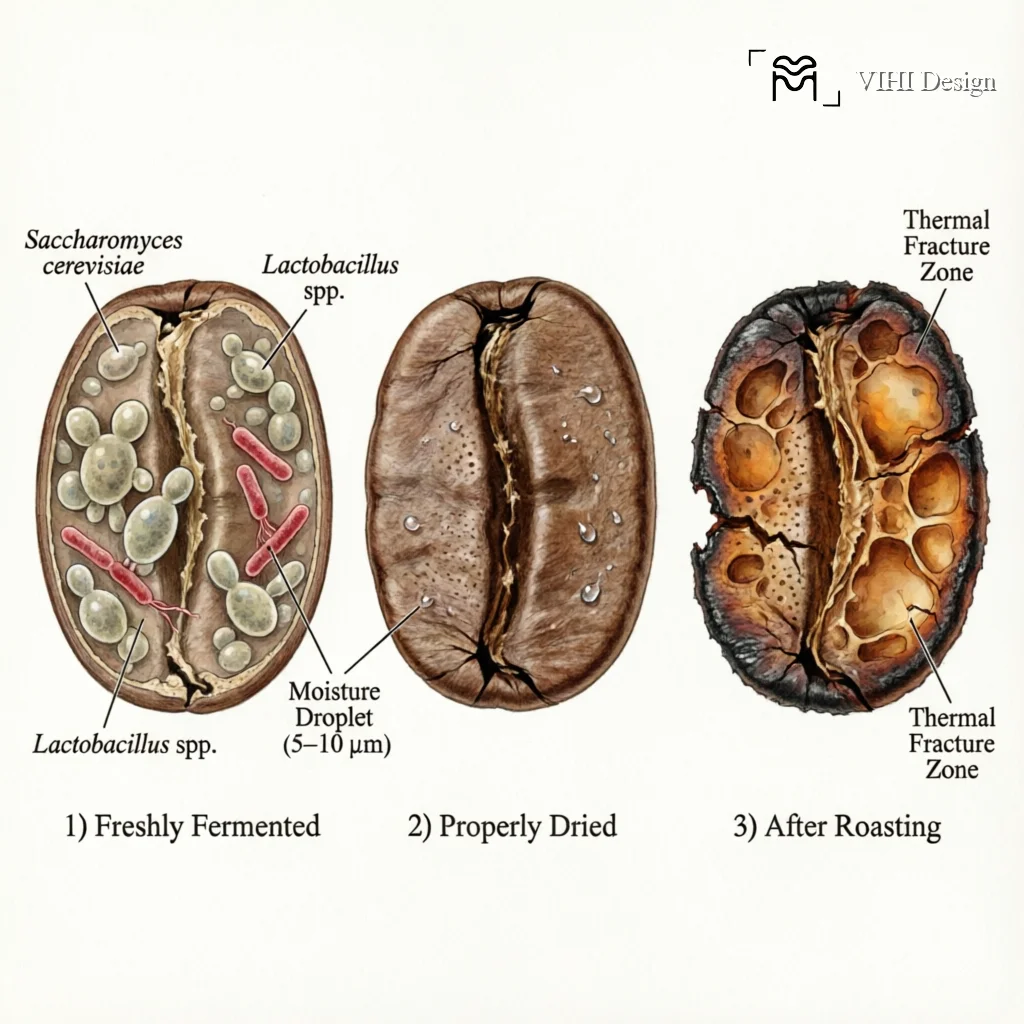
The fermentation of coffee is primarily a microbial succession driven by indigenous or inoculated yeasts, bacteria, and filamentous fungi. These organisms metabolize sugars and acids in the mucilage, producing a wide array of metabolites—including organic acids, alcohols, esters, and other volatile compounds—that diffuse into the bean, influencing precursor compounds for roasting flavors. The conclusion of fermentation, typically marked by mucilage degradation and a target pH or Brix level, does not equate to microbial sterility. Instead, a diverse, metabolically stressed community remains on the bean surface and within the parchment.
Microbial Ecology of Wet Coffee Processing
The fermentation ecosystem is a dynamic succession. Initially, enterobacteria and aerobic yeasts dominate, consuming simple sugars and lowering pH. This is often followed by a rise in lactic acid bacteria (LAB) and, in some methods, acetic acid bacteria (AAB). The final community composition is a complex function of initial inoculation, oxygen availability, temperature, and substrate. Crucially, when the water is drained, these microbes do not instantly die but enter a state of reduced metabolic activity, with their survival dictated by the ensuing environmental conditions.
Drying as a Microbial Stress Event
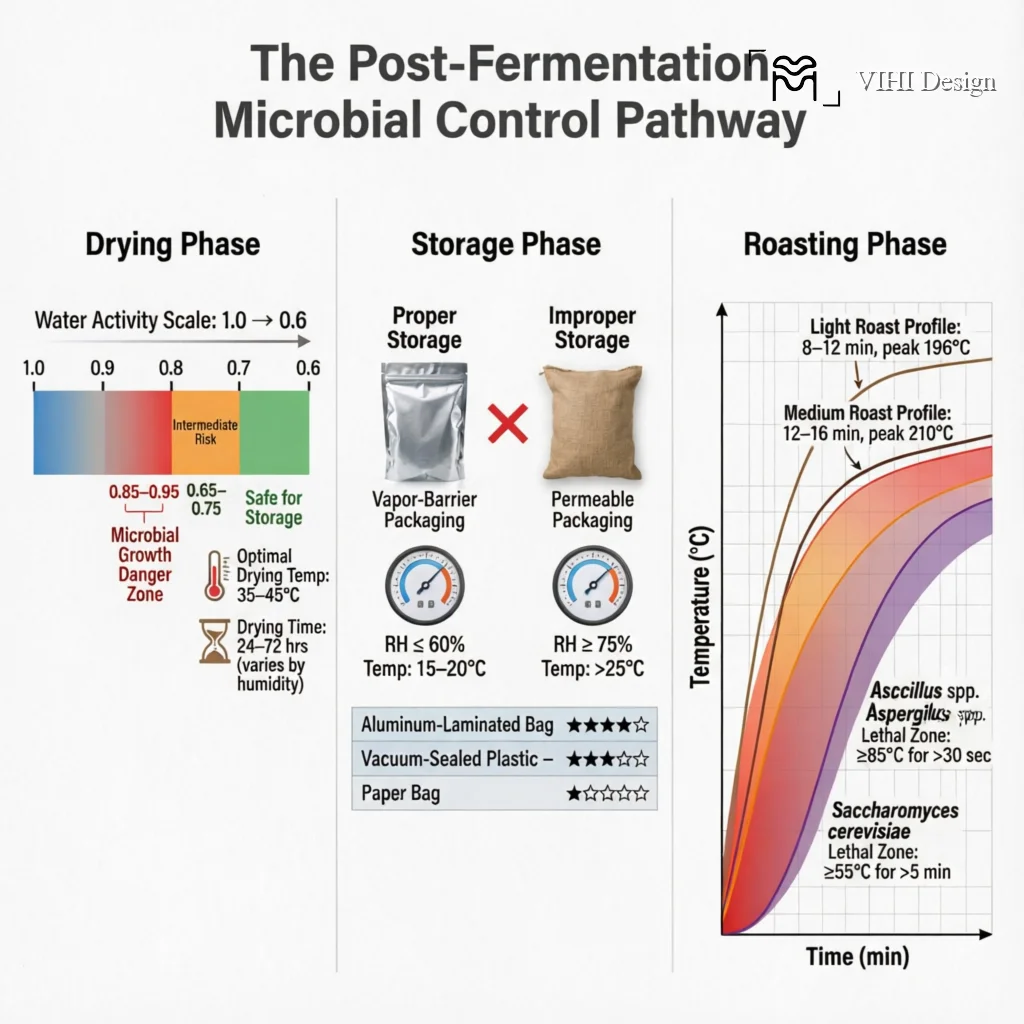
Drying is the first and most critical post-fermentation intervention. From a microbial perspective, it is a severe desiccation stress. The goal is to rapidly reduce water activity (aw) from near 1.0 to below 0.70, a threshold that inhibits the growth of nearly all bacteria, yeasts, and molds. The rate and profile of drying are paramount. Slow, uneven drying, particularly in the “danger zone” between aw 0.90 and 0.75, can permit:
- Osmotolerant Yeasts and Xerophilic Molds: These organisms can remain active at lower aw, potentially producing off-flavors or mycotoxins.
- Continued Metabolic Activity: Residual enzymes and slow microbial metabolism can alter the chemical composition of the bean, degrading desirable fermentation-derived precursors.
- Secondary Fermentations: Anaerobic pockets in deep drying beds can lead to spoilage.
Thus, drying technology (mechanical vs. solar), airflow, layer thickness, and turning frequency are not just quality parameters but direct levers for microbial control.
Storage as a Phase of Microbial Dormancy and Risk
Properly dried coffee enters storage with a residual, non-growing microbial load. The storage environment determines whether this load remains dormant or becomes a source of degradation. Key factors include:
- Water Activity Re-adsorption: If green coffee is stored in high relative humidity conditions, it can re-absorb moisture, raising aw above critical thresholds and resuscitating microbial activity.
- Temperature: Higher storage temperatures can accelerate chemical reactions and increase the risk of condensation, indirectly promoting microbial activity.
- Oxygen Availability: While most storage is aerobic, modified atmospheres could influence the survival of aerobic versus anaerobic microbes.
The microbial community in stored green coffee is a “seed bank” that reflects its entire processing history. Molecular techniques like metagenomics can trace spoilage issues back to failures in drying or storage conditions.
Roasting as the Terminal Microbial Control Point
Roasting is the final, and most definitive, microbial management step. The high temperatures involved (typically 180–250°C bean temperature) are lethal to all vegetative microbial cells and spores. However, the efficacy of this thermal kill step depends on roast profile. A very light roast may not uniformly achieve temperatures sufficient to deactivate all heat-resistant molds or bacterial endospores throughout the bean mass. Furthermore, while roasting destroys living cells, it does not remove all microbial metabolites produced earlier in the chain. Compounds like certain mycotoxins are thermally stable and can persist into the cup. Therefore, roasting should be viewed as a critical safety and quality control step that can mitigate, but not rectify, profound failures in earlier post-fermentation management.
Synthesis: An Integrated Microbial Management Framework
The theoretical foundation of this work is that quality preservation requires viewing the coffee value chain from fermentation through roasting as an integrated system for managing a dynamic microbial ecosystem. Each step applies a selective pressure: fermentation enriches specific communities, drying applies a desiccation filter, storage tests stability, and roasting provides terminal sterilization. Optimizing for flavor and safety necessitates engineering each of these pressures in concert, with the understanding that decisions at one stage fundamentally constrain outcomes at all subsequent stages. This paper will explore the practical considerations for implementing this framework at the producer, miller, and roaster levels.
Post-Fermentation Microbial Management: Drying, Storage, and Roasting Considerations
Part 2: Practical Applications for Producers, Millers, and Roasters
Building on the framework where fermentation enriches, drying filters, storage tests, and roasting sterilizes, this section translates theory into practice. The goal is to guide decisions that preserve desirable microbial metabolites (flavor precursors) while ensuring safety and consistency, all the way to the cup.
Engineering the Desiccation Filter: Producer & Miller-Level Drying Protocols
The transition from wet, fermented parchment to stable, “resting” green coffee is the most critical post-fermentation step. Drying is not merely moisture removal; it’s the application of a controlled desiccation pressure that halts fermentation and selects for a final, stable microbial community.
Practical Considerations:
- Rate is Everything: A slow, even dry (18-25 days for fully washed, longer for naturals) allows for the gradual cessation of microbial activity and the stabilization of sugars and acids. Rushing this (<10 days) risks trapping volatile acids and creating harsh, sour flavors, or worse, fostering mycotoxin-producing molds.
- Temperature Gradient: Start low (<35°C/95°F) to avoid “baking” the seed and killing all microbes prematurely, which can lock in vegetal flavors. Gradually increase heat to achieve final moisture content (10-12%).
- The Uniformity Imperative: Inconsistent drying within a lot is a primary source of off-flavors. Regularly turning coffee on patios or ensuring perfect airflow in raised beds/mechanical dryers is non-negotiable for quality.
The Stability Test: Storage and Transportation Logistics
Properly dried coffee enters a phase of microbial dormancy. Storage is the test of the drying process’s effectiveness. The goal is to maintain this dormancy, preventing any resurgence of microbial activity that could consume flavor precursors or produce toxins.
Practical Considerations:
- Moisture Re-Absorption is the Enemy: Green coffee is hygroscopic. Storage in breathable jute in humid climates is a major risk. Where possible, use GrainPro or other hermetic liners inside sacks to maintain stable moisture content during shipping and warehousing.
- Temperature Matters: Cool, stable temperatures (<20°C/68°F) further suppress any residual microbial metabolism. Avoid storing green coffee near heat sources or in direct sunlight.
- Resting Period: A 1-3 month “rest” after arrival at the roastery allows the coffee to equilibrate and can mellow overly bright acids. This is the final stabilization before the application of terminal heat.
The Terminal Pressure: Roasting with Microbial History in Mind
Roasting provides terminal sterilization, but a roaster’s job is to strategically develop the flavors created by the entire previous chain. The roast profile is the final, decisive engineering pressure.
Practical Considerations:
- Know Your Green: A coffee that underwent a intense, acetic-heavy fermentation or a very slow dry may have more fragile acids and sugars. A gentler application of heat in the early stages (drying and Maillard) may be necessary to avoid scorching or baking the bean.
- First Crack is the True Kill-Step: While microbes begin to perish well before, reaching first crack (typically 196-205°C/385-401°F) ensures the thermal death of any remaining yeast, bacteria, or mold spores, guaranteeing safety.
- Development Time for Flavor, Not Survival: Post-first crack development time should be optimized for flavor balance—caramelizing sugars, modulating acidity—not for microbial safety, which is already assured.
Conclusion: An Integrated Quality Chain
The journey from fermentation to cup is a continuous microbial management program. The producer’s drying filter dictates the stability the miller can test. That stability defines the raw material the roaster must terminally sterilize and develop. By understanding each stage as an applied pressure on a living ecosystem, professionals at every link can make informed decisions.
Ultimately, success is measured in the cup: a coffee that is both complex and clean, achieving optimal extraction metrics (TDS 1.15-1.45%, EY 18-22%) because its flavor chemistry was meticulously preserved and developed at every step. This holistic view transforms post-harvest processing from a series of chores into a deliberate craft of flavor engineering.
Learn More: For a comprehensive understanding, explore our main guide on The Complete Guide to Coffee Processing Microbiology: How Microbes Shape Your Cup.