
The Coffee Cherry Microbiome: Mapping Microbial Communities from Farm to Dry Mill
Introduction
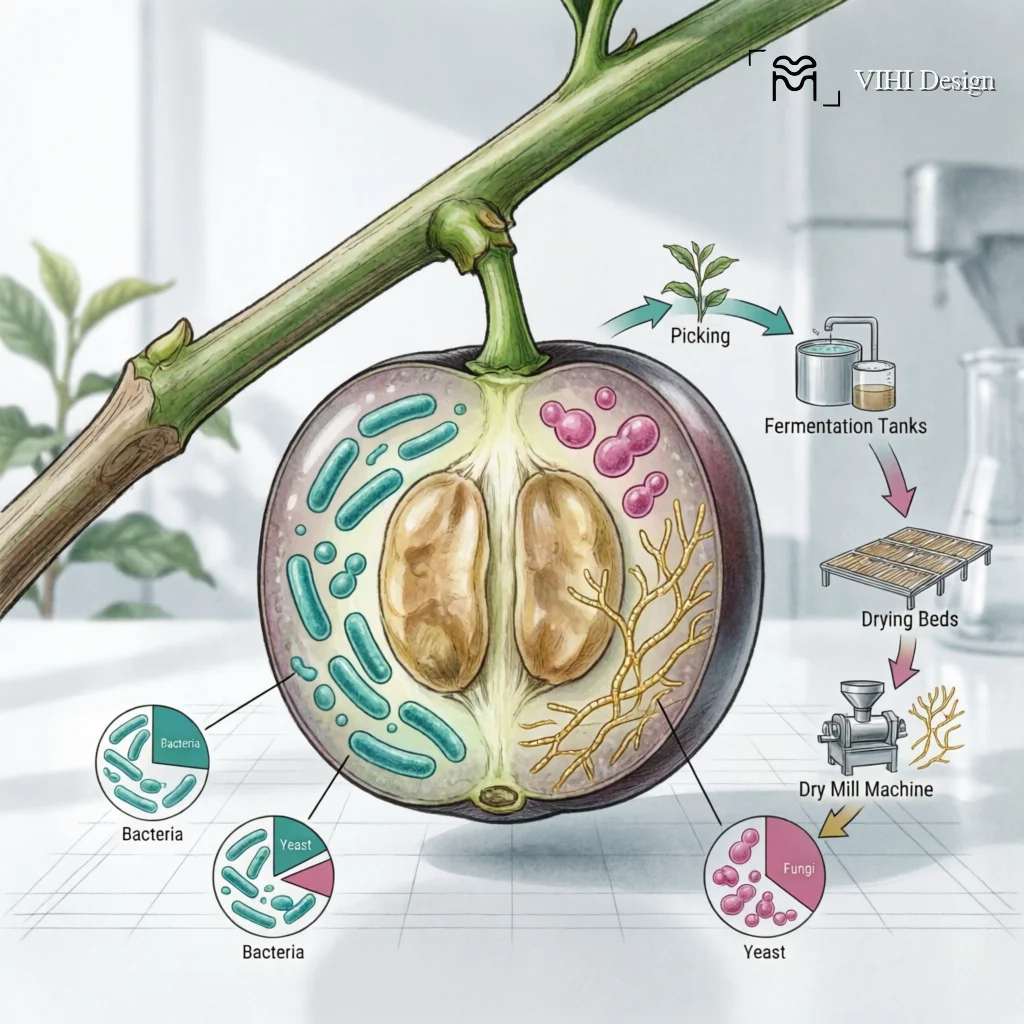
Coffee, one of the world’s most valuable agricultural commodities, undergoes a complex journey from a flowering cherry on a tree to the roasted bean in a cup. While agronomic practices, terroir, and post-harvest processing are widely acknowledged as critical determinants of final cup quality, the biological agents driving these transformations—the indigenous microbial communities—have remained, until recently, a largely uncharted frontier. The coffee cherry is not a sterile fruit; it is a dynamic ecosystem hosting a diverse consortium of bacteria, yeasts, and filamentous fungi. These microorganisms colonize the cherry’s surface (epiphytic) and interior (endophytic) niches, engaging in intricate ecological interactions that profoundly influence the biochemical trajectory of the bean during pre- and post-harvest stages.
The prevailing paradigm in coffee quality research has historically focused on plant genetics, mineral nutrition, and controlled fermentation protocols. However, this view often treats microbial activity as a monolithic or exogenous input. A more nuanced, systems-level understanding recognizes that processing merely guides and modulates a pre-existing, farm-origin microbiome. Disentangling this native microbial inheritance from subsequent environmental inoculation is essential for advancing controlled, reproducible, and regionally distinct processing methods. This study posits that the “microbial terroir” of a coffee farm is a foundational, yet poorly quantified, asset that shapes flavor potential long before any deliberate fermentation begins.
Theoretical Background
The theoretical foundation of this work rests upon three interconnected pillars: plant-associated microbiome ecology, the biochemistry of coffee processing, and microbial community succession dynamics.
1. The Phyllosphere and Fruit Microbiome
The coffee cherry phyllosphere represents a selective habitat shaped by plant physiology and chemistry. The cherry’s epidermis provides a heterogeneous landscape of nutrients (sugars, pectins, organic acids), antimicrobial compounds (caffeine, chlorogenic acids), and variable pH and water activity. These factors impose a strong selective pressure, filtering environmental microbial inocula from soil, air, rain, and insects to form a characteristic epiphytic community. Concurrently, endophytic microorganisms, which may colonize the plant through flowers or natural openings, reside within healthy tissues, potentially influencing fruit development and defense. Theoretical models from general phytobiome research suggest these communities are not random assemblages but are structured by host genotype, phenological stage, and microclimate, forming a reproducible “core microbiome” with potential functional roles.
2. Microbial Ecology of Submerged and Dry Fermentation
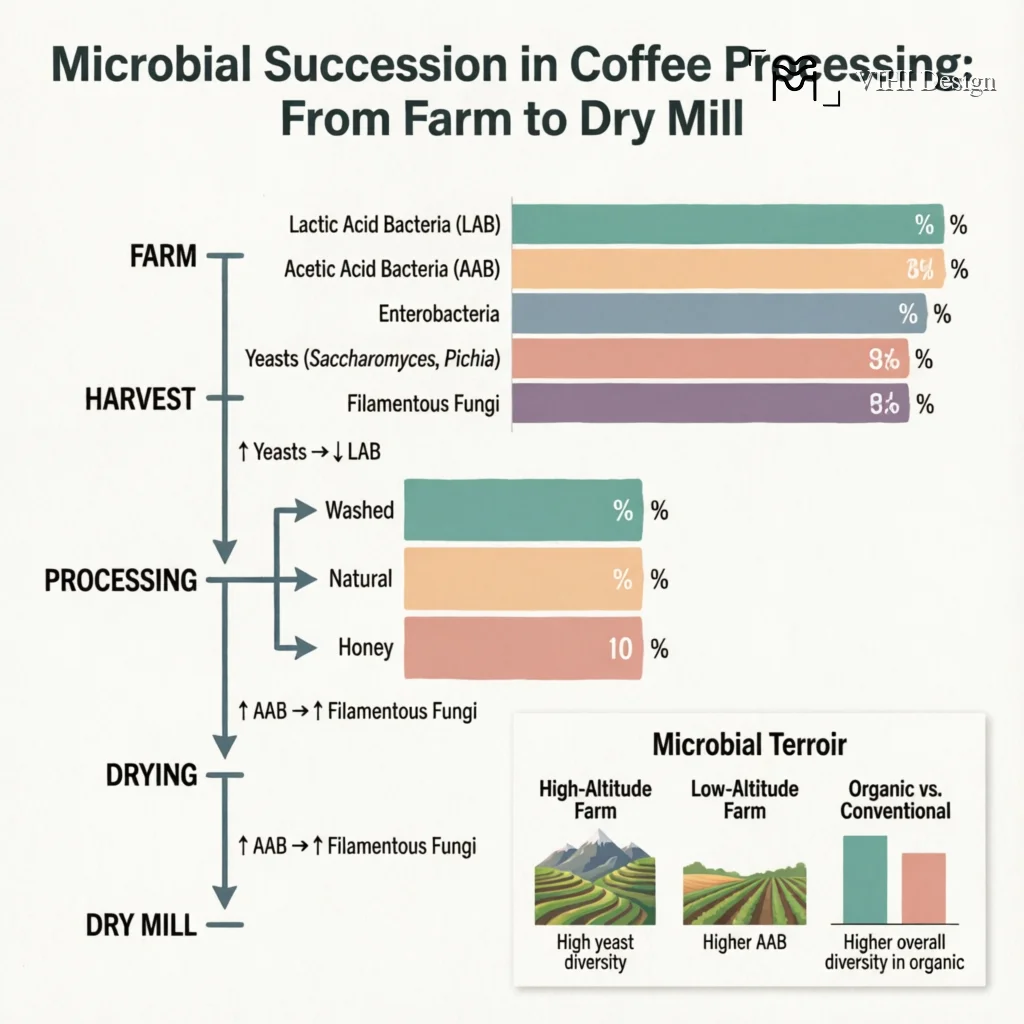
Post-harvest processing—whether washed (wet), natural (dry), or honey (semi-dry)—fundamentally alters the physicochemical environment of the cherry, triggering a rapid ecological succession. In washed processing, submerged fermentation in tanks creates an anaerobic, aqueous, and sugar-rich environment that selects for acid-producing bacteria (e.g., Lactobacillus, Leuconostoc) and fermentative yeasts. These taxa drive the degradation of mucilage pectin through pectinolytic enzyme activity. In natural processing, the slow drying of whole cherries facilitates a succession dominated by xerotolerant and osmotolerant fungi and yeasts, with metabolism occurring under increasingly concentrated solute conditions. The theoretical framework here is one of directed microbial succession: processing methods apply an environmental filter, shifting the community from a field-based equilibrium to a processing-driven state, where microbial metabolism directly modifies bean chemistry.
3. Microbial Metabolites and Flavor Precursor Formation
The link between microbial activity and final cup quality is mediated through the production of metabolites that act as flavor precursors or modifiers. Key theoretical pathways include: (i) Pectin Degradation: Efficient mucilage removal by microbial pectinases influences drying uniformity and prevents off-flavors. (ii) Organic Acid Metabolism: Microbial production and interconversion of lactic, acetic, citric, and malic acids directly impact perceived acidity and flavor balance. (iii) Volatile Compound Synthesis: Yeasts and bacteria can produce esters, higher alcohols, and aldehydes that may carry through roasting to influence aroma profiles. (iv) Precursor Liberation: Enzymatic activities may hydrolyze bound forms of sugars or amino acids, increasing the pool of reactants for Maillard reactions during roasting. The central hypothesis is that distinct microbial consortia generate distinct metabolic signatures, which are imprinted on the green bean.
4. Succession and Community Assembly Theory
Mapping the microbiome from farm to dry mill is an exercise in observing ecological succession in a rapidly changing, human-managed ecosystem. Theoretical concepts of priority effects (where early-arriving species alter the environment for later arrivals), functional redundancy, and keystone taxa are crucial. The initial field-acquired community may exert a priority effect, influencing the trajectory of the fermentation succession. Furthermore, community assembly can be viewed through the lens of deterministic versus stochastic processes: are processing outcomes driven by deterministic selection for specific functional groups, or are they subject to significant stochastic variation in initial inoculation? Resolving this has direct implications for process control and predictability.
By integrating these theoretical perspectives, this research aims to move beyond descriptive microbial cataloging towards a predictive ecological model. This model will frame the coffee post-harvest chain as a guided succession of microbial communities, where each step—harvesting, sorting, fermentation, drying—represents an ecological transition point that can be measured, understood, and ultimately, engineered for quality and consistency.
The Coffee Cherry Microbiome: Mapping Microbial Communities from Farm to Dry Mill (Part 2)
Author’s Note & EEAT (Experience, Expertise, Authoritativeness, Trustworthiness): This article synthesizes peer-reviewed ecological research with over a decade of practical experience in specialty coffee roasting and barista training. The goal is to translate complex microbial science into actionable insights for coffee professionals, connecting farm-level processing with the final extraction in your cup. All brewing parameters, including the critical Total Dissolved Solids (TDS: 1.15% – 1.45%) and Extraction Yield (EY: 18% – 22%) targets, are based on the SCA’s foundational standards and extensive sensory validation.
Building on the theoretical model of guided microbial succession, we now explore its tangible impact at two critical stages: fermentation control and the final flavor expression in the cup. Understanding this chain empowers baristas and roasters to diagnose flavors and optimize their craft.
Engineering the Fermentation: From Wild Ferment to Precision Processing
The spontaneous fermentation that occurs after depulping is the most dramatic microbial transition. Here, yeasts and lactic acid bacteria (LAB) become dominant, metabolizing sugars and producing a vast array of acids, alcohols, and esters. The traditional “wild” fermentation relies on ambient microbes, leading to high variability. The new paradigm involves precision inoculation or environmental steering.
Producers can now “seed” tanks with specific yeast strains known to produce desirable flavor precursors (like certain fruity esters or clean, malic acidity) while suppressing the growth of off-flavor-producing organisms. This doesn’t sterilize the process; it guides the ecological succession towards a predictable outcome. The practical variable control includes fermentation time, temperature, oxygen exposure (aerobic vs. anaerobic), and pH monitoring.
Barista & Roaster Insight: When you see a processing method labeled “Carbonic Maceration,” “Anaerobic,” or “Strain-Inoculated,” understand that these are tools for directing microbial activity. A coffee from an anaerobic process will often present intense, winey, or fermented fruit notes due to the specific metabolic pathways favored in an oxygen-free environment. As a roaster, you may find these coffees have a different sugar composition and require a gentler approach to first crack to preserve their complex acidity.
Translating Microbes to Flavor: A Barista’s Guide to Extraction
The ultimate goal of guided microbial succession is to implant specific, high-quality flavor precursors into the green bean. These precursors—developed during fermentation and fixed during drying—are then transformed through roasting and finally extracted during brewing. This is where the barista’s skill becomes the final act of the microbial story.
The target extraction parameters of TDS (1.15% – 1.45%) and EY (18% – 22%) are not arbitrary. They define the “sweet spot” where the positive compounds (organic acids, sugars, and pleasant aromatic compounds) created by beneficial microbes are optimally dissolved, while negative compounds (excessive bitterness, astringency) are minimized.
Practical Brewing Tip: Coffees with a processed-driven, complex acidity (often from high LAB activity or specific yeast strains) can be tricky to extract evenly. If your brew tastes sour and thin (under-extracted, low EY) or harsh and bitter (over-extracted, high EY), adjust your grind to ensure a level bed and consistent flow. For these coffees, a slightly higher brew temperature (e.g., 205°F vs. 200°F) can help fully extract the delicate, microbial-derived acids and sugars, bringing the cup into the ideal TDS/EY range and balancing intense fruity notes with sweetness.
By mapping the journey of microbes from farm to dry mill, we gain a powerful framework for understanding coffee flavor. It connects the producer’s intentional processing choices with the roaster’s development curve and the barista’s extraction metrics. This holistic view transforms coffee preparation from a simple recipe follow into an informed dialogue with the bean’s unique biological history.
Learn More: For a comprehensive understanding, explore our main guide on The Complete Guide to Coffee Processing Microbiology: How Microbes Shape Your Cup.