How Farm Soil and Compost Practices Cultivate a Unique Microbial Terroir: Introduction and Theoretical Background
1. Introduction
The concept of terroir—the unique combination of environmental factors, including soil, climate, and topography, that gives an agricultural product its distinctive character—has long been central to the appreciation of wine, cheese, and specialty coffee. Traditionally, terroir has been framed in abiotic terms: mineral composition, rainfall patterns, altitude, and sun exposure. However, a paradigm shift is underway, driven by advances in microbial ecology and metabolomics. We now understand that a critical, living component is integral to this expression: the soil microbiome. This complex consortium of bacteria, fungi, archaea, and protists forms a dynamic interface between the coffee plant (Coffea arabica or Coffea canephora) and its physical environment. This microbial community, which we term the microbial terroir, is not a passive backdrop but an active biochemical factory and communication network that directly influences plant health, stress resilience, nutrient acquisition, and, ultimately, the chemical precursors of flavor and aroma in the coffee bean.
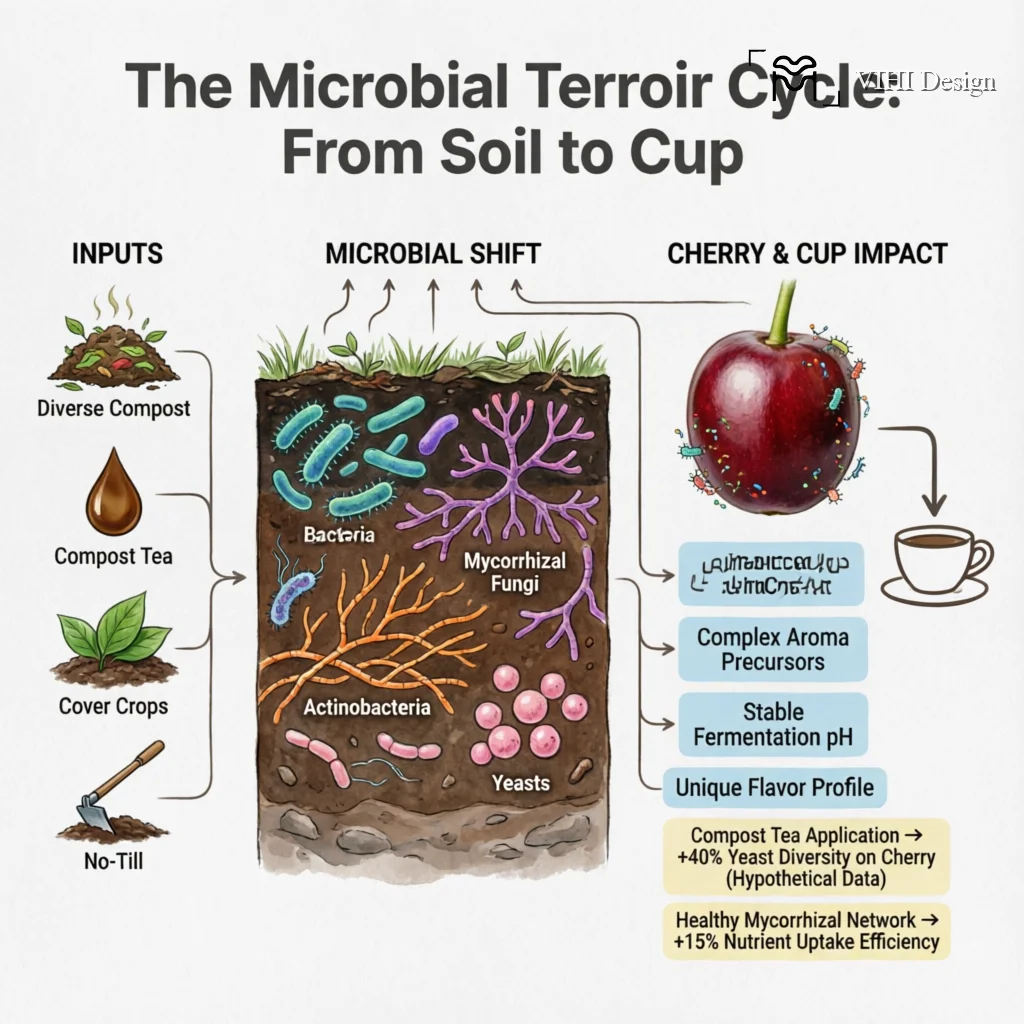
While geographic origin provides a broad template, on-farm management practices, particularly those pertaining to soil health and organic amendments, are the primary sculptors of this microbial terroir. Conventional, input-intensive agriculture often degrades soil biodiversity, leading to simplified, functionally impoverished microbial communities. In contrast, regenerative practices—such as the application of tailored composts, maintenance of organic matter, and reduced chemical disturbance—promote a diverse, robust, and functionally specific soil ecosystem. This research posits that these intentional practices do not merely sustain soil fertility; they actively cultivate a unique microbial fingerprint. This fingerprint, through a cascade of plant-microbe interactions, becomes imprinted on the bean’s metabolic profile, contributing to the nuanced sensory attributes—the cup profile—that define a truly distinctive specialty coffee. This document establishes the theoretical framework for understanding how farm-scale soil and compost management directly engineer the microbial terroir, thereby offering a scientifically-grounded pathway for farmers to intentionally shape the quality and uniqueness of their crop.
2. Theoretical Background
2.1. The Soil Microbiome as an Extended Phenotype of the Plant
The rhizosphere, the narrow zone of soil directly influenced by root exudates, is one of the most biologically active habitats on Earth. The coffee plant actively recruits and shapes its associated microbial community through the exudation of a complex cocktail of carbohydrates, amino acids, and secondary metabolites. This process, termed the “rhizosphere effect,” creates a selective environment where specific microbial taxa are enriched. In return, this recruited microbiome acts as an extended phenotype of the plant, providing services the plant genome does not encode directly. These services include: 1) Nutrient Solubilization and Cycling: Phosphate-solubilizing bacteria and mycorrhizal fungi unlock bound phosphorus and other minerals; free-living nitrogen-fixing bacteria contribute to nitrogen budgets. 2) Stress Mitigation: Microbes can induce systemic resistance in the plant against pathogens and produce compounds that alleviate abiotic stress (e.g., drought, salinity). 3) Direct Growth Promotion: Through the production of phytohormones like auxins and gibberellins. The specific composition of the exudate profile, which can vary with plant genotype, health, and phenological stage, dictates the functional structure of this extended phenotype.
2.2. Compost as a Microbial Inoculant and Ecological Catalyst
Compost is not merely an organic fertilizer; it is a stabilized, nutrient-rich repository of microbial diversity and dormant inoculum. The composting process, when managed for thermophilic phases, creates a selective environment that fosters beneficial, metabolically robust communities. The application of compost introduces a vast, pre-assembled consortium of microorganisms into the soil ecosystem. This acts as a microbial inoculant, directly introducing functional taxa. More importantly, it serves as a long-term ecological catalyst. The complex organic matter in compost provides a slow-release carbon and energy source (a “bank account” of carbon) that sustains a more diverse and active soil food web compared to simple mineral fertilizers. This increased microbial activity drives aggregate formation, improving soil structure, water retention, and aeration—creating a more hospitable physical habitat for both roots and microbes. The chemical composition of the compost feedstock (e.g., coffee pulp, cherry mucilage, manure, green waste) determines the initial microbial and biochemical signature introduced, allowing for the potential “design” of compost to select for desired functional traits.
2.3. From Microbial Metabolism to Bean Chemistry: The Flavor Pathway
The link between soil management and cup quality is mediated by plant physiology. A resilient, nutritionally balanced plant supported by a diverse microbiome is capable of more efficient photosynthesis and secondary metabolite production. Many key flavor and aroma precursors in coffee, such as sugars, organic acids, amino acids, and phenolic compounds, are synthesized in the cherry during fruit development. The availability of nutrients like potassium, phosphorus, and sulfur, mediated by microbial activity, directly influences the concentrations of these compounds. Furthermore, specific microbial groups, particularly certain plant growth-promoting rhizobacteria (PGPR) and mycorrhizal fungi, can upregulate plant defense and signaling pathways (e.g., jasmonic acid, salicylic acid pathways) that are intrinsically linked to secondary metabolism. Thus, a distinct microbial terroir, fostered by specific soil practices, can lead to a distinct biochemical profile in the developing bean. This profile is then transformed during post-harvest processing and roasting, but its foundational template is laid in the field. The hypothesis is that the microbial community signature, shaped by farm practice, leaves a metabolic imprint on the plant that is traceable through the value chain.
2.4. Defining and Characterizing Microbial Terroir
For the purpose of this research, microbial terroir is defined as: The spatially and temporally dynamic assemblage of soil microorganisms associated with a coffee production system, whose structure, diversity, and metabolic function are shaped by the interaction of geographic factors and intentional agricultural management, and which contributes to the genotype-independent expression of crop quality attributes. Characterizing this terroir moves beyond simple cataloging of species (who is there) to include: Functional Potential: What metabolic pathways are enriched (e.g., nitrogen fixation, chitin degradation, siderophore production)? Community Stability and Resilience: How does the community resist and recover from perturbation? Interaction Networks: What are the co-occurrence and putative cooperative or competitive relationships between microbial taxa? Modern tools—including high-throughput amplicon sequencing (16S rRNA, ITS), metagenomics, and metabolomics—allow for the detailed profiling of these aspects, enabling a mechanistic understanding of how practice shapes community, and how community shapes product.
How Farm Soil and Compost Practices Cultivate a Unique Microbial Terroir
From Community Resilience to Cup Clarity
The resilience of a soil microbial community—its ability to resist and recover from disturbances like drought or harvest—is directly tied to farm management. A diverse, complex network of fungi and bacteria, fostered by organic matter and compost, creates a buffer. This biological resilience translates to more stable cherry development and, ultimately, more consistent green coffee. For the roaster and barista, this means a more predictable raw ingredient. Coffees from such resilient ecosystems often require less drastic roast profile adjustments to achieve sweetness and clarity, as the foundational flavors are already robust and well-defined.
When dialing in a coffee from a farm known for regenerative practices, pay close attention to its performance across different brew methods. You may find it exhibits remarkable consistency—maintaining its core flavor notes and balance—even with minor grind size or temperature variations. This is a practical sign of that microbial resilience in your portafilter.
Practical Implications for Roasting and Brewing
Understanding microbial terroir isn’t just academic; it provides a roadmap for handling the coffee. Lively, complex microbial networks often correlate with coffees that have a higher concentration of diverse sugars and organic acids. In practice, these beans can be both dense and porous, absorbing heat efficiently during roasting but also requiring careful development to avoid tartness.
This is where our target metrics become crucial. To fully express this cultivated complexity, aim for an Extraction Yield (EY) of 18% to 22% and a Total Dissolved Solids (TDS) of 1.15% to 1.45%. A lower TDS/higher EY combination (e.g., 1.2% TDS, 21% EY) will emphasize acidity, floral notes, and transparency, perfect for highlighting a coffee’s origin character. A higher TDS/lower EY combination (e.g., 1.4% TDS, 19% EY) will emphasize body, sweetness, and layered complexity, which can beautifully present the deep, fermented fruit or chocolate notes nurtured by rich soils.
Coffees from heavily composted, microbially rich soils often carry a significant metabolic “load” of precursors to flavor. They may benefit from a slightly slower drying phase or a more gradual ramp to first crack to fully develop sweetness and integrate complex acids. Trust your color readings and smell—these beans often announce their readiness with a profound, caramelized sweetness during the roast.
Cultivating Your Own Understanding: A Tasting Framework
To truly appreciate microbial terroir, engage in comparative tasting. Source two coffees of the same variety and region—one from a farm using conventional methods, another from a farm using intensive compost and soil-life practices. Brew them side-by-side to the same TDS (e.g., 1.3%).
You might observe: The “living soil” coffee often has a more vibrant, articulate acidity (think malic apple vs. generic tartness), a longer, sweeter aftertaste, and a texture that feels integrated rather than thin or watery. The microbial work in the soil has essentially pre-processed complexity into the seed, giving you, the barista, a wider palette of flavors to extract.
By connecting farm ecology to brewing parameters, we move beyond mere description to a deeper, more experiential understanding of coffee. The cup becomes a direct reflection of an invisible world, cultivated with intention and revealed through skill.