Introduction: The Critical Final Lock – Why Drying is the Make-or-Break Phase After Fermentation
Post-harvest coffee processing is a sequential biochemical intervention where each stage establishes precursor compounds for the final beverage. Following fermentation—a phase of controlled microbial and enzymatic activity that degrades mucilage and modifies seed biochemistry—the coffee seed enters a state of high metabolic potential. Drying is the critical stabilization phase that arrests this biological activity and determines the chemical fate of these precursors. An improperly executed drying phase can degrade or volatilize compounds developed during fermentation, induce uncontrolled enzymatic reactions, or create substrates for post-processing microbial contamination. Therefore, drying is not merely a dehydration process but a final, deterministic thermal and environmental treatment that locks in the sensory profile. The choice of drying technology—solar tent dryers, raised beds, or mechanical dryers—directly governs the kinetics of water removal, the thermal environment of the seed, and the resultant physicochemical transformations, making it a primary determinant of green coffee quality and storage stability.
The Science of Drying: How Moisture Migration and Rate Directly Impact Final Cup Flavor
Coffee drying is a coupled heat and mass transfer operation. The primary objective is to reduce seed moisture content from approximately 55-60% (wet basis) after washing to a stable 10-12% for storage. This reduction must occur at a rate that prevents spoilage while preserving desirable organoleptic compounds.
Moisture Migration and Seed Structure
The coffee seed is a hygroscopic biological matrix. Water exists in three primary states within the bean: free water within the macro-pores, capillary water in the cellular structure, and bound water associated with cellular constituents like polysaccharides and proteins. Drying involves the sequential removal of these water types. Initial stages remove free water with relatively low energy input. The latter stages, removing bound water, require more energy and, critically, if too rapid, can cause structural stress (case-hardening) that traps moisture internally, leading to uneven drying and potential mold growth during storage. The migration of water from the endosperm’s interior to the surface is driven by diffusion gradients established by the external environment.
Drying Rate as a Chemical Reaction Controller
The rate of moisture removal is the principal variable influencing biochemical and Maillard reaction pathways. A slow drying rate, often associated with ambient conditions on raised beds, prolongs the window for enzymatic activity. Enzymes such as pectinases, proteases, and polyphenol oxidases, residual from fermentation, continue to act, potentially increasing complexity in sugar and amino acid profiles. Conversely, a rapid drying rate, typical of mechanical dryers, thermally inactivates these enzymes early, preserving a different precursor snapshot. Crucially, the drying temperature profile directly governs non-enzymatic browning (Maillard reaction) between reducing sugars and amino acids. Optimal, controlled heat application can generate favorable aromatic compounds like furans and pyrazines. Excessive or uneven heat can drive reactions toward the production of bitter, burnt, or stale-tasting compounds and degrade volatile aromatics.
Impact on Sensory Attributes
The physical drying parameters manifest in the cup through specific chemical modifications:
- Acidity and Sweetness: Prolonged, low-temperature drying can help preserve organic acids (e.g., citric, malic) and allow for the gradual breakdown of sucrose into simpler, perceptibly sweeter sugars. Rapid drying may lock in higher sucrose but can result in a sharper, less integrated acidity.
- Body and Mouthfeel: The final moisture content and the uniformity of drying affect the structural integrity of polysaccharides. Even drying to the correct endpoint supports a fuller, more consistent body. Case-hardening and uneven moisture can lead to a hollow or papery mouthfeel.
- Flavor Stability and Defects: Drying is the last barrier against microbiological spoilage. Moisture levels above 12% or uneven drying create micro-environments conducive to fungi, leading to off-flavors (musty, earthy) and mycotoxin risk. Proper drying ensures chemical and microbial stability for storage and transport.
In conclusion, the drying phase is a controlled thermodynamic process that finalizes the chemical composition of the coffee seed. The method—solar, raised bed, or mechanical—defines the environmental parameters (temperature, humidity, airflow) that control the drying rate and seed temperature, thereby directly determining the sensory profile of the roasted coffee.
The Thermodynamic Blueprint: Mapping Heat, Air, and Time to Flavor
Drying is not merely water removal; it is the final, decisive stage of green coffee metabolism. The thermodynamic conditions—specifically the seed’s internal temperature and the rate of water migration—lock in the precursor compounds for roasting. Slow, gentle drying (below 40°C seed temperature) preserves enzymatic activity and allows for the gradual formation of sugars and amino acids through non-enzymatic browning precursors. Conversely, rapid or high-temperature drying accelerates metabolic shutdown, often trapping harsh, vegetal notes and degrading delicate acids. The target is a steady, linear descent in moisture content, which demands precise control of three environmental variables:
- Temperature: Ambient air should not exceed 35°C for solar/patio methods. Seed temperature must remain below 40°C to prevent “baking.” Mechanical dryers require strict inlet air control.
- Airflow: Consistent, gentle movement is critical. It evacuates humid air from the bean mass, prevents condensation, and ensures uniform drying. Stagnant air is the primary vector for mold.
- Relative Humidity (RH): The driving force for evaporation. Effective drying requires an RH lower than the equilibrium moisture content of the bean. High ambient RH drastically slows the process.
Method Analysis: Engineering the Drying Environment
Selecting a drying method means engineering a specific microclimate. Each system presents a distinct thermodynamic profile with direct implications for quality and risk.
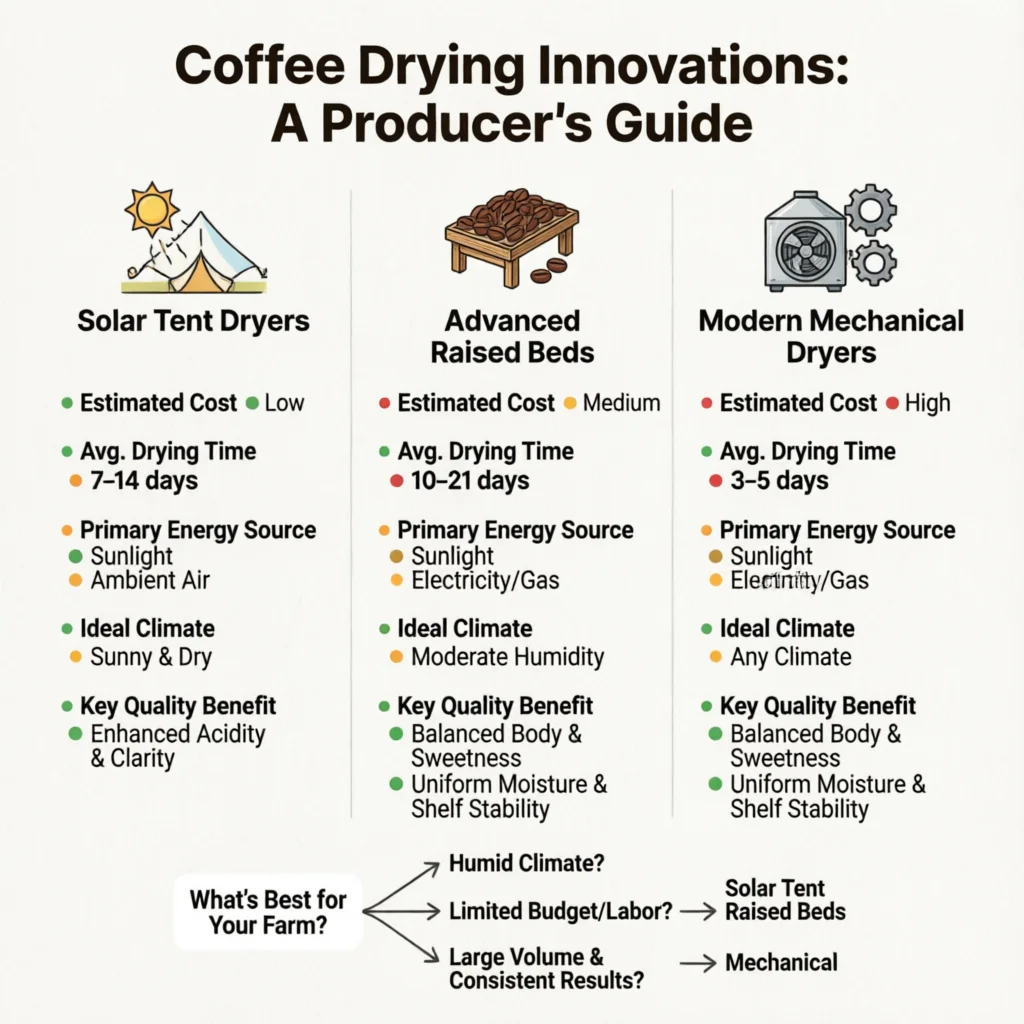
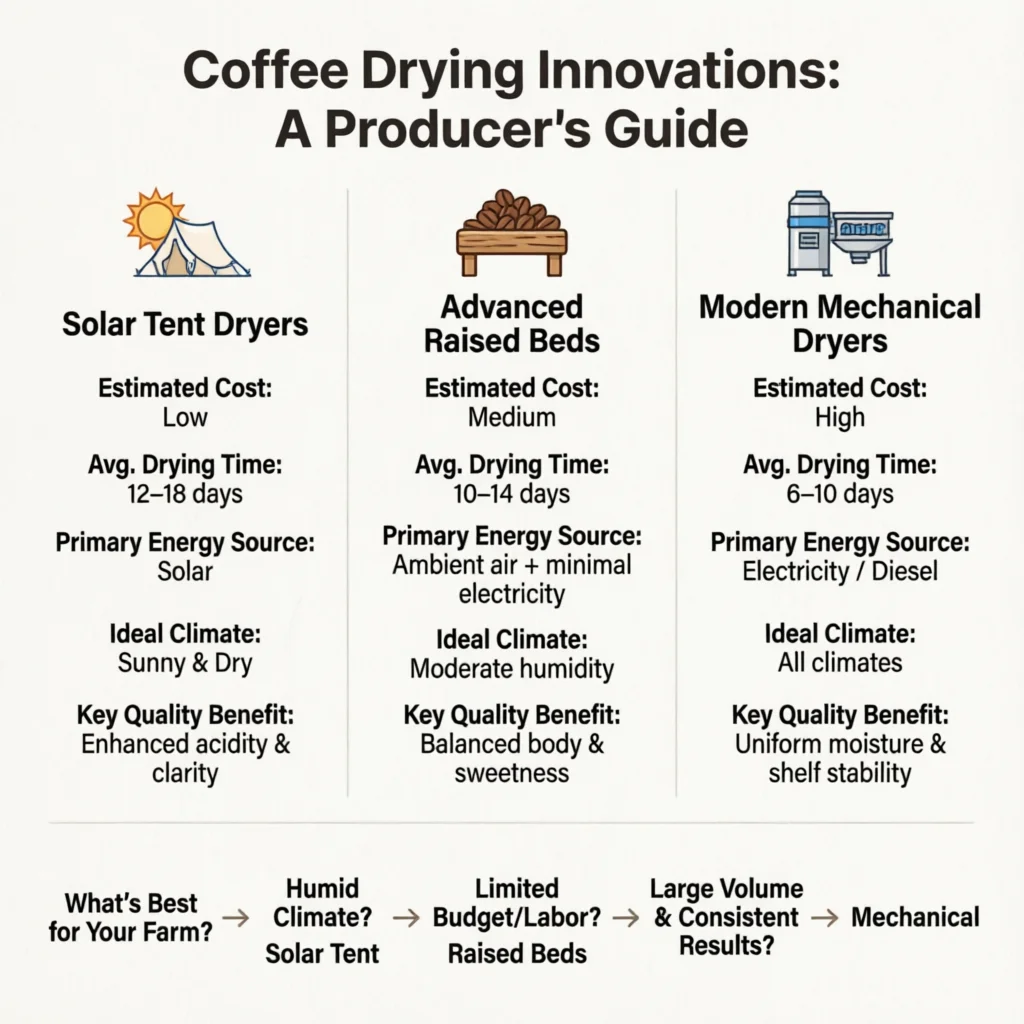
- Concrete Patio (Solar): High thermal mass stores and radiates heat, but risks re-absorption of ground moisture and rapid evening cooling leading to condensation. Prone to extreme temperature fluctuations.
- Raised African Beds (Solar/Air): Superior airflow from all sides and insulation from ground humidity. Permits more consistent drying but extends process duration in humid climates, increasing exposure time to environmental threats.
- Mechanical Dryers (Drum/Guardiola): Provide maximum control over temperature and airflow, decoupling the process from weather. The critical danger is convective heat overpowering the bean’s ability to shed moisture, causing internal starch gelatinization (“baked” flavor).
Barista’s Field Notes: Addressing Common Struggles
Theory meets reality on the drying patio. These common failures highlight critical gaps between principle and practice.
- “Unexpected rain ruined my patio lot.” This is a failure of moisture monitoring and risk planning. Solar drying requires a dedicated weather watch and proactive covering protocols. The “musty” flavor indicates mycotoxin-producing mold growth, which begins within hours in a rewetted, warm bean mass. Solution: Invest in rapid-covering systems and never leave beans unattended when rain is possible.
- “Raised beds take 3+ weeks and still get mold.” In high humidity, airflow alone is insufficient. The drying front stalls as bean moisture equilibrates with saturated air. Solution: Implement a hybrid approach. Use beds for the initial stage, then finish with supplemental, low-temperature mechanical drying (<35°C inlet air) to break the stall. Increase turning frequency to 5-6 times daily to disrupt microclimates.
- “Our mechanical dryer cooks the beans.” This indicates excessive inlet temperature or insufficient airflow. The bean’s exterior dries and heats faster than internal moisture can migrate, causing thermal damage. Solution: Lower the inlet temperature dramatically (start at 32°C) and prioritize high airflow volume over high heat. Cycle the dryer in intervals (e.g., 2 hours on, 4 hours off in a resting bin) to allow moisture to equalize within the bean.
Pro-Tip: The ‘Crack Test’ for Doneness
Before relying solely on a moisture meter, take a handful of dried parchment beans. Squeeze them tightly in your fist. Perfectly dried beans (11-12% moisture) will make a distinct, sharp cracking sound as the brittle parchment breaks. Under-dried beans will be silent or make a dull thud. Over-dried beans will shatter into pieces. This sensory check, used by experienced processors, is a quick field verification of your instrument’s reading.
From Dry Parchment to Brew: The Drying Quality Bridge
The impact of drying precision manifests directly in the extraction metrics and sensory profile of the final brew. Improper drying creates physical and chemical barriers to quality.
- Physical Structure: Over-drying (below 10% moisture) makes the bean brittle, leading to excessive fracturing during milling and roasting. This creates a wide particle distribution, which exacerbates channeling and uneven extraction. Under-drying (>12.5% moisture) yields a spongy, resilient bean that roasts unevenly, developing baked and sour notes simultaneously.
- Extraction Consequences: A well-dried bean provides a consistent canvas. Target a Total Dissolved Solids (TDS) of 1.15% – 1.45% and an Extraction Yield (EY) of 18% – 22% with a uniform particle size. Beans damaged by aggressive drying often require a significantly finer grind to achieve target TDS, but this increases the risk of astringent over-extraction of bitter compounds, narrowing the optimal brewing window.
- Sensory Translation: Baked beans from high-heat drying express flat, cereal-like flavors with a hollow body. Fermented or mold-affected beans introduce off-flavors that no roast profile can rectify, often manifesting as musty, medicinal, or overly sharp acidity.
Technical Summary
- Drying is a controlled thermodynamic process finalizing the coffee seed’s chemical composition for storage and roasting, directly determining sensory profile.
- Key parameters are seed temperature (must stay below 40°C), ambient humidity, and consistent airflow to ensure a linear moisture decline.
- Method choice defines risk: patios risk rewetting, raised beds stall in humidity, and mechanical dryers risk thermal damage from excessive heat over airflow.
- Optimal drying to 11-12% moisture content ensures chemical stability, prevents mycotoxin growth, and creates a physically sound bean for uniform roasting and extraction.
- Quality is verified by the parchment “Crack Test” and correlates to target brew metrics (TDS: 1.15%-1.45%, EY: 18%-22%) achieved with consistent particle size.