1. Introduction: The Thermal Revolution in Coffee Processing – From Accidental Defect to Precision Tool
Traditional coffee processing—washed, natural, honey—relies on ambient environmental conditions to govern the biochemical transformations during fermentation and drying. This paradigm is defined by passive thermal management, where temperature is an uncontrolled variable, leading to inconsistent metabolic activity of microbes and enzymes, and ultimately, unpredictable cup quality. The emerging field of precision fermentation challenges this by introducing active thermal control as a primary processing parameter. Within this field, the deliberate application of rapid temperature shifts, often mischaracterized as “thermal shock,” and multi-stage thermal profiles represent a significant technological advancement.
Historically, rapid temperature changes during processing were considered a defect. A sudden drop during drying, for instance, could stall metabolism or promote spoilage microorganisms, resulting in off-flavors. Contemporary research, however, inverts this perspective. By applying principles from biochemical engineering and materials science, researchers now employ programmed thermal variation not as a stressor to be avoided, but as a precise tool to modulate reaction kinetics, microbial succession, and cell wall permeability. This shift marks a transition from processing as an agricultural practice to processing as a controlled bioreactor operation, where temperature-time profiles are engineered to target specific sensory outcomes.
The core hypothesis of thermal-controlled processing is that discrete thermal phases can selectively activate or suppress metabolic pathways. A phase at a lower temperature may favor the production of certain acids by yeast, while a subsequent higher-temperature phase could promote enzymatic degradation of pectins or induce Maillard reaction precursors. This guide examines the scientific foundation of using thermal shock and multi-stage thermal processing, deconstructing the underlying physics and biochemistry to provide a framework for its application in temperature-controlled coffee fermentation.
2. The Physics of Failure: Deconstructing ‘Thermal Shock’ in Materials Science
The term “thermal shock,” borrowed from materials science and engineering, describes the development of stress and potential fracture in a material subjected to a rapid temperature change. Its direct application to biological systems like coffee cherries is an analogy, but one grounded in measurable physical and physiological consequences. A rigorous analysis requires examining the mechanisms of stress induction at multiple structural levels.
2.1. Differential Thermal Expansion and Induced Stress
At the macro- and micro-structural level, a coffee cherry is a composite material comprising tissues with distinct thermophysical properties (e.g., skin, pulp, mucilage, parchment, bean). When subjected to a rapid temperature change (ΔT/Δt), these constituent materials expand or contract at different rates, a phenomenon governed by their coefficients of thermal expansion (α). This differential expansion generates shear and tensile stresses at tissue interfaces. In materials science, the thermal shock resistance parameter (R) is often defined as R = σ(1-ν)/Eα, where σ is fracture strength, ν is Poisson’s ratio, and E is the elastic modulus. While biological tissues are viscoelastic and not brittle ceramics, the principle holds: rapid ΔT/Δt can exceed the yield stress of cell walls and middle lamellae, leading to structural failure.
2.2. Manifestations in Coffee Cherry Tissue
This mechanically induced stress has two primary physical manifestations relevant to processing:
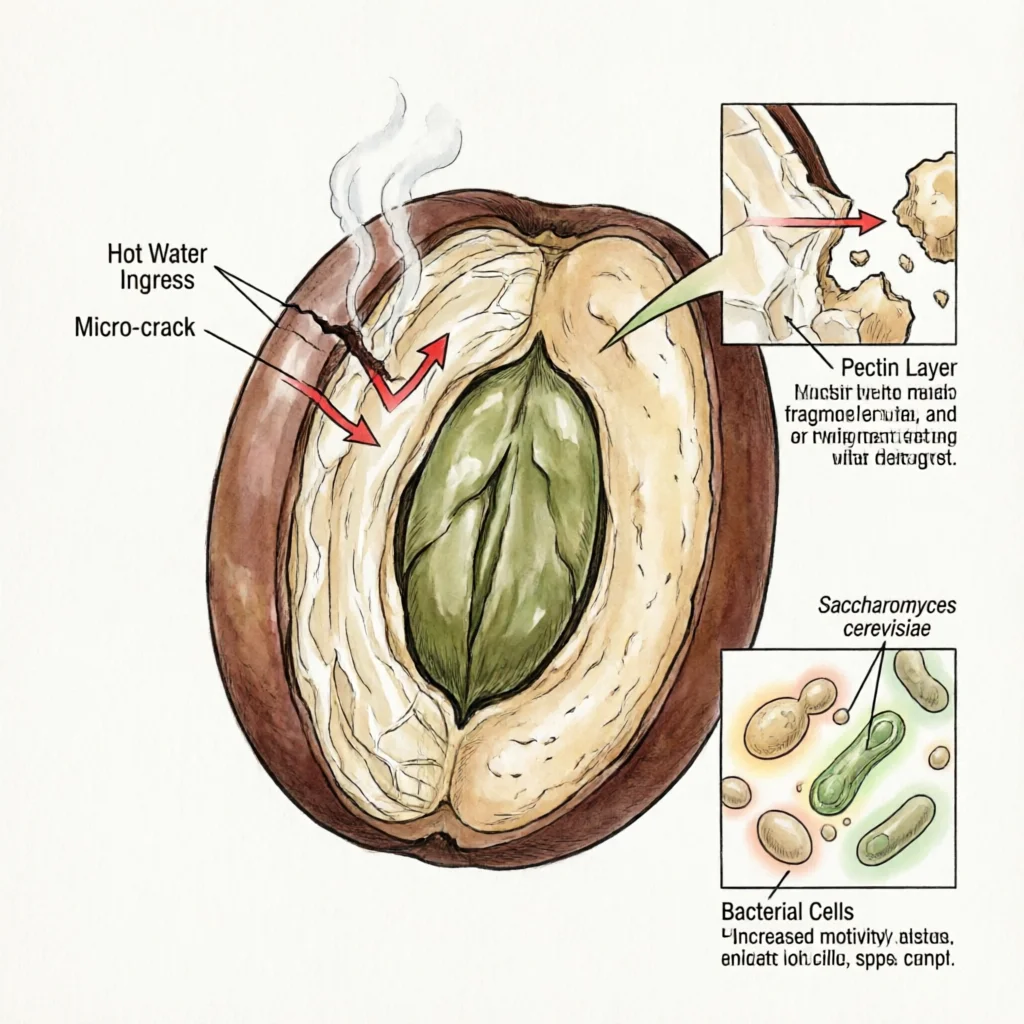
- Microfracturing of Parenchyma Cell Walls: The pulp and mucilage are primarily composed of parenchyma cells. Stress from differential expansion can cause microscopic ruptures in the primary cell wall and middle lamella (pectin-rich layer connecting cells). This dramatically increases the effective surface area for microbial colonization and enzyme-substrate interaction.
- Compromised Selective Permeability: The cellular plasma membrane’s lipid bilayer is sensitive to thermal phase transitions. A rapid temperature shift can alter membrane fluidity and integrity, potentially compromising its role as a selective barrier. This can lead to the uncontrolled leakage of intracellular metabolites (sugars, organic acids, ions) into the intercellular space, radically altering the fermentation substrate.
2.3. From Physical Failure to Biochemical Opportunity
It is critical to distinguish the material science event from the biochemical outcome. In coffee processing, the objective is not to catastrophically fracture the tissue but to leverage controlled, sub-critical stress to achieve specific ends. The “shock” is a controlled input parameter. The physical failures described are not defects but engineered modifications to the fermentation matrix:
- The increased surface area from microfractures accelerates diffusion-limited processes, such as the hydrolysis of pectins by polygalacturonase or the diffusion of sugars to yeast cells.
- The release of intracellular contents provides a sudden, concentrated nutrient pulse to the microbial community, potentially shifting population dynamics.
- Altered membrane permeability can allow for the more efficient diffusion of flavor precursors from the pulp into the bean, a process critical to flavor development in methods like anaerobic fermentation.
Therefore, the applied thermal transient is a processing tool designed to physically precondition the substrate, making it more amenable to subsequent targeted microbial and enzymatic activity during the fermentation stage. This deconstruction provides the theoretical basis for designing intentional multi-stage thermal profiles, where a rapid shift is one phase within a broader thermal strategy.
Deconstructing the Thermal Shock: Cellular Mechanics and Flavor Precursors
The initial thermal transient is not merely a warming step; it is a precise physical intervention. When coffee cherries experience a rapid temperature increase, several key structural changes occur. The waxy cuticle on the skin develops micro-fractures, dramatically increasing permeability. Simultaneously, the pectin chains in the mucilage begin to denature and loosen from the parchment. This controlled damage creates a uniform gateway for microbial inoculation and enzymatic diffusion. The heat also deactivates native seed enzymes that promote early germination, effectively pausing the seed’s metabolism and redirecting the entire system’s energy toward fermentation-driven flavor precursor development in the mucilage, not the bean.
Quantifying the Fermentation Environment: From Art to Replicable Science
Moving beyond “time and feel” requires monitoring key biomarkers. Successful anaerobic fermentation hinges on managing a cascade of microbial successions, primarily driven by shifting pH and Brix levels.
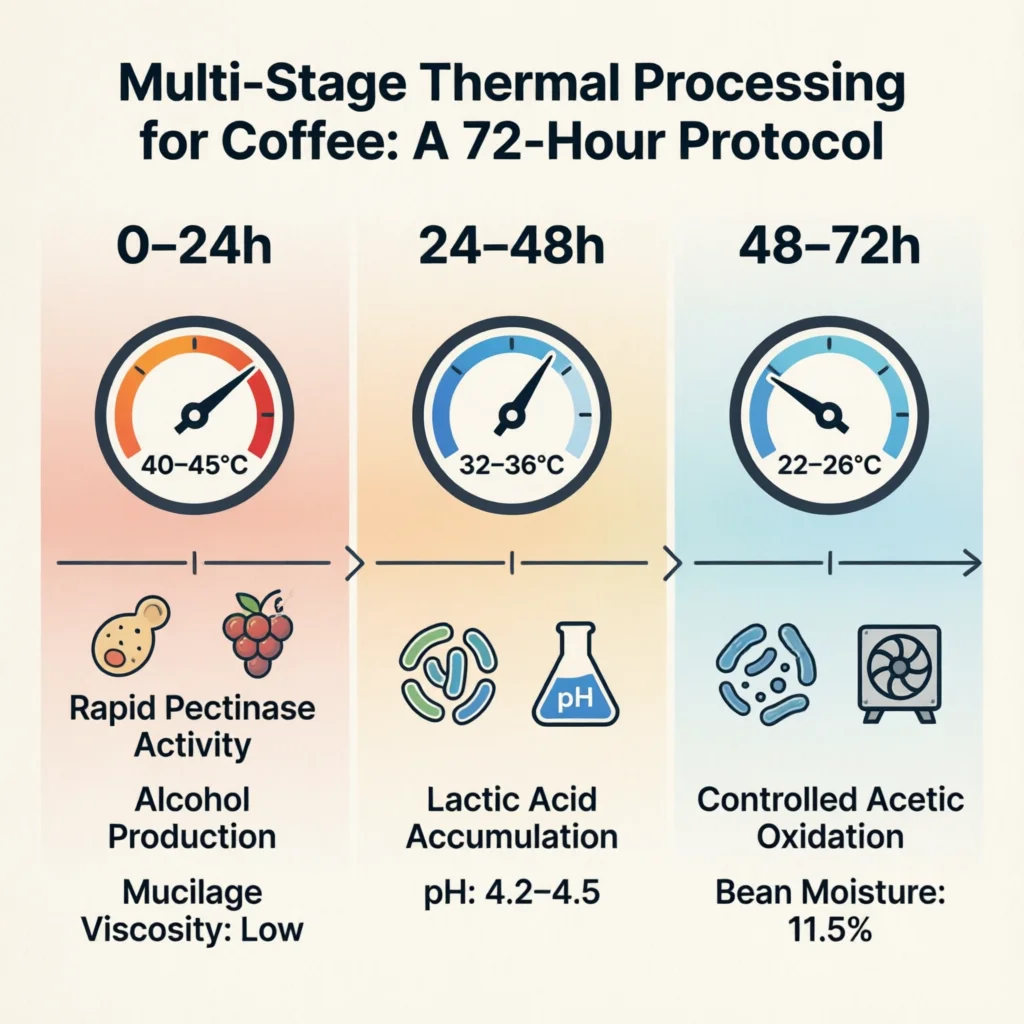
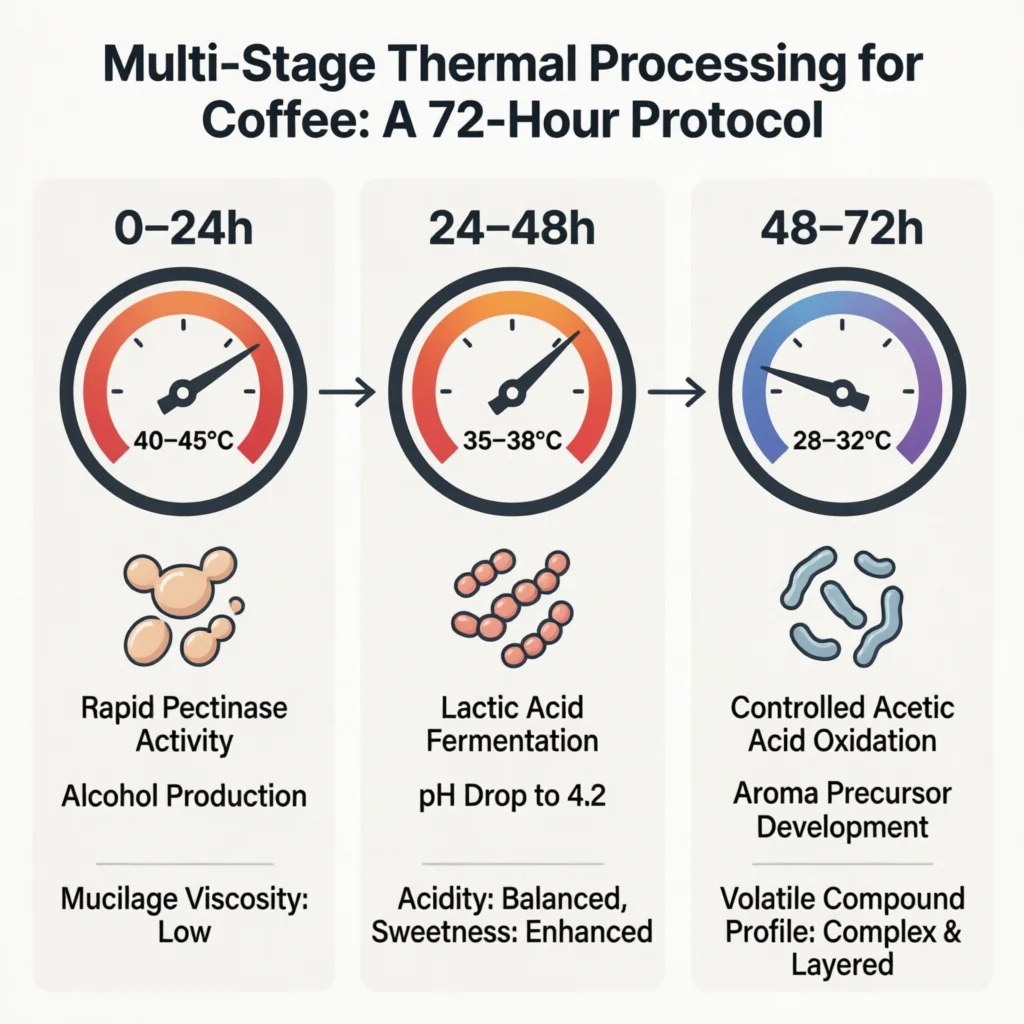
- Phase 1 (0-24 hrs): Yeasts and aerobic bacteria dominate, consuming simple sugars. Brix drops rapidly, pH falls from ~6.5 to 4.2. Ethanol and CO2 production begins.
- Phase 2 (24-72 hrs): Lactic Acid Bacteria (LAB) become dominant in the anaerobic environment. pH stabilizes between 3.8 – 4.1. Malic acid converts to softer lactic acid, and fruity esters form.
- Phase 3 (72+ hrs): Risk zone. Prolonged fermentation without control can see acetic acid bacteria or spoilage microbes proliferate if pH rises or temperature spikes, producing volatile acidity or butyric off-notes.
Tools like digital pH meters, refractometers (for Brix), and temperature data loggers transform this phase from a black box into a programmable, repeatable process.
Barista’s Field Notes: Addressing Common Struggles
Laboratory theory meets farm reality. Here are the most frequent pain points and actionable solutions based on two decades of mill visits and cupping failures.
- Inconsistent Results from Ambient Temperature: Never ferment without insulation. Use sealed fermentation tanks wrapped in insulating blankets or placed in a temperature-controlled water bath. This buffers against nighttime cold and daytime heat, ensuring microbial activity follows your timeline, not the weather’s.
- Incomplete Mucilage Removal & Over-Fermentation: These are two symptoms of the same problem: poor substrate preparation. The thermal shock phase must be optimized. Incomplete removal often means insufficient ΔT or time in the hot water dip. Over-fermentation suggests the mucilage was *too* broken down, creating a runaway fermentation. Dial in your initial thermal step.
- Stuck Fermentations & Off-Flavors: A “stuck” fermentation, where pH stalls, often indicates a lack of viable yeast. Consider using a selected culture starter. The dreaded vinegar (acetic) note signals oxygen ingress—check tank seals. Rotten fruit (butyric) points to contamination from fruit flies or unclean equipment; sanitation is non-negotiable.
- Lack of Directional Flavor Control: To emphasize fruitiness, favor lower fermentation temperatures (18-22°C) and shorter times (48-60 hrs) to preserve volatile esters. For brighter, wine-like acidity, allow pH to drop lower (closer to 3.8) and consider a pre-fermentation maceration stage to boost malic acid presence.
Pro-Tip: For producers experimenting with hot water dips: The critical metric is not just water temperature, but the **ΔT (Delta-T)** between the cherry’s internal temperature at harvest and the dip water. A 25-30°C ΔT is often sufficient to micro-fracture the skin without ‘cooking’ the seed. Use an infrared thermometer to check cherry pulp temp in the shade before designing your dip protocol. This precision prevents the baked vegetable flavor of thermal damage.
Optimizing the Roast and Brew for Process-Driven Coffees
These processed coffees demand a tailored approach post-harvest. The roaster must acknowledge the altered organic acid structure and higher solubility of the developed beans.
- Roasting Strategy: Employ a gentler, more conductive roast with a longer drying phase. The Maillard reaction often begins earlier. Aggressive application of heat during browning can scorch developed sugars and volatilize delicate fruit compounds. Target a slightly lower drop temperature than for a washed coffee of the same origin.
- Brewing Parameters: These coffees extract efficiently. To highlight clarity and avoid a muddy or overly fermented taste, use a slightly lower brewing temperature (90-92°C) and coarser grind. Target a Total Dissolved Solids (TDS) range of 1.15% – 1.35% and an Extraction Yield (EY) of 18% – 20%. Pushing extraction higher often pulls out excessive, unbalanced soluble material from the intensive processing.
- Particle Size Recommendation: Due to higher solubility, grind 15-20% coarser than your standard filter benchmark to modulate flow rate and extraction. This compensates for the increased number of soluble cells created during fermentation.
Technical Summary
- The applied thermal transient physically preconditions the cherry, creating micro-fractures and loosening mucilage to standardize microbial access and enzymatic action.
- Fermentation must be monitored through pH and Brix phases to direct microbial succession toward desired flavor outcomes (fruity esters, specific acids) and avoid off-flavors.
- Real-world consistency requires insulating fermentation vessels, impeccable sanitation, and potentially using starter cultures to ensure complete, clean fermentations.
- Roast and brew parameters require adjustment: use gentler roast profiles, lower brew temperatures (90-92°C), and coarser grinds to target a TDS of 1.15-1.35% and EY of 18-20% for optimal clarity.
- The entire process chain—from measuring cherry ΔT to monitoring fermentation pH to adjusting grind size—is a single, integrated system for flavor design.