
Introduction
The pursuit of a balanced and expressive cup of coffee, particularly through manual pour-over methods like the Origami dripper, hinges on the brewer’s ability to manipulate extraction kinetics. While established parameters—grind size, water temperature, and total brew time—form the foundational control set, the structure of the pour itself remains a potent yet nuanced variable. This article investigates a specific pour protocol, the “2:1 structure,” defined by an initial, high-agitation pour equal to twice the coffee mass, followed by a series of smaller, gentler pours. The central hypothesis is that this structure offers a targeted method for modulating the sequential extraction of organic acids and sugars, thereby providing the brewer with direct influence over the perceived acidity and sweetness in the final cup. Moving beyond anecdotal technique, this analysis will ground the 2:1 method in the principles of coffee extraction science, referencing established models and research to clarify its proposed mechanistic action.
Theoretical Background
Coffee extraction is a complex process of dissolving soluble material from the roasted coffee matrix into water. The Solubility Yield Curve, a cornerstone concept in coffee science (Illy & Viani, 2005), describes how different compounds dissolve at varying rates. Highly soluble compounds, such as chlorogenic acids (contributing to perceived acidity), citric acid, and malic acid, extract rapidly in the initial stages. Medium-solubility compounds, primarily sucrose and other reducing sugars (key contributors to sweetness and body), dissolve subsequently. Finally, less soluble compounds, including certain bitter phenolics and alkaloids like caffeine, extract more slowly over extended contact time.
The Specialty Coffee Association (SCA) provides a framework for quantifying this process, defining optimal extraction as occurring between 18-22% Extraction Yield (EY) with a Total Dissolved Solids (TDS) concentration of 1.15-1.45% for most filter brews. However, these metrics describe the quantity of extraction, not the qualitative composition of the solubles. Two brews with identical EY can have starkly different sensory profiles based on which compounds were emphasized during extraction.
This is where pour structure exerts its influence. Agitation—mechanical energy introduced via water flow—is a critical driver of extraction kinetics. As described by Hendon et al. (2014) in their work on the role of dissolution kinetics in coffee brewing, increased agitation disrupts the static boundary layer around coffee particles, enhances convective mass transfer, and can elevate slurry temperature by introducing fresh, hot water. The 2:1 pour structure leverages this principle in a phased manner:
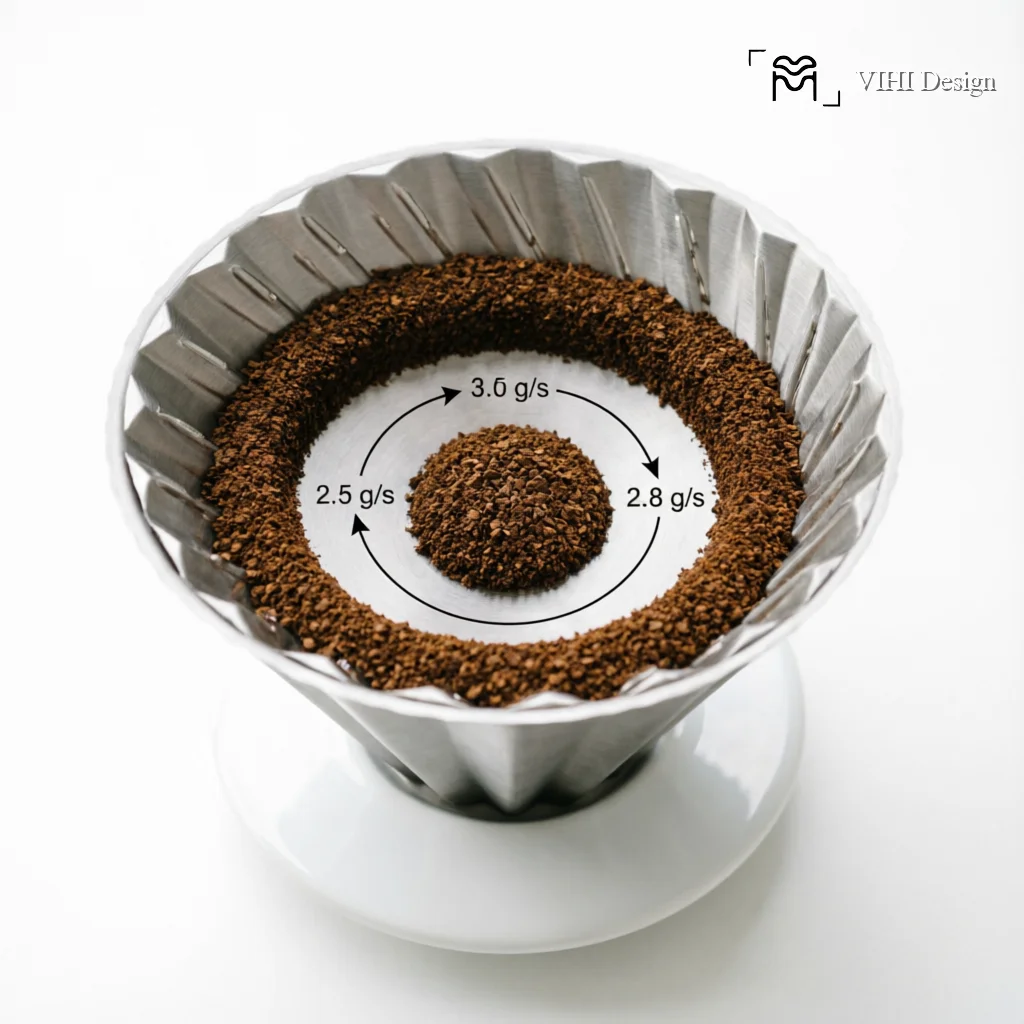
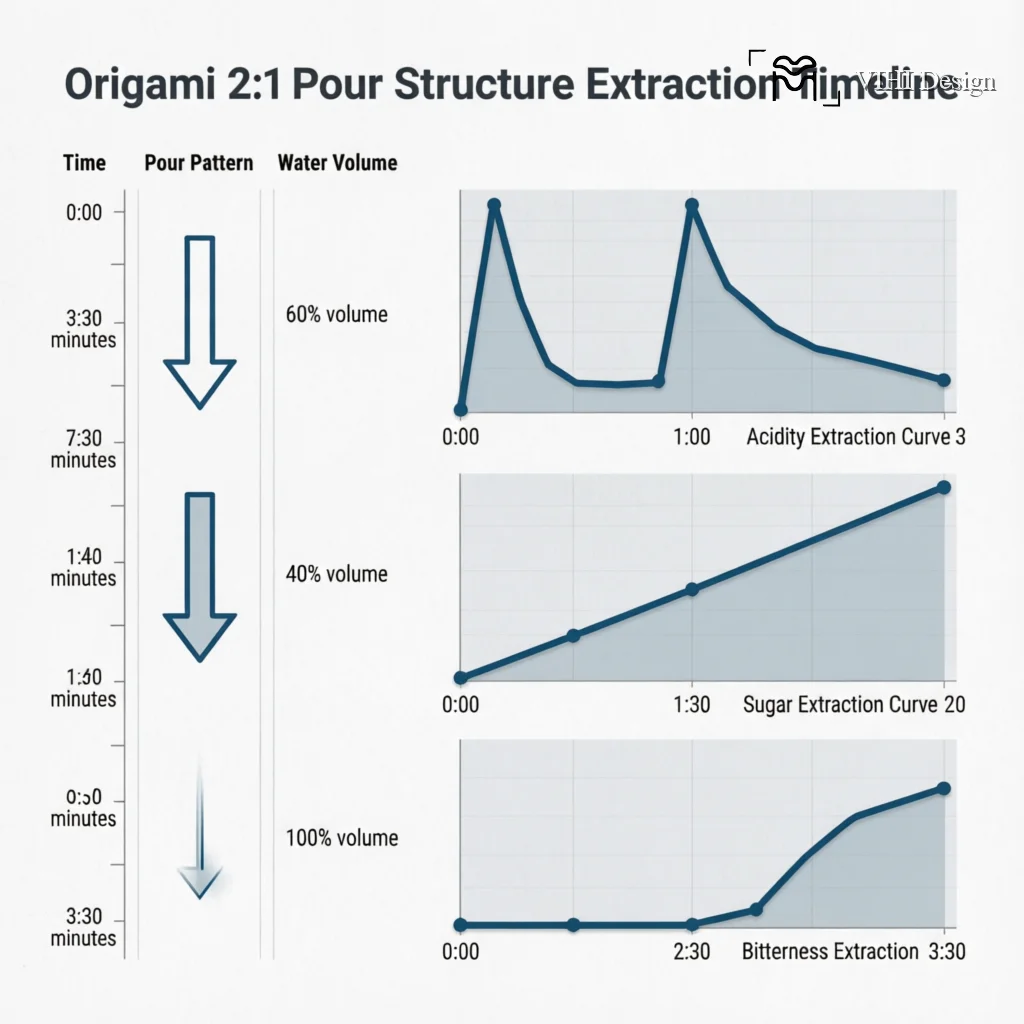
Phase 1 (High-Agitation Pour): The initial pour, using twice the mass of water to coffee (e.g., 60g water for 30g coffee), creates a highly turbulent, fluid slurry. This maximizes initial agitation, ensuring efficient and rapid dissolution of the highly soluble acids. The goal is not to fully saturate the bed but to create a dynamic environment that targets this first wave of solubles.
Phase 2 (Low-Agitation Pours): Subsequent, smaller pours (e.g., 60-80g increments) are executed with minimal agitation, often from a lower height and with a gentler flow rate. This reduces convective forces, slowing the extraction rate. The theory, supported by the sequential nature of the solubility curve, is that this gentler phase favors the dissolution of medium-solubility sugars without over-extracting the bitter compounds that require more energy and time. Furthermore, each small pour introduces a pulse of hot water, which can temporarily elevate the slurry temperature (Colonna-Dashwood & Hendon, 2015), potentially boosting the solubility of sucrose during these critical later stages.
Therefore, the 2:1 structure is not merely a timing template; it is a deliberate attempt to stage extraction energy. By front-loading agitation, it aims to efficiently manage acidic compounds. By then reducing agitation, it seeks to create a controlled window for sugar extraction, thereby shaping the qualitative balance of the brew towards greater perceived sweetness and complexity, all within the target quantitative range of SCA protocols.
The 2:1 Pour Structure: How to Control Acidity and Sweetness in Your Origami Brew
Part 2: Practical Application and Sensory Experience
Having established the theory—that the 2:1 structure stages extraction energy—the true craft lies in its execution. This is where your skill as a barista directly translates into the sensory experience in the cup. Let’s move from principle to practice.
Dialing In: From Theory to Your Taste Buds
The 2:1 structure provides a framework, but your coffee and your palate are the final guides. The target extraction yield (EY) of 18% to 22% and total dissolved solids (TDS) of 1.15% to 1.45% are your quantitative checkpoints, but the qualitative balance is your art.
- If your brew tastes sour, sharp, or thin: Your acidity stage may be under-developed. Focus on the vigor of your first pour. Ensure you’re achieving a full, even saturation and a consistent, gentle swirl. A higher agitation here can help extract more of the desirable acids and set a stronger foundation for sweetness.
- If your brew tastes flat, hollow, or overly bitter: You may be over-agitating during the second, gentle phase. The goal is a steady, laminar flow that maintains temperature without churning the bed. Protect that “controlled window” for sugar extraction. Also, check your grind; it might be too fine, causing over-extraction even with gentle pouring.
The Sensory Payoff: Experiencing the Structured Brew
When executed with intention, the 2:1 structure doesn’t just make “good” coffee; it creates a specific and repeatable experience. The staged extraction often manifests in the cup as a clear, layered profile.
On the Nose: You might first encounter the volatile aromatic compounds unlocked during the high-agitation bloom and first pour—floral notes, bright fruits, or citrus zest.
On the Palate: This is where the structure shines. The initial sip often presents a defined, clean acidity—think of it as the “shape” of the coffee. Mid-palate, you should experience a transition as the sugars extracted during the gentle phase come forward, rounding out the acidity and providing body. The finish should be sweet and lingering, not astringent or abruptly bitter.
This clarity is a direct result of separating the extraction phases. It allows the drinker to perceive the coffee’s complexity sequentially, rather than as a muddled blend of all flavors at once.
Conclusion: Mastery Through Intentionality
The Origami dripper, with its flat-bottomed design and flow-enhancing ribs, is a tool of unparalleled clarity. The 2:1 pour structure is the method that harnesses this tool with surgical precision. It moves beyond simply hitting a target TDS or EY and into the realm of flavor sculpting.
By front-loading agitation, you efficiently manage the acidic backbone. By then shifting to a gentle, controlled pour, you foster an environment where sugars can dissolve without pulling out excessive bitterness. The result is a brew that honors both the science of extraction (staying within the 18-22% EY range) and the art of balance, leading to a cup where vibrant acidity and foundational sweetness don’t just coexist—they complement and elevate each other. In the end, this structure empowers you, the brewer, to consistently translate the potential of a beautiful coffee into a tangible, delightful experience.
Learn More: For a comprehensive understanding, explore our main guide on The Origami Dripper Mastery Guide: From Paper Selection to Perfect Extraction.