The Origami Dripper Mastery Guide:
From Paper Selection to Perfect Extraction
Introduction: The Convergence of Geometry and Gastronomy
The pursuit of the perfect cup of filter coffee has driven innovation in brew device design for decades. Among the plethora of available tools, the Origami Dripper has emerged as a singular object of study, representing a unique synthesis of aesthetic form, hydrodynamic function, and material science. Unlike conical or flat-bottomed brewers with fixed geometries, the Origami Dripper’s distinctive ribbed, tulip-shaped design—capable of accommodating both conical and flat-bottom paper filters—introduces a variable and highly tunable extraction environment. This guide posits that mastery of this device is not merely a procedural skill but an applied science, requiring a foundational understanding of the principles governing water flow, particle degradation, and solute diffusion. The objective of this work is to deconstruct the brewing process into its constituent variables, providing a rigorous framework for achieving reproducible and optimized extraction.
Theoretical Background: Foundational Principles of Coffee Extraction
At its core, coffee brewing is a mass transfer process, where soluble compounds (approximately 30% of the coffee bean’s mass) are dissolved from the roasted, ground matrix into water. The extraction yield (EY), expressed as a percentage of the dry coffee mass, and the total dissolved solids (TDS) concentration in the beverage are the primary quantitative metrics for this process. The widely accepted “Gold Cup” standard, as defined by the Specialty Coffee Association, targets an extraction yield between 18-22% and a TDS of 1.15-1.45% for optimal sensory balance. Deviation from this range typically results in under-extraction (sour, sharp, lacking sweetness) or over-extraction (bitter, astringent, hollow).
Hydrodynamics in the Origami Dripper: Flow Rate and Bed Permeability
The geometry of a brew device directly influences the hydrodynamics of the water passing through the coffee bed. The Origami Dripper’s pronounced ribs create multiple, consistent channels for air and water vapor to escape, promoting an even wetting phase and reducing the potential for channeling. The choice between a conical or flat-bottom filter further modulates the hydraulic gradient. A conical filter creates a deeper, more compact bed, generally leading to a longer contact time and increased resistance. A flat-bottom filter creates a shallower, wider bed with lower resistance, often facilitating a faster flow rate. The brewer must understand this relationship to manipulate contact time—a critical, though not independent, variable in extraction.
The Role of Filter Paper: Material Science at the Microscale
The filter paper is an active, not passive, component in the extraction system. Its material composition (typically wood pulp, abaca hemp, or synthetic fibers), thickness, and pore size distribution govern two key functions: the retention of fine coffee particles and the adsorption of oils and diterpenes. Thicker, denser papers (e.g., certain wood pulp filters) can impede flow and absorb more oils, yielding a cleaner, brighter cup. Thinner, more porous papers (e.g., high-quality abaca or fast-flow filters) allow faster drainage and greater oil passage, contributing to increased body and texture. The selection of filter paper for the Origami Dripper is therefore a primary calibration point for tailoring the sensory profile of the final brew.
Grind Particle Distribution and Its Impact on Extraction Uniformity
The coffee grind represents a polydisperse system of particles with a wide size distribution. The mean particle size (often correlated with grind setting) controls the overall surface area available for extraction, while the particle distribution (the range of sizes) dictates uniformity. A narrow distribution promotes even extraction, as all particles require similar time to fully saturate and yield solubles. A wide distribution leads to a bimodal extraction: fines over-extract quickly, contributing bitterness, while large boulders under-extract, leaving desirable sugars behind. The Origami Dripper’s flow dynamics interact intimately with this particle bed, making grind quality a non-negotiable parameter for mastery.
Thermodynamics of Brewing: Water Temperature as an Energy Variable
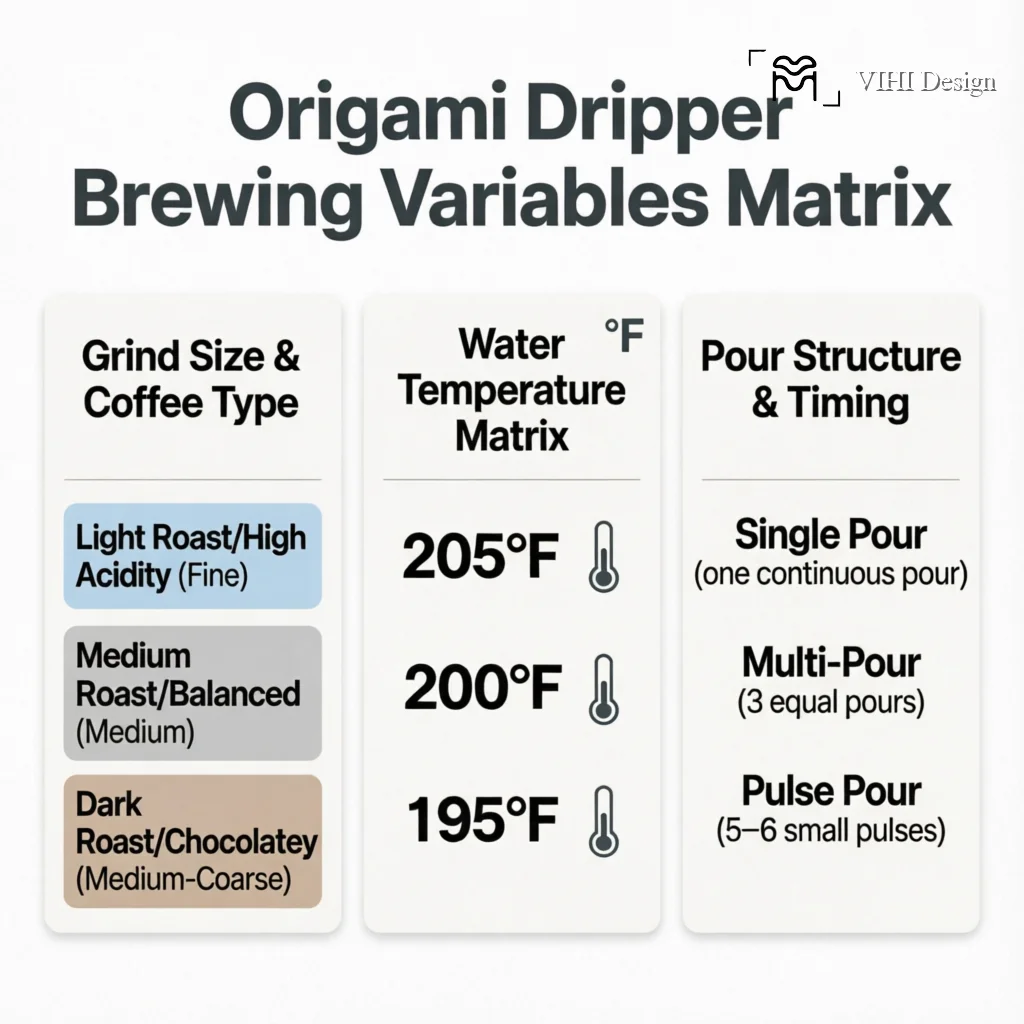
Water temperature serves as the kinetic energy driver for the extraction process. Higher temperatures (e.g., 92-96°C) increase the solubility of compounds, the rate of diffusion, and the degradation of cellular structures within the coffee particle, accelerating extraction. Lower temperatures (e.g., 85-89°C) selectively slow the extraction of less soluble, often bitter-tasting compounds. The optimal temperature is not a fixed value but a function of coffee roast degree (darker roasts generally require lower temperatures to mitigate ashiness), bean density, and desired flavor emphasis. In the Origami Dripper, temperature loss during the pour is a factor that must be accounted for, especially in longer draw-down times.
The Agitation Variable: Turbulence and Its Controlled Application
Agitation—the manual introduction of turbulence into the coffee slurry via pouring technique or stirring—is a powerful tool for managing extraction uniformity. It disrupts static zones, re-suspends grounds, and ensures all particles are fully wetted, mitigating channeling. In the Origami Dripper, the pour structure (central vs. spiral, flow rate, height) is the primary source of agitation. Excessive agitation, however, can lead to unpredictable migration of fines and clogging of the filter paper, creating inconsistent flow. A scientific approach requires understanding agitation as a means to achieve a target slurry motion, not as an arbitrary action.
Synthesis: The Origami Dripper as an Integrated System
The preceding theoretical components do not operate in isolation. They form a complex, interdependent system where a change in one variable (e.g., filter paper) necessitates compensatory adjustments in others (e.g., grind size or pour rate) to maintain the target extraction yield. The Origami Dripper’s unique design offers a wider palette for these adjustments than many static brewers. Mastery, therefore, lies in developing a predictive mental model of this system, allowing the brewer to diagnose and correct imbalances—such as a sour cup indicating under-extraction, which could be addressed by finer grind, higher temperature, increased agitation, or a slower-flow filter—with precision and intent. The following phases of this guide will apply this theoretical framework to practical methodology.
The Origami Dripper Mastery Guide: From Paper Selection to Perfect Extraction
Phase 2: The Practical Brew Framework
With the theoretical model in mind, we now establish a repeatable, high-quality brew framework. This is your baseline recipe, designed to produce a balanced cup within our target extraction parameters: a Total Dissolved Solids (TDS) of 1.15% to 1.45% and an Extraction Yield (EY) of 18% to 22%. This range is the sweet spot for most modern, light-to-medium roast specialty coffees, highlighting clarity, sweetness, and complexity.
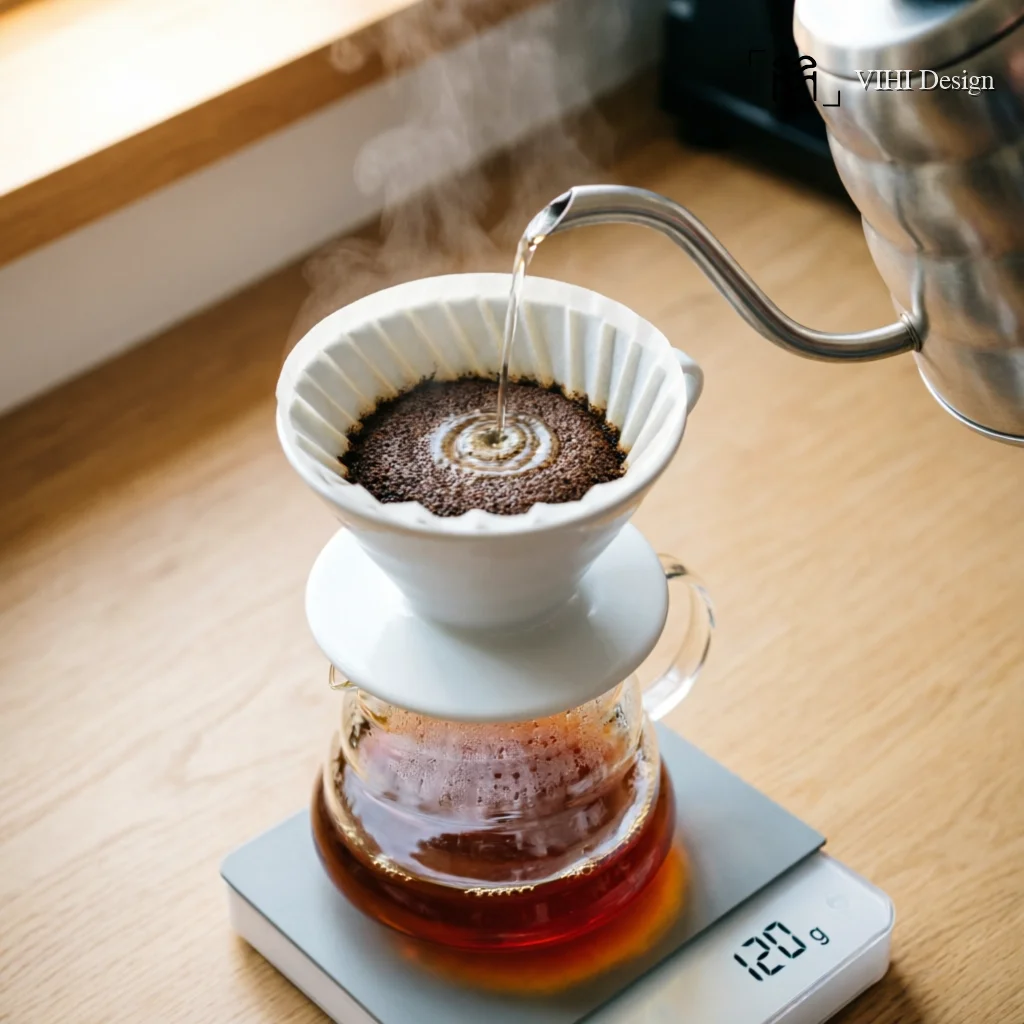
The Baseline Recipe: Use 20g of coffee ground slightly finer than for a V60 (aiming for a 3:00-3:30 total brew time). Heat 320g of water to 94°C (201°F). After a 45-second bloom with 60g of water, pour in gentle, slow spirals to maintain a consistent water level, finishing all water by the 2:00 mark. Allow the brewer to fully drain.
Phase 3: Diagnosis, Adjustment, and Refinement
This is where the Origami’s versatility shines. Your baseline brew is a diagnostic tool. Use the taste and, if available, TDS measurements to guide your adjustments within the interconnected system of variables.
- For a Sour, Sharp Cup (Under-Extraction): Your EY is likely below 18%. Beyond grinding finer, consider:
- Increasing water temperature (up to 96°C) to increase energy for extraction.
- Using a slower-flow filter paper (like untabbed Kalita wave papers) to increase contact time.
- Employing more aggressive agitation during pours to scour more solids from the coffee bed.
- For a Bitter, Astringent Cup (Over-Extraction): Your EY is likely pushing past 22%. Correct by:
- Grinding coarser as your first action.
- Lowering water temperature (down to 92°C).
- Using a faster-flow filter (like standard V60 papers) or reducing agitation to a gentle center pour.
Phase 4: Mastering the User Experience – Ritual and Consistency
True mastery transcends recipe following; it’s about embedding the process into muscle memory and sensory awareness. The Origami, with its elegant form, invites a mindful brewing ritual.
Developing Consistency:
Use a gooseneck kettle for precise water control. Practice a consistent pouring pattern—speed, height, and spiral width. Weigh your coffee and water every time. The goal is to make every variable except the one you’re intentionally testing identical from brew to brew. This disciplined approach builds your predictive mental model faster than any other practice.
The Ultimate Test – Taste: Numbers from a refractometer (TDS & EY) are invaluable guides, but your palate is the final judge. Train it by cupping coffees to understand their inherent flavors, and then taste your pour-overs critically. Ask: Is it sweet? Is the acidity pleasant? Is the body appropriate? Is the finish clean? Your adjustments should always be in service of a more enjoyable, expressive cup.
By marrying this structured methodology with the Origami Dripper’s unique adaptability, you move from simply making coffee to crafting it. You become not just a brewer, but a designer of flavor.