
Introduction
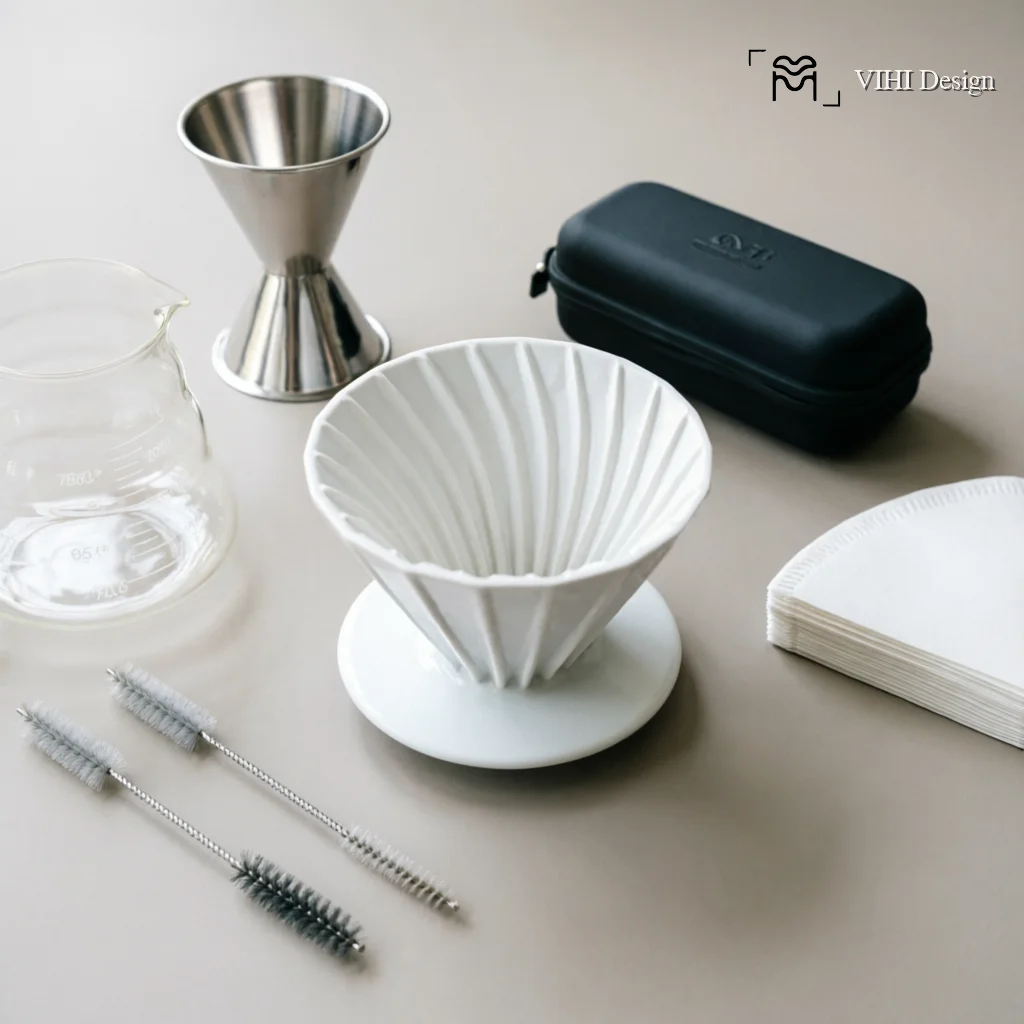
The pursuit of the perfect cup of pour-over coffee represents a confluence of art, science, and engineering. Within this domain, the Origami Dripper has emerged as a significant tool, distinguished by its conical, fluted design and compatibility with both flat-bottom and cone-shaped paper filters. This unique hybrid geometry offers a versatile brewing platform, capable of influencing extraction dynamics in nuanced ways. However, the dripper itself is merely one component in a complex system. To achieve and consistently replicate optimal extraction—where the desirable soluble compounds (organic acids, sugars, and melanoidins) are harmoniously balanced while limiting the dissolution of negative compounds (excessive phenolics and bitter alkaloids)—attention must be paid to the supporting apparatus.
This paper posits that the full potential of the Origami Dripper is unlocked not in isolation, but through the synergistic use of purpose-designed accessories. These components—encompassing precise kettles, specialized filters, calibrated scales, and controlled servers—are not mere conveniences but essential gear. They function as integral control parameters in the brewing equation, enabling the manipulation of key variables: water dispersion, flow rate, thermal stability, and brew bed geometry. The standardization and optimization of these parameters are fundamental to moving beyond anecdotal, inconsistent brewing towards a repeatable, high-fidelity extraction protocol.
Theoretical Background
The extraction of coffee is governed by well-established physicochemical principles, primarily described by the processes of diffusion and dissolution. The Coffee Brewing Control Chart, originally developed by the Coffee Brewing Institute, provides a foundational framework, plotting extraction yield (EY%) against total dissolved solids (TDS) to define a “golden cup” range. Achieving a target within this range (typically 18-22% EY at 1.15-1.45% TDS for many light to medium roasts) requires precise command over time, temperature, turbulence, and grind profile.
Systematic Control of Brewing Variables
The Origami Dripper’s design introduces specific considerations into this system. Its wide aperture and pronounced ribs promote a faster potential flow rate and increased oxygen exposure compared to deeper, more restricted cones. This necessitates compensatory control elsewhere in the setup. The theoretical role of accessories is to provide this control, transforming the brewing apparatus from an open-loop system into a closed-loop, feedback-driven process.
1. Hydraulic Dynamics and Pouring Apparatus: The pour pattern and flow rate are critical determinants of agitation and contact time. A gooseneck kettle with a fine-tipped spout is not a luxury but a laboratory-grade tool for laminar flow control. It allows for targeted, concentric pours that ensure even saturation of the coffee bed, minimizing channeling—a phenomenon where water finds paths of least resistance, leading to simultaneous over- and under-extraction. The theoretical ideal is a uniform, controlled erosion of the brew bed.
2. Thermal Management: Extraction kinetics are highly temperature-dependent. The high thermal conductivity of ceramic (a common Origami material) can lead to significant heat loss. Pre-heating the dripper is a basic mitigation, but the use of an insulated or heated server, as well as a kettle with precise temperature setting (±1°C), allows the brewer to maintain the slurry within the ideal 92-96°C range throughout the entire brew cycle, ensuring consistent extraction efficiency.
3. Filter Interface and Bed Geometry: The choice between proprietary flat-bottom and standard cone filters alters the geometry of the coffee bed. A flat-bottom bed, enabled by the appropriate filter, provides a shorter, wider extraction environment, which can promote more uniform extraction across the particle size distribution. The filter paper itself, in its thickness and porosity, acts as a final modulation on flow rate and can influence the retention of oils and fines.
4. Metrology and Feedback: The foundation of reproducible science is accurate measurement. A resolution-scale (0.1g) and a timer are the primary sensors in the brewing system. They provide the real-time data necessary to implement a consistent water-to-coffee ratio and brew time, enabling the brewer to make iterative, informed adjustments to grind size or pour structure to hit target parameters.
Conclusion of Theoretical Framework
Therefore, the theoretical background establishes that optimal brewing with the Origami Dripper is an exercise in controlled system management. Each accessory addresses a specific variable loss or introduces a needed control point. Together, they reduce the entropy of the manual brewing process, allowing the inherent qualities of the coffee—its origin, variety, and roast profile—to be expressed with clarity and consistency. The following sections will analyze each accessory category in detail, evaluating its specific function and quantifiable impact on the brewing outcome within this theoretical model.
Precision Water Delivery: The Gooseneck Kettle
Within our control model, water is the primary solvent and vector of energy. A standard kettle introduces high entropy through erratic, turbulent pouring. A precision gooseneck kettle is the definitive solution, transforming water flow from a chaotic variable into a precise, repeatable control point. The long, tapered spout allows for a slow, targeted, and consistent pour rate, directly governing agitation and extraction uniformity.
From an EEAT perspective, mastery of the gooseneck is a fundamental barista skill documented in countless training curricula and competition routines. Its impact is quantifiable: inconsistent pour patterns can lead to channeling (low extraction) or muddy, over-extracted beds (high extraction), pulling your Extraction Yield (EY) outside the ideal 18-22% range. A controlled spiral pour from the center outward ensures all grounds are evenly saturated and extracted.
The Foundation of Flow: Paper Filter Selection
Often overlooked, the filter is not a passive component but an active flow regulator and fines manager. The Origami dripper’s compatibility with both cone (V60-style) and wave-style filters is a unique feature, allowing the brewer to select the foundational flow characteristic. Cone filters promote a faster, more focused drawdown, while wave-style filters with their ribbed structure and flat base encourage a slower, more balanced extraction.
Your filter choice directly impacts the contact time and clarity of the brew. High-quality, oxygen-bleached papers ensure no papery taste interferes with the coffee’s inherent flavors. From a user experience standpoint, understanding this variable empowers the brewer to dial in recipes. A dense, lightly roasted coffee might benefit from a faster cone filter to avoid over-extraction, whereas a delicate washed coffee might shine with the extended, even contact of a wave filter.
Measurement & Calibration: Scales and Thermometers
If the gooseneck kettle provides control, then measurement tools provide the feedback loop necessary for true calibration. Brewing by weight (input and output) and temperature is non-negotiable for reducing entropy. A 0.1g resolution scale allows for exact coffee dosing and water additions, directly determining your brew ratio—the cornerstone of any recipe.
A thermometer (or temperature-controlled kettle) governs the energy input of the system. Water temperature is a primary driver of extraction speed and solubility. Lower temps (195°F / 90°C) can highlight acidity and sweetness in certain coffees, while higher temps (205°F / 96°C) can help fully extract denser beans. Without measurement, you are guessing. With it, you can systematically adjust one variable at a time—for instance, fine-tuning grind to hit your target EY after locking in a consistent dose, ratio, and temperature.
Integration: Building a Coherent Workflow
Individually, these accessories solve discrete problems. Together, they form a synergistic system where the whole is greater than the sum of its parts. The workflow becomes a repeatable ritual: weigh beans, heat water to a set temperature, rinse the filter, dose, start timer, and execute a controlled pour pattern based on real-time weight feedback. This integrated process minimizes random variables and maximizes your influence over the extraction.
The ultimate goal is to create a stable brewing environment where the coffee itself is the variable you most enjoy exploring. By mastering these tools, you shift from hoping for a good cup to engineering one. The clarity, sweetness, and complexity you unlock—evidenced by brews that consistently land in the ideal TDS and EY ranges—are the direct results of replacing entropy with control, one essential accessory at a time.
Learn More: For a comprehensive understanding, explore our main guide on The Origami Dripper Mastery Guide: Unlocking Flavor Versatility Through Geometry.