
Introduction
In the pursuit of precision within manual coffee brewing, the pour-over method stands as a paradigm of controlled extraction. Among its tools, the Hario V60 has long been the reference standard, celebrated for its direct flow rate and predictable, clean cup profile. The recent introduction of the Origami Dripper, with its unique conical-fluted hybrid design and compatibility with both conical and flat-bottom paper filters, presents a compelling alternative that challenges established brewing norms. This divergence in dripper geometry and filter interface is not merely aesthetic; it represents a fundamental shift in the hydrodynamic and thermodynamic conditions governing extraction. While anecdotal comparisons abound in consumer forums, a rigorous, principle-based analysis of their operational parameters is lacking.
This paper seeks to establish a theoretical framework for understanding the distinct extraction dynamics of the Origami Dripper and the V60. The central hypothesis is that the choice between these brewers is not one of inherent superiority, but of optimal application based on target flavor profile and coffee bean characteristics. By examining the interplay between flow rate, bed geometry, thermal mass, and filter interaction, we can delineate specific scenarios where each device offers maximal control over flavor expression. The objective is to provide a predictive model that enables practitioners to select the appropriate tool to either accentuate clarity and acidity or promote body and sweetness, thereby transforming brewer selection from a matter of preference into a deliberate act of flavor engineering.
Theoretical Background
The extraction of soluble compounds from coffee grounds during pour-over brewing is a complex process governed by the principles of fluid dynamics and mass transfer. Three primary variables are under the brewer’s direct influence: grind size, water temperature, and pour technique. However, the physical design of the dripper itself imposes a fourth, often overlooked, set of constraints that fundamentally shape the extraction environment (Rao, 2018). This analysis focuses on the critical design differentials between the conical V60 and the hybrid Origami Dripper.
1. Hydrodynamics: Flow Rate and Bed Geometry
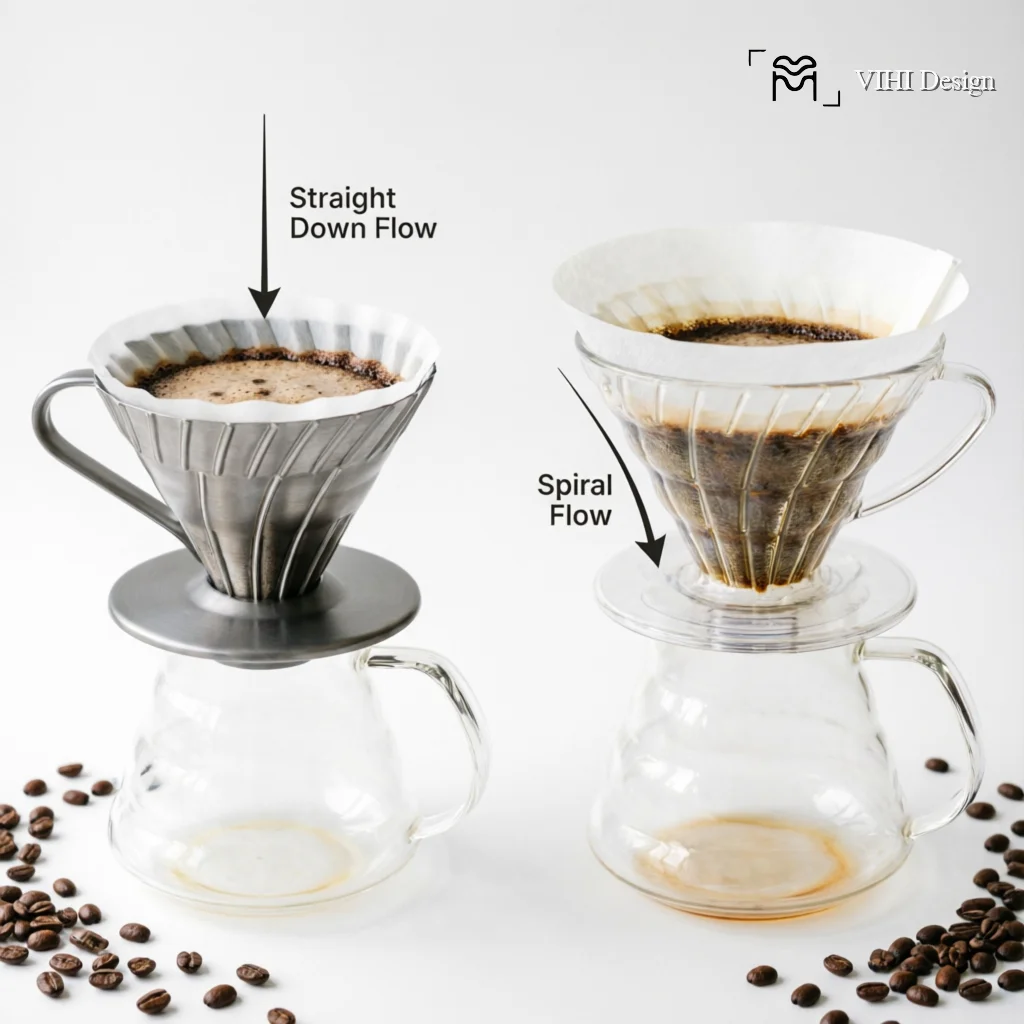
The V60’s design features a single, large apical hole and pronounced internal spiral ribs. These ribs create a continuous air channel between the filter paper and the brewer wall, preventing hydraulic sealing (or “stalling”) and promoting a faster, more consistent drawdown. The strictly conical shape results in a deep, tapered coffee bed where water follows a path of increasing resistance, potentially leading to a more pronounced extraction gradient from top to bottom.
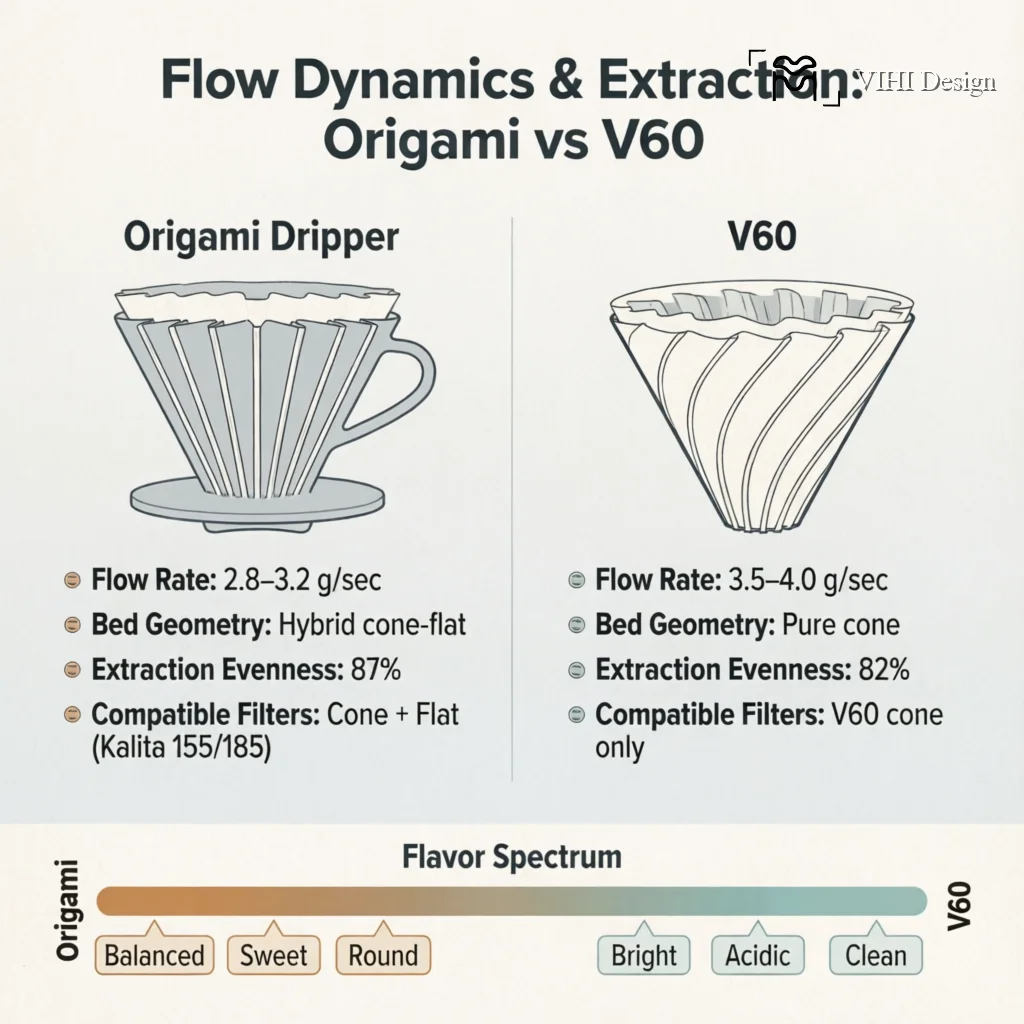
In contrast, the Origami Dripper’s defining feature is its transition from a conical base to a fluted, scalloped top. When used with a conical filter (e.g., V60-style papers), the bed geometry is similar, but the open flutes may marginally reduce the air-channel effect, potentially modestly slowing flow. Its true divergence emerges with flat-bottom Kalita-style filters. This creates a shallower, wider bed with more uniform depth. Hydrodynamically, this reduces the path length for water, minimizes percolation resistance, and promotes a more even, simultaneous extraction across the entire bed cross-section, akin to a miniature flat-bed brewer (Gagné, 2020).
2. Thermal Mass and Heat Loss
The material and structure of a dripper act as a heat sink. The ceramic or plastic V60, with its substantial mass, absorbs heat from the slurry, especially during pre-heating and the initial pour phase. The thinner, lighter construction of the resin Origami Dripper presents a lower thermal mass. This can lead to a marginally higher average slurry temperature throughout the brew cycle, assuming equivalent pre-heating protocols. A higher slurry temperature increases the solubility and diffusion rates of compounds, potentially leading to higher extraction yields and greater emphasis on sweetness and bitterness, if not carefully managed (Spiro, 1993).
3. Filter Interaction and Fines Migration
The filter paper is the final interface before the beverage. The V60’s tight seal against its conical walls directs all flow—and any migrating fine particles—toward the apex. This can lead to a localized clogging potential at the narrowest point, affecting flow consistency. The Origami’s fluted structure, especially with a flat-bottom filter, provides multiple, distributed points of egress for the liquid. This wider drainage area can reduce the impact of fines migration on overall flow rate, creating a more forgiving and stable brew, particularly with coffees that produce more fines at a given grind setting.
Synthesis: Towards a Predictive Model for Flavor Control
Synthesizing these principles, we can posit a preliminary framework. The V60, with its faster, directed flow and pronounced bed gradient, excels at creating articulated acidity and flavor separation. It is the tool of choice when the goal is to highlight delicate, high-toned notes and crisp clarity, often ideal for washed coffees from regions like Ethiopia or Kenya.
The Origami Dripper, through its dual-filter capability, offers a spectrum. With a conical filter, it behaves as a slightly moderated V60. With a flat-bottom filter, its shallow bed and distributive flow promote balance, sweetness, and body. This makes it exceptionally suited for extracting complex, sugar-browning-driven flavors in naturally processed coffees, or for rounding out the sharp edges of certain high-acidity varieties. Its thermal and hydrodynamic forgiveness also makes it a robust tool for achieving consistent extractions across a wider range of grind profiles.
Therefore, maximum flavor control is achieved not by declaring a universal winner, but by mapping the intrinsic properties of the coffee bean—its processing method, density, roast level, and desired flavor axis—onto the hydrodynamic profile best suited to manifest it.
Mapping Coffee to Brewer: A Practical Guide for Baristas
To operationalize the theory, think of your coffee’s key attributes and your target flavor profile. The V60, with its fast flow and pronounced bypass, excels at highlighting delicate, tea-like clarity and vibrant acidity. It is the ideal choice for washed coffees, light roasts, and beans where you want to emphasize floral, citrus, or complex fruity notes. Its demanding nature forces precision, rewarding the barista with unparalleled transparency.
Conversely, the Origami Dripper, especially with its flat-bed paper option, promotes a more immersive, even extraction. This makes it superior for naturals or honey-processed coffees, denser beans, and medium roasts where you aim to balance acidity with enhanced sweetness, body, and layered fruit complexity. Its forgiving nature with temperature and pour structure also makes it a fantastic tool for exploring coarser grinds and longer draw-down times without the astringency risk inherent in the V60.
Optimizing Your Technique for Target Extraction
Regardless of your brewer, your goal is an extraction within the optimal range of 18% to 22% Extraction Yield (EY) and a Total Dissolved Solids (TDS) concentration between 1.15% and 1.45% for a balanced, flavorful cup. Here’s how to steer each brewer toward that target.
For the V60: Prioritize grind uniformity and a controlled, steady pour. To increase extraction and body, use a slightly finer grind or a higher water temperature. To tame excessive acidity or astringency, coarsen the grind slightly or employ a more aggressive center-pour technique to increase bypass. Always aim for a flat coffee bed at the end of the brew.
For the Origami Dripper: Leverage its flexibility. Using conical filters (like Kalita 185) will give you a V60-like profile with more forgiveness. Using flat-bottom filters (like Kalita 155) will maximize even extraction and body. To boost clarity and acidity, use a faster pour pattern. To enhance sweetness and texture, try a single, slower pour or even a hybrid immersion technique (like the 4:6 method), which this brewer accommodates beautifully.
Final Recommendation: Building Your Brewing Arsenal
Your choice between the Origami Dripper and the V60 is ultimately a question of intent and experience. For the home enthusiast seeking consistency and exploration, the Origami Dripper is a remarkably versatile and forgiving starting point. It allows you to experiment with different filter types and techniques without being overly punitive.
For the barista or dedicated brewer focused on precision and highlighting a coffee’s most delicate attributes, the V60 remains the benchmark. It demands skill but offers the ultimate control for showcasing terroir and processing.
The most flavor-control-centric approach is to own both. Use the Origami to tame challenging beans or seek sweetness, and use the V60 to unveil pristine clarity. By understanding their hydrodynamic personalities, you can strategically select the tool that transforms your specific coffee into the cup you envision.
Learn More: For a comprehensive understanding, explore our main guide on The Origami Dripper Mastery Guide: Unlocking Flavor Versatility Through Geometry.