Introduction: The Geometric Frontier of Pour-Over Brewing
The pursuit of the perfect cup of coffee is a confluence of art and science, where controlled variables—grind size, water temperature, and flow rate—are meticulously manipulated to extract a symphony of flavors from the roasted seed. Within the pour-over domain, the brewer itself is often treated as a static vessel, a passive conduit for water. This perspective, however, overlooks a critical and dynamic variable: the geometry of the dripper. The Origami Dripper, with its distinctive conical form and unique rib structure, represents a paradigm shift. It is not merely a tool but a variable geometric system, engineered to accommodate multiple filter types (both conical and flat-bottomed), thereby fundamentally altering the hydrodynamics of extraction. This guide posits that mastery of this brewer lies not in finding a single “best” recipe, but in understanding and harnessing its geometric versatility to achieve targeted and reproducible flavor profiles.
Theoretical Background: Hydrodynamics, Geometry, and Extraction
The extraction of soluble compounds from coffee grounds is a complex process governed by principles of fluid dynamics and mass transfer. The geometry of the brewing chamber directly influences three key parameters: flow dynamics, bed geometry, and thermal mass.
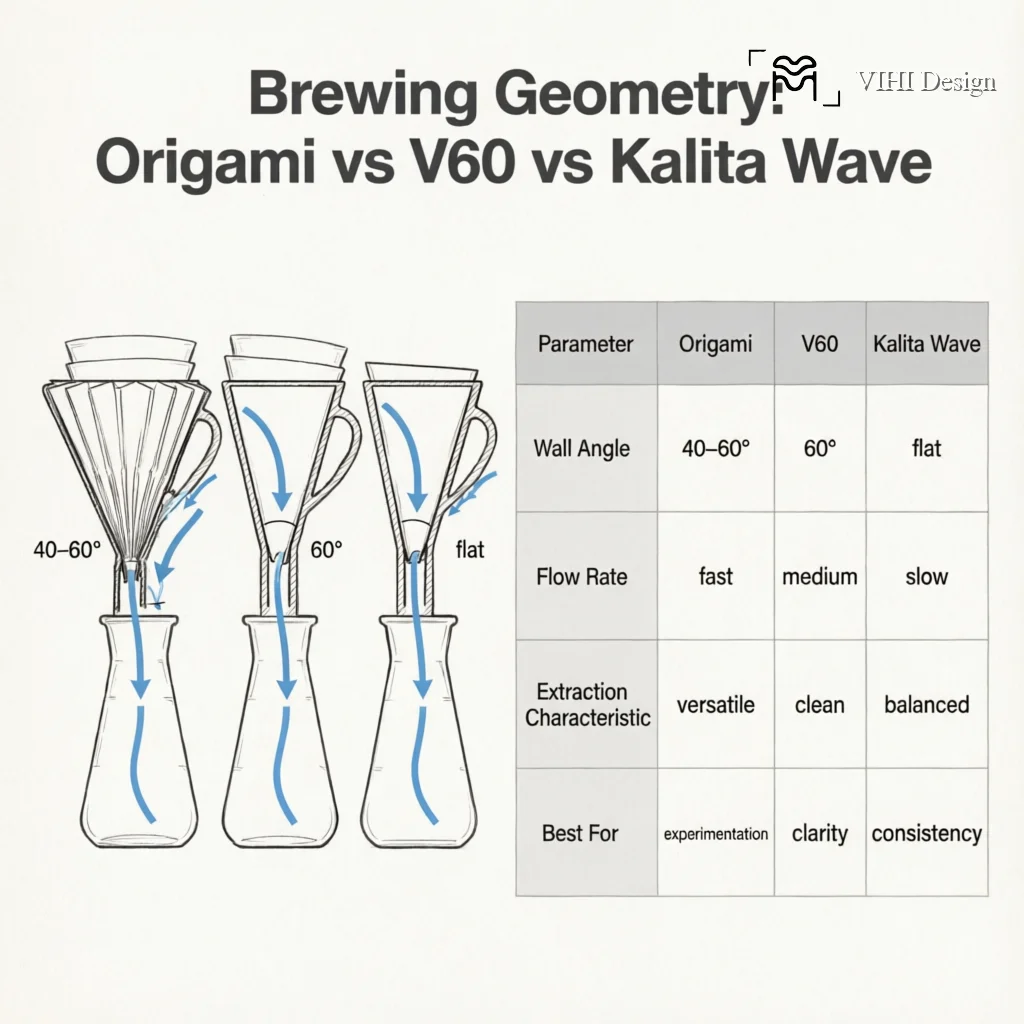
Flow Dynamics and Resistance: A dripper’s internal angle and rib pattern dictate the path of water through the coffee bed. A steeper conical angle (e.g., a traditional V60) promotes a faster, more centralized flow, potentially requiring finer grinds to increase resistance and contact time. The Origami Dripper’s ribs are designed to create a consistent air gap between filter and wall, ensuring uniform water egress and preventing bypass. When paired with a flat-bottom Kalita-style filter, the geometry shifts dramatically, creating a wider, shallower bed with more uniform resistance across its base, leading to a more balanced, multi-directional flow.
Bed Geometry and Extraction Uniformity: The shape of the coffee bed is a primary determinant of extraction uniformity. Conical beds are inherently prone to a vertical extraction gradient, with fines migrating downward and potentially causing clogging. Flat-bottom beds offer a more consistent particle-to-water exposure ratio horizontally, which can promote even extraction and offer greater tolerance to grind size variation. The Origami Dripper’s ability to host both bed shapes allows the brewer to strategically select for either high-clarity, layered extraction (conical) or balanced, sweet, and robust extraction (flat-bottom) from the same coffee.
Thermal Mass and Heat Retention: The material (ceramic) and structure of the dripper act as a heat sink. The Origami’s design, with its fluted edges and specific mass, influences the thermal environment of the slurry. A stable thermal mass helps maintain optimal extraction temperature throughout the brew cycle, a critical factor given the sensitivity of extraction yield and quality to temperature fluctuations.
Therefore, the Origami Dripper is best understood as a modular brewing platform. Its mastery requires a systems-thinking approach, where the choice of filter geometry becomes the primary variable from which all other parameters—grind size, pour structure, and agitation—logically follow. This guide will establish a framework for mapping these geometric choices to specific sensory outcomes, transforming the brewer from a simple device into an instrument of precise flavor design.
The Origami Dripper Mastery Guide: Unlocking Flavor Versatility Through Geometry
Part 2: The Geometry-to-Flavor Framework
With the Origami understood as a modular brewing platform, we can now build a practical framework. The core principle is this: filter geometry dictates flow rate, which in turn dictates your entire brewing approach. A flat-bottomed paper filter creates a “bath” of water, encouraging immersion and even extraction. A conical metal filter creates a fast, directed flow, emphasizing percolation and clarity. Your choice here is the first and most critical decision on the path to your target cup.
Before you grind a single bean, ask: “What is my goal?” Seeking a juicy, balanced cup with layered sweetness? Start with the flat-bottom geometry. Craving a tea-like, bright, and articulate cup? Start with the conical metal filter. Let intention guide your hardware.
Mastering the Flat-Bottom Geometry: The Art of the Bed
When using Kalita-style flat-bottom papers, your focus shifts to managing the entire coffee bed as a single, consistent unit. The goal is uniform saturation and a controlled, steady drawdown. This geometry is forgiving and excellent for highlighting a coffee’s inherent sweetness and body.
- Grind & Pour Strategy: Use a medium grind (similar to table salt). Your pour structure should aim for full, even bed saturation early. Try a single, steady pour after the bloom, maintaining a consistent water level 1cm above the bed until your target weight is reached. This minimizes agitation and promotes the “bath” effect.
- Sensory Target: Expect a cup with pronounced body, rounded acidity, and integrated flavors. It’s ideal for naturally processed coffees or dense, hard beans that benefit from longer contact time.
- Target Metrics: Aim for the higher end of our Extraction Yield (EY) range (20-22%) and a Total Dissolved Solids (TDS) around 1.3-1.4% for a rich, satisfying mouthfeel.
Mastering the Conical Metal Geometry: The Path of Percolation
Switching to a conical metal filter (like a Chemex or Kone style) transforms the Origami into a high-clarity brewer. The open flow path and fast drawdown require a more active, pulsed pouring technique to achieve proper extraction.
- Grind & Pour Strategy: Use a slightly finer grind than for flat-bottom. To compensate for the fast flow, employ a multi-pulse pour (e.g., 5-6 pours after the bloom). Each pulse re-saturates the bed and creates gentle agitation, ensuring all grounds are efficiently extracted before water channels through.
- Sensory Target: This method yields exceptional clarity, separating distinct flavor notes. Acidity is brighter, mouthfeel is lighter and tea-like. Perfect for complex washed coffees or delicate geshas where you want to isolate floral and fruity top notes.
- Target Metrics: You may land in the middle of the EY range (19-20%) but with a lower TDS (1.15-1.25%), creating a intense yet lightweight flavor experience.
A common pitfall is chasing a high EY number alone. With the Origami’s versatility, remember that sensory balance is key. A flat-bottom brew at 1.4% TDS and 21% EY can taste beautifully complete. A conical metal brew at 1.2% TDS and 19% EY can be equally stunning but radically different. Let your palate, not just the numbers, be the final judge. This understanding is a hallmark of experienced brewers.
From Framework to Flow: Practical Dialing-In
Your first brew is a hypothesis. Taste it critically. Is it astringent or sour? Muddy or hollow? Use the geometry framework to diagnose:
Flat-Bottom Issue (Slow, Muddy Drawdown): The grind is likely too fine, or pours caused channeling. Coarsen grind slightly and ensure your pour is centrally focused and gentle.
Conical Metal Issue (Fast, Sour Drawdown): The grind may be too coarse, or agitation was insufficient. Try a slightly finer grind or increase agitation with more vigorous, targeted pours during the pulse sequence.
By starting with a geometric intention and systematically adjusting the linked parameters of grind and pour, you move from random experimentation to directed flavor design. The Origami, in your hands, becomes not just a brewer, but a true instrument of expression.
Advanced Geometry: Hybrid Pour Strategies for Complex Profiles
While the base geometry dictates the flow, the pour is your dynamic tool for sculpting extraction within that framework. Moving beyond simple center pours or gentle spirals, hybrid strategies intentionally combine techniques to leverage the brewer’s shape at different stages of the brew.
The Conical-Flat Hybrid (for Brightness with Body): Begin with a high-agitation, focused center pour to saturate the entire bed rapidly, exploiting the conical geometry’s efficient flow-through to highlight bright, acidic notes. After the bloom, switch to a gentle, wide spiral pour that spreads water across the flat bottom’s perimeter. This encourages a more uniform, slower extraction from the wider bed, pulling out deeper sugars and body-building compounds for a balanced, complex cup.
The Flat-Conical Hybrid (for Clarity with Structure): Start with low-agitation, wide spirals across the flat bottom to establish an even, controlled extraction foundation, maximizing clarity and sweetness. For the final pour, employ a targeted, central pulse. This drives water quickly through the center of the now-established bed, creating a slight preferential flow that mimics a conical’s finish, adding a clean, structured acidity to lift the finish without introducing astringency.
By sequencing pour geometries—consciously switching between conical-style (focused, high-flow) and flat-style (dispersed, low-flow) techniques—you gain precise temporal control over extraction, allowing you to layer flavor notes and engineer a profile that transcends the inherent bias of any single shape.